








































What to Know
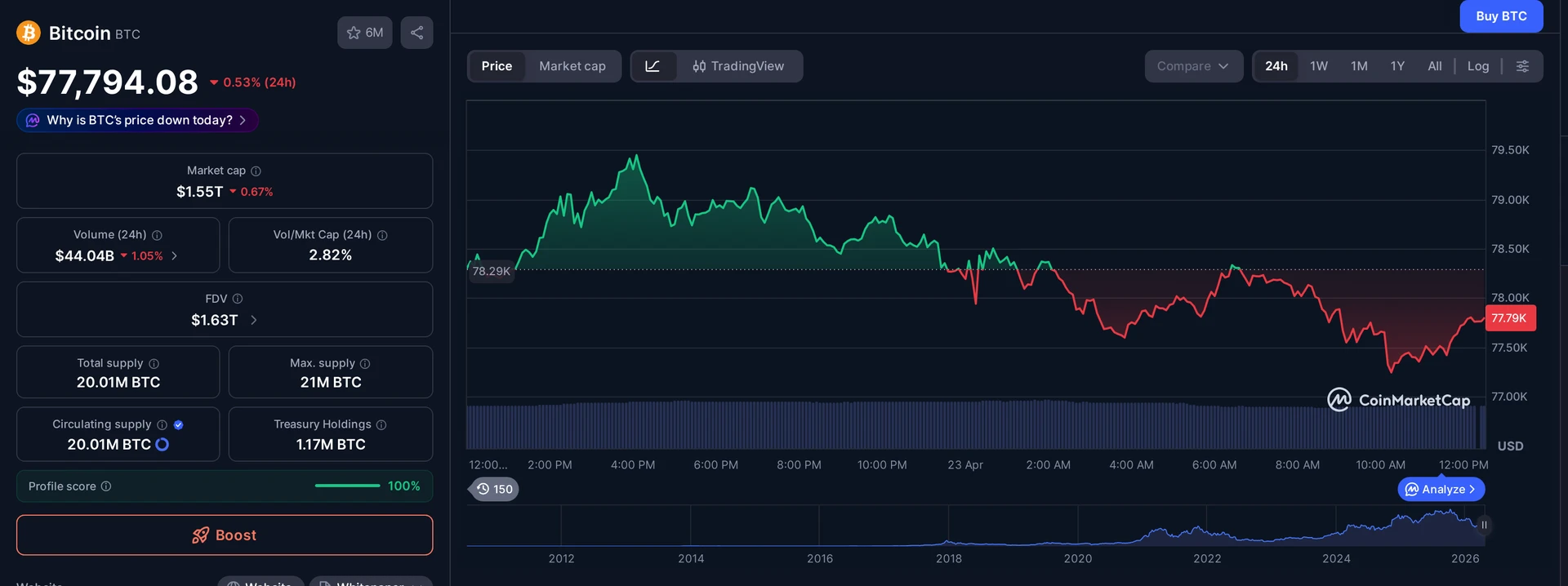
- Bitcoin cleared $79,000 Wednesday morning, an 11-week high, before sliding back to $77,300 overnight
- Justin Sun sued World Liberty Financial over a hidden blacklist function that froze 2.9 billion WLFI tokens worth over $100 million
- Kalshi fined and banned three congressional candidates for betting on their own races, with penalties between $539 and $6,229.30
- Admiral Samuel Paparo told the Senate the US government is running a Bitcoin node for operational cybersecurity tests
Bitcoin tops $79,000 Iran ceasefire rally Wednesday morning, punching through its highest level in eleven weeks before giving it all back by breakfast on the East Coast. That is the kind of session traders call a bull trap. Price hit $79,000 on the back of President Trump saying the US-Iran ceasefire would hold indefinitely. By overnight, BTC was changing hands near $77,300. Oil did the opposite, ripping another 4% to $94 a barrel as the IEA chief warned of the biggest energy security threat in history. Stock futures went red after setting a fresh all-time high the day before. A green candle that lasted about as long as a press conference.
Bitcoin Tops $79,000 Iran Ceasefire Rally: Why Did It Fade?
Bitcoin ran to $79,000 after Trump extended the ceasefire indefinitely, a move that followed Iran refusing to send negotiators to talks in Islamabad. Trump said the extension holds until Tehran submits a “unified proposal” to end the war. Crypto traders read that as risk-on and bid the top of the book.
Then oil decided to remind everyone that a ceasefire is not peace. Brent tacked on another 4%, hitting $94 a barrel, and IEA chief Fatih Birol used the phrase “biggest energy security threat in history” on the wires. That sentence alone moved futures. Stocks slipped after making a new all-time high the previous session. Bitcoin, which had been trading like a risk asset all week, followed equities lower rather than oil higher. As Bitcoin tops $79,000 Iran ceasefire reporting laid out, the initial rally leaned almost entirely on the ceasefire headline, and the unwind started the moment energy traders started pricing in the alternative.
Call it whiplash trading. The tape opened bullish, closed defensive, and left a wick on the daily chart that technicians will be pointing at for a week.
We are facing the biggest energy security threat in history.
Justin Sun Takes World Liberty Financial to Federal Court
On April 21, Justin Sun sues World Liberty Financial became the biggest story in DeFi litigation history. The Tron founder filed in California alleging fraud, breach of contract, and unjust enrichment against the Trump family-backed project. The core claim is that WLFI quietly added a blacklist function to its token smart contract back in August 2025. No governance vote. No disclosure. Just a new piece of logic sitting in the contract code, waiting.
Sun says WLFI used that function in September 2025 to freeze roughly 2.9 billion WLFI tokens in his wallet after he moved about $9 million in holdings, a transfer he describes as routine. At the time of the freeze, his position was worth over $100 million. The complaint reads like a masterclass in why on-chain governance matters and what happens when it does not exist.
WLFI did not retreat. The project posted a combative response: “We have the contracts. We have the evidence. We have the truth. See you in court.” Eric Trump went further, openly mocking Sun’s $6 million banana art purchase in the same breath as the lawsuit. Classy, it was not.
Here is the uncomfortable part for anyone holding governance tokens anywhere. If a project can ship an opaque upgrade that lets the treasury freeze wallets at will, the word “decentralized” is doing a lot of work it has not earned.
We have the contracts. We have the evidence. We have the truth. See you in court.
Kalshi Fines Three Candidates for Betting on Themselves
Prediction market platform Kalshi took action Wednesday, fining and suspending three congressional candidates for what it called “political insider trading,” which, in plain English, means betting on their own elections. Per the Kalshi political insider trading notice, the three are Ezekiel Enriquez, a Republican in Texas’ 21st District primary, Matt Klein, a Democrat in Minnesota’s 2nd, and Mark Moran, who ran in Virginia’s Democratic Senate primary before switching to an independent campaign.
The fines ranged from $539 to $6,229.30, which frankly is rounding error for a political campaign. All three got five-year bans from the platform. Two cooperated with the investigation. Moran did not, and by his own admission, the trade was a publicity stunt from the start.
Moran wrote on X that he traded $100 on himself “knowing this would happen” and would use the attention to go after Kalshi. He promised that as a senator he would impose a 25% “vice tax” on the platform to pay down the national debt. Whether you take that seriously or not, the episode hands Kalshi a compliance win and gives regulators a fresh data point about what retail users will actually do when you let them bet on elections.
- Ezekiel Enriquez, Republican, Texas 21st District primary
- Matt Klein, Democrat, Minnesota 2nd District primary
- Mark Moran, Virginia Democratic Senate primary, later independent
The US Military Is Running a Bitcoin Node
Of all the headlines on this tape, this one is the sleeper. Admiral Samuel Paparo, commander of US Indo-Pacific Command, disclosed Wednesday that the US military Bitcoin node is active and running operational network security tests using the Bitcoin protocol. That came after his Tuesday testimony to the Senate Armed Services Committee, where he called Bitcoin a “peer-to-peer, zero-trust transfer of value” with “really important computer science applications for cybersecurity.”
Paparo also told lawmakers that proof-of-work “imposes more costs than just the algorithmic securing of networks.” If that framing sounds familiar, it should. It tracks almost exactly with the Jason Lowery thesis that proof-of-work can function as a physical-cost cyberdefense layer, analogous to conventional military deterrence. Lowery spent years getting laughed at for that argument inside national security circles. Paparo just said it into a microphone in a Senate hearing.
This is the first time a combatant commander has publicly characterized Bitcoin as a national security asset in congressional testimony. Read that sentence twice. The same asset that FinCEN spent a decade calling a payments workaround for drug traffickers is now being described by the officer responsible for deterring China in the Pacific as a potential cybersecurity primitive. The Overton window on state-level Bitcoin use just moved, and it did not move slowly.
Bitcoin shows incredible potential as a computer science tool that, through the proof-of-work protocols, actually imposes more costs than just the algorithmic securing of networks.
Andre Cronje’s Flying Tulip Ships DeFi Circuit Breakers
Andre Cronje, the developer behind Fantom, Yearn Finance, and Solidly, rolled out something this week that DeFi has needed for three bull cycles. His new AMM and lending protocol, Flying Tulip, introduced a programmatic circuit breaker module that rate-limits capital outflows during abnormal withdrawal events. The Flying Tulip circuit breaker contract is deployed on-chain with no admin override, which is the whole point.
Here is how it works in practice. The contract watches outflow velocity in real time. When withdrawals cross a defined threshold, whether from a smart contract exploit, an oracle failure, or a large coordinated unwind, the system automatically throttles the rate at which capital can leave the protocol. No multisig vote. No governance emergency call. Just code, running.
Cronje has argued for years that DeFi needs TradFi-style risk infrastructure without TradFi’s centralization trade-offs. He is not wrong. Circuit breakers are standard equipment in equity markets. The NYSE halts trading when the S&P drops 7%, 13%, or 20% in a session. DeFi has avoided them because the usual implementations require either centralized admin keys or governance coordination so slow it would be useless in a live exploit.
The timing of this launch is not subtle. Last week’s $292 million KelpDAO exploit is still being unwound, and the hack cadence across DeFi protocols has only accelerated in 2026. A protocol-level circuit breaker that fires automatically, without a human in the loop, is exactly the kind of primitive that could have blunted half of those losses. Whether the rest of DeFi copies the pattern is the real question. Open-source makes it trivial. Competitive pressure makes it likely.
What Traders Should Watch Next
Short-term, the tape is being driven by oil and the ceasefire. If Brent holds above $94 and the IEA keeps using the phrase “energy security threat,” Bitcoin is likely to keep trading with equities, which means any further move into the red on stock futures drags BTC with it. A reclaim of $79,000 on a daily close would put the November range back in play. Losing $77,000 opens the door to a retest lower.
Medium-term, watch the WLFI case. If the court allows the blacklist claim to move forward, every governance token with a hidden upgrade function is suddenly a liability on someone’s balance sheet. Watch the Paparo testimony too. When the US military publicly endorses running Bitcoin infrastructure for national security reasons, the political cost of hostile regulation goes up. That does not show up in a candle, but it shows up in risk premiums.
And watch Flying Tulip. If circuit breakers get adopted across the top ten lending protocols by the end of the year, the entire risk profile of on-chain credit changes. That is the kind of structural shift that makes TVL numbers actually meaningful again.
Frequently Asked Questions
Why did Bitcoin hit $79,000 and then fall?
Bitcoin topped $79,000 after President Trump announced an indefinite extension of the US-Iran ceasefire, pushing it to an 11-week high. The rally faded as oil jumped 4% to $94 a barrel, the IEA flagged the biggest energy security threat in history, and stock futures turned red, pulling BTC back to $77,300.
What is Justin Sun suing World Liberty Financial for?
Justin Sun filed a federal lawsuit in California on April 21 alleging fraud, breach of contract, and unjust enrichment. He claims World Liberty Financial added a hidden blacklist function to its token contract in August 2025 without a governance vote, then used it to freeze 2.9 billion of his WLFI tokens worth over $100 million.
Is the US government really running a Bitcoin node?
Yes. Admiral Samuel Paparo, commander of US Indo-Pacific Command, disclosed Wednesday that the US government runs a Bitcoin node and conducts operational network security tests on the protocol. His Senate testimony is the first time a combatant commander has publicly framed Bitcoin as a national security cybersecurity asset.
How do Flying Tulip's circuit breakers work?
Flying Tulip’s circuit breaker module monitors outflow velocity on-chain in real time. When withdrawals from the protocol exceed a set threshold, triggered by exploits, oracle failures, or coordinated unwinds, the contract automatically throttles the exit rate. There is no admin override, so the logic runs identically regardless of governance or team intervention.
This article is for informational purposes only and does not constitute investment advice. Every investment and trading decision involves risk. Readers should conduct their own research before making any financial decisions.











the speed of that reversal from 79k to 77.3k tells me leverage did most of the work on the way up. ceasefire news is a catalyst but funding rates were already stretched coming into the 23rd
Calling a 4% oil pop and an IEA warning a ceasefire rally feels off. If energy markets are pricing the biggest security threat in history, why is BTC the thing we’re celebrating
back to 77.3 in a day, classic
genuine question for anyone watching spot flows: did the pump to 79k come with real ETF inflows on the 23rd or was this mostly perps? the reversal pattern looks awfully thin to me
been around since the 2019 geopolitical spikes and BTC always front-runs the headline then gives it back within 48 hours. the IEA language is what I’d actually watch here, not the ceasefire bounce