








































What to Know
- 1.47% of XRP’s total supply, a record 977.41 million tokens worth $1.04 billion, is now locked inside U.S. spot ETFs, according to data as of July 23, 2026.
- Grayscale Research head Zach Pandl says Bitcoin has outgrown its four-year halving cycle and now trades on Federal Reserve policy, with the next rate decision due July 28-29.
- Three DeFi protocols, AFX Trade, Verus Bridge, and B² Network, lost a combined $35.56 million to hackers within hours of each other.
- AFX Trade absorbed the biggest hit at $24.15 million, while Verus Bridge was exploited for the second time in three months, losing $7.55 million laundered through Tornado Cash.
XRP ETFs have swallowed a record share of the token’s supply, locking away 977.41 million tokens worth roughly $1.04 billion as U.S. institutions bet big ahead of a looming Senate deadline. It’s one of three stories worth your attention this morning, the others involve a Grayscale researcher telling Bitcoin holders to throw out their old playbooks, and three separate DeFi protocols getting robbed within hours of each other.
XRP ETFs Lock Away a Record Share of Supply
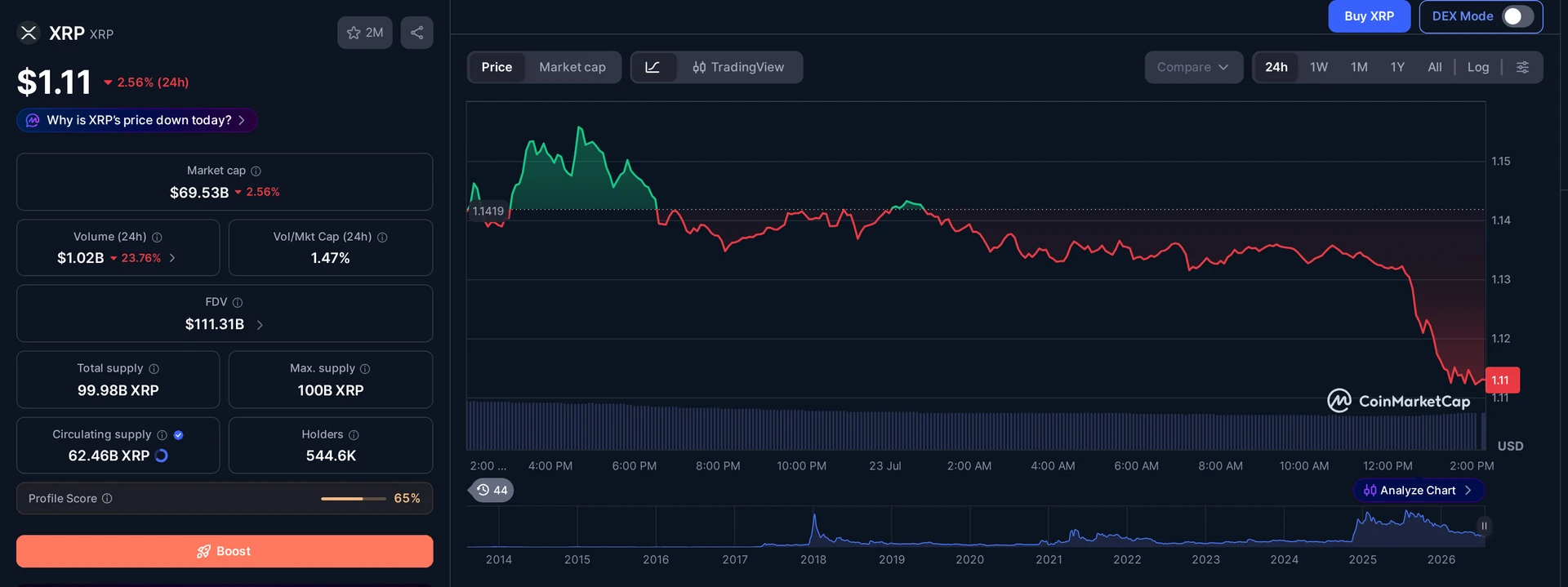
As of July 23, 2026, U.S. spot XRP funds hold 977.41 million tokens, equal to 1.47% of the total circulating supply, according to record share of XRP supply locked in ETFs data. That’s the highest percentage removed from exchange circulation since the funds launched, and it’s happening while lawmakers race against a hard deadline. The Senate has roughly two weeks to finalize the CLARITY Act before Congress breaks for its traditional August recess on Aug. 7, and funds appear to be positioning early rather than waiting for the ink to dry.
The accumulation is happening despite XRP sitting in a fairly unglamorous spot technically, trapped inside a descending channel near $1.1338, with local support at $1.1158 and a neutral RSI reading of 54.82. Do the math on the fund flows and something interesting shows up: total capital invested across the ETFs sits at $1.49 billion, against a current net asset value of just $1.04 billion. That’s a real unrealized loss, and the funds are holding anyway. Bitwise leads the pack with $501 million in net inflows, followed by Franklin Templeton at $416 million, neither has blinked.
Here’s the part that should worry XRP bears more than bulls. Daily trading volume across the ETFs is modest, around $10.9 million, but pulling 1.47% of total supply into cold custodial wallets thins out order book depth in a way that doesn’t show up until someone actually tries to buy in size. If the Senate passes the CLARITY Act before recess and a wave of new capital shows up looking for spot liquidity, it may find less of it than it expects.
Is Bitcoin’s Four-Year Cycle Theory Officially Dead?
Bitcoin’s four-year cycle theory holds that price bottoms and tops track the halving schedule roughly every four years. Grayscale Research head Zach Pandl says that framework no longer applies, arguing in the firm’s Grayscale Zach Pandl four-year cycle theory research that Bitcoin now trades like a macro asset governed by Federal Reserve policy.
The old script called for a brutal collapse right about now. The traditional theory predicted Bitcoin would fall below $25,000 by autumn, following last year’s record high of $126,000. Instead, the coin is holding near $65,800, down a comparatively mild 48% from its peak. Pandl’s argument leans on charts from Bloomberg and Coin Metrics showing that, since 2014, Bitcoin’s price bottoms have lined up far more closely with declines in the ISM Manufacturing Index and peaks in U.S. two-year Treasury real yields than with anything tied to block subsidies.
Call it insight, call it convenient framing for a firm whose XRP funds are currently underwater, either way, if Pandl is right, the number that matters this week isn’t a halving countdown. It’s the Federal Reserve meeting on July 28-29, where the central bank is expected to keep rates at 3.50%-3.75%. A confirmed pause, with no further hikes signaled, would hand Bitcoin the kind of tailwind that used to come from a supply shock.
AFX Trade’s Bridge Drained for $24 Million on Arbitrum
It was a rough morning for DeFi bridges. Attackers hit three separate protocols back to back, walking away with a combined $35.56 million, and the AFX Trade $24 million bridge exploit accounted for the biggest single chunk of it. Hackers drained $24.15 million in USDC from AFX Trade’s custodial bridge on Arbitrum, exploiting exactly the kind of cross-chain weak point that keeps showing up in postmortems.
The team’s response was fast, if not exactly reassuring. Operations were suspended immediately, security firms SlowMist and Zellic were brought in to investigate, and AFX offered the attacker a deal: keep 30% of the stolen funds as a bounty in exchange for returning the remaining 70%. Whether the hacker takes it is anyone’s guess.
- AFX Trade (Arbitrum), $24.15 million drained via custodial bridge
- Verus Bridge (Ethereum), $7.55 million (3,816 ETH) via repeated-import bug
- B² Network (BNB Chain), $3.86 million via staking contract exploit
Verus Bridge Hit Again as Funds Flow Through Tornado Cash
Then there’s Verus. The Verus Bridge second exploit Tornado Cash attack drained 3,816 ETH, worth roughly $7.55 million, from the Verus-Ethereum cross-chain bridge using an old repeated-import vulnerability. The attacker is already routing the funds through Tornado Cash.
The irony writes itself. This is the second time Verus has been hit through essentially the same door, the bridge suffered a near-identical exploit back in May, the team recovered and returned the funds to liquidity pools in July, and then got hit again on July 23 because the underlying bug was never actually fixed.
This appears related to the previous Verus Ethereum Bridge incident in May 2026: same bridge contract, same entry path, and same bug class. However, this is a new tx with a different attacker and loot wallet.
What Does This Mean for XRP and Bitcoin Investors?
If you’re holding XRP, the ETF supply squeeze matters more than the price action suggests right now. Liquidity is being pulled out of circulation faster than it’s being replaced, and a regulatory green light from the Senate could turn a quiet market into a scramble for scarce coins. For Bitcoin holders, the message is different but related: stop watching the halving clock and start watching the Fed calendar.
There’s a broader thread tying all three stories together, and it’s not a comfortable one. Institutional money is pouring into crypto, a seven-day inflow streak has pulled $1 billion into U.S. spot Bitcoin ETFs even as the price sits in a range just below $65,500, while, underneath that institutional confidence, the plumbing keeps springing leaks. Three bridges lost $35.56 million in a single morning. Wall Street can buy all the XRP and Bitcoin it wants. It still hasn’t figured out how to keep the pipes from bursting.
Frequently Asked Questions
What percentage of XRP supply is locked in ETFs?
U.S. spot XRP ETFs hold 977.41 million tokens, or 1.47% of total circulating supply, as of July 23, 2026, according to SoSoValue data. That marks a record share of XRP removed from active exchange trading, with the funds’ combined holdings valued at roughly $1.04 billion despite sitting below their total invested cost basis.
What is Bitcoin's four-year cycle theory?
Bitcoin’s four-year cycle theory holds that price tops and bottoms follow the halving schedule, which cuts mining rewards roughly every four years. Grayscale Research head Zach Pandl argues this framework has broken down, saying Bitcoin now moves with macro indicators like Federal Reserve policy and Treasury yields rather than supply-driven mining cycles.
Why does the AFX Trade and Verus Bridge exploit matter?
AFX Trade, Verus Bridge, and B² Network lost a combined $35.56 million to separate hacks within hours on July 23, 2026, exposing ongoing weaknesses in cross-chain bridge security. Verus was hit for a second time using the same bug class as a May exploit, raising doubts about whether the underlying vulnerability was ever properly patched.
How does the CLARITY Act affect XRP ETFs?
The CLARITY Act is pending digital asset legislation the U.S. Senate is trying to finalize before its August 7 recess. Analysts say passage could bring regulatory certainty that pushes more capital into XRP ETFs, tightening spot market liquidity further given nearly 1.5% of supply is already locked in custodial funds.
This article is for informational purposes only and does not constitute investment advice. Every investment and trading decision involves risk. Readers should conduct their own research before making any financial decisions.















1.47% of supply in ETFs is wild for a token that was in SEC limbo two years ago. Curious what the net inflow pace looks like weekly vs BTC spot funds at the same maturity stage.