








































What to Know
- Panic, maker of the Playdate handheld, now bars AI-generated art, music, and writing from third-party games in its Catalog storefront
- AI coding assistants remain allowed, but developers must disclose their use so buyers know what is under the hood
- Playdate Season 3 goes further and forbids generative AI in every form, including code, making it the strictest indie curation to date
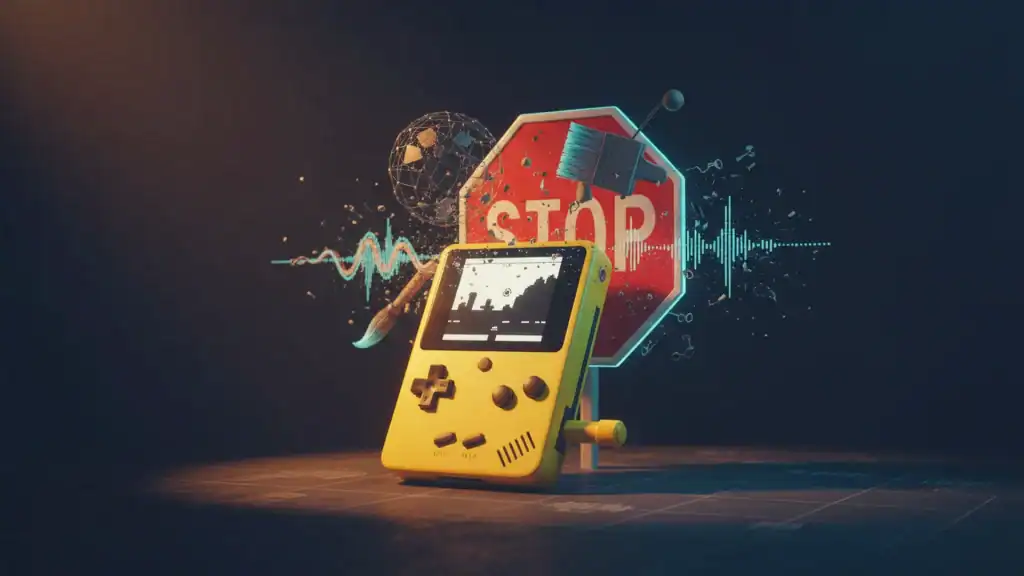
The Playdate is not the console anyone expected to draw a hard line on generative AI, yet here we are. Panic, the small Portland studio behind the yellow handheld with the fold-out crank, quietly updated its Playdate Catalog rules this month to kick AI-generated art, music, and writing off its digital storefront. Coding assistants survived the cut, for now. Games in the curated Playdate Season 3 lineup will not get that courtesy.
What the New Playdate Catalog Policy Actually Says
The updated terms draw a line most platforms have refused to draw. As of April 2026, any third-party game submitted to the Playdate Catalog cannot contain AI-generated creative content. That means no prompt-generated illustrations, no diffusion-model chiptunes, no machine-written dialogue. Developers can still reach for Panic-approved coding tools like Copilot or ChatGPT, but only if they disclose that usage publicly on the storefront listing.
Disclosure is not new. Panic has required developers to flag AI use since the Catalog launched. What changed is the hard ban on the creative side. Cabel Sasser, Panic’s co-founder, framed it as a quality-first decision rather than a moral crusade.
Plenty of storefronts wave through anything that compiles. This one does not.
Playdate Catalog has historically required AI use be disclosed by the developer for any game submissions, that part has never changed. But as of this month, the Playdate Catalog storefront now prohibits AI-generated art, music, and writing from any third-party game submissions moving forward.
Why Is Panic Drawing a Line the Giants Will Not?
Short answer: because nobody else will. Steam, the Nintendo eShop, the PlayStation Store, and itch.io all still permit AI-generated assets in listed games with varying disclosure. Panic is betting a boutique storefront with a finite audience can care about provenance in ways a trillion-dollar platform cannot.
There is also the brand math to consider. The Playdate audience skews toward buyers who paid $229 for a monochrome device with a hand crank because they wanted something handmade. That crowd is not going to shrug when a Catalog game turns out to be half-generated slop. Sasser clearly heard the feedback and acted.
He argued the move serves both craft and community. Whether it scales to larger platforms is another question entirely.
We believe we’re one of the first (and possibly only?) digital game storefronts to do this. Steam, Nintendo eShop, PlayStation Store, even Itch, etc. all still permit this type of AI-generated work in their listings.
The Wheelsprung Mess That Triggered the Crackdown
Every policy has an origin story. This one starts with Wheelsprung, a title tucked inside the Playdate Season 2 curated bundle that was later found to have used ChatGPT and GitHub Copilot for both coding and writing help. The discovery was embarrassing for Panic, which hand-picks its seasonal lineups and positions them as a tastemaker’s shelf rather than a random drop.
Sasser did not hide behind a PR statement. In comments to Exp. magazine last year about generative AI slipping into Season 2, he called the assumption that no Season 2 developer would touch a large language model “naive,” and took responsibility for the game getting through Panic’s review. That kind of public chin-checking is rare in gaming. It is rarer still to see a company then rewrite its rules because of it.
Call it a reputational repair job. Call it principle. Either way, the outcome is a storefront that now treats AI provenance as a first-class metadata field, not an afterthought.
- Wheelsprung used ChatGPT for writing and GitHub Copilot for code assistance
- The title shipped inside the hand-curated Playdate Season 2 collection
- Panic admitted its review process did not screen for large language model use
- Sasser publicly called the oversight “naive” rather than deflecting blame
Playdate Season 3 Goes Further: No AI, Full Stop
If the Catalog rule is a fence, Season 3 is a wall. Panic confirmed in a Bluesky post that every developer working on Playdate Season 3 signed an agreement banning generative AI in every part of production. That covers art, music, writing, and, for the first time, code. The coding exemption that still protects Catalog developers does not exist inside the curated season.
This matters because Season 3 is the showcase. These are the games Panic markets directly, bundles with the console, and stakes its reputation on. By drawing the tightest possible circle around its flagship lineup, the company is signalling that when it owns the curation, it owns the creative standard end to end.
Developers pitching for future seasons now know the rule going in. No exceptions, no retroactive disclosure clean-up, no Wheelsprung 2.0.
We can happily confirm that it was a requirement for all Season 3 devs that no AI can be used in Season 3 games. This includes art, music, writing, and, yes, code.
What This Means for Indie Gaming and the AI Debate
Panic just handed the indie scene a template. The distinction between AI as a creative co-author and AI as a junior coder is one developers have argued about in private Discord servers for two years. Seeing a storefront formalise it, ban one, tolerate the other with disclosure, gives smaller platforms cover to follow suit. It also puts pressure on the big three storefronts to explain why their policies still collapse both categories into one shrug.
There is a crypto and Web3 parallel worth naming. Digital scarcity only works when provenance is verifiable. The whole NFT thesis rested on that claim, and collapsed partly because buyers could not trust what they were getting. Panic is applying the same logic to pixels and chiptunes: if you cannot verify who made it, you cannot price it fairly, and the community loses trust in the shelf. That is why the disclosure requirement, not the ban, might be the more durable piece of this policy.
Expect copycats. Small curated stores like the Playdate Catalog are built on trust, not scale, and a ban that costs almost nothing to enforce at 200 developers becomes a branding moat. The question is whether any platform with millions of listings can realistically do the same.
Panic’s bet is that quality beats quantity. On a black-and-white screen with a hand crank, that bet has worked before.
Frequently Asked Questions
What did Panic ban from the Playdate Catalog?
Panic banned AI-generated art, music, and writing from any third-party game submissions to the Playdate Catalog storefront as of April 2026. Coding tools like ChatGPT and GitHub Copilot remain permitted, but developers must disclose their use so buyers know which parts of the game were built with machine assistance.
Is generative AI allowed in Playdate Season 3 games?
No. Panic confirmed that every developer working on Playdate Season 3 signed an agreement banning generative AI across every part of production. The rule covers art, music, writing, and code, making Season 3 the strictest curated lineup the company has released since Playdate launched in 2022.
Why did Panic introduce the Playdate AI ban now?
The policy followed the discovery that Wheelsprung, a Playdate Season 2 title, had used ChatGPT and GitHub Copilot for coding and writing help. Co-founder Cabel Sasser publicly took responsibility for the oversight, called his team’s assumptions naive, and rewrote the Catalog rules to prevent similar incidents in future submissions.
Do other gaming storefronts ban AI-generated content?
Not yet. Steam, the Nintendo eShop, the PlayStation Store, and itch.io all still permit AI-generated art, music, and writing in listed games, with varying disclosure requirements. Panic believes Playdate Catalog is one of the first, and possibly only, digital game storefronts to prohibit AI-generated creative work outright from third-party submissions.
This article is for informational purposes only and does not constitute investment advice. Every investment and trading decision involves risk. Readers should conduct their own research before making any financial decisions.





respect to panic for drawing a hard line. the catalog has always been curated, this is just an extension of that ethos and it fits the playdate’s whole handmade vibe.
does the ban cover AI assisted code in tooling too, or only shipped game logic in Season 3? the post makes it sound binary but most devs use copilot for boilerplate now.
feels like a marketing move dressed up as principle. enforcement is the real question, how exactly do they detect generative assets in a pixel art game submitted as a finished bundle?
saw the same purity wars on itch back in 2023, nothing got resolved.