







































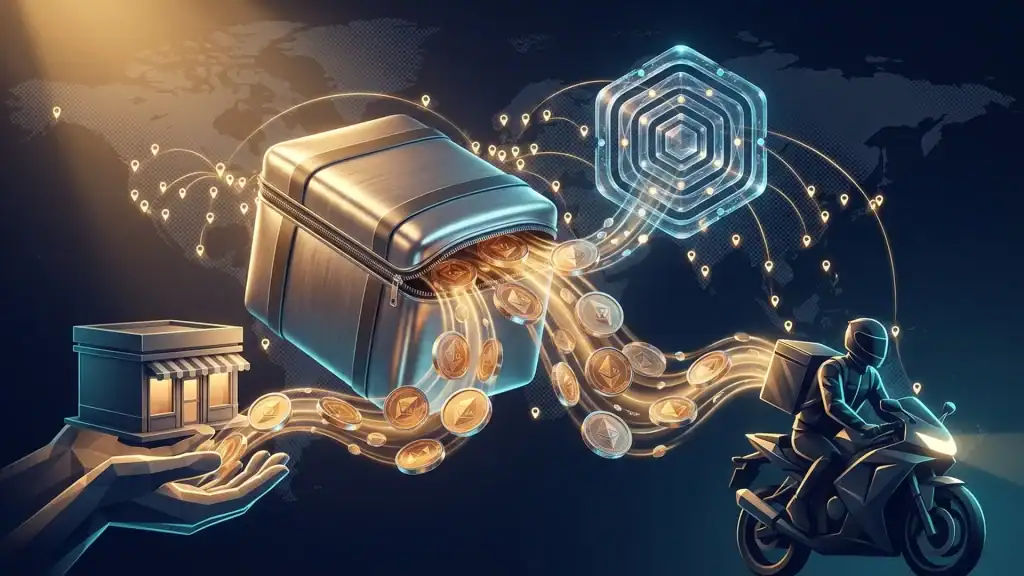
What to Know
- DoorDash is plugging its delivery app into stablecoin rails built by Tempo, a payments blockchain backed by Stripe and Paradigm.
- The rollout covers dashers, merchants and diners in more than 40 countries, with faster payouts and cheaper cross-border settlement pitched as the headline benefits.
- DoorDash moved 903 million orders worth $29.7 billion in Q4 2025, making this the largest consumer delivery app ever to wire itself into a stablecoin payout system.
DoorDash stablecoin payments are coming to the food delivery app’s drivers, restaurants and customers through Tempo, a payments blockchain co-built by Stripe and Paradigm. The company confirmed on Tuesday that dashers and merchants in more than 40 countries will soon be able to pocket their earnings in digital dollars instead of waiting on bank rails. For a platform that moved $29.7 billion in orders in a single quarter last year, that is not a pilot. That is a payment stack being rebuilt in public.
DoorDash Stablecoin Payments Move Its Payment Rails On-Chain
The food delivery giant is joining the launch cohort of DoorDash stablecoin payments flowing across Tempo, alongside Stripe, investment firm Paradigm, Coastal Bank and fintech ARQ. Tempo’s pitch is blunt: move dasher payouts in seconds, cut cross-border fees, and give merchants settlement flexibility that legacy card networks cannot match at this scale.
Andy Wang, DoorDash co-founder, summed up the logic in a single sentence. If dashers and merchants get paid faster and cheaper, nobody on the platform has to argue about it. That kind of plain-language endorsement from a publicly traded delivery company is rarer than it sounds. Most corporate statements about blockchain still read like legal hedging. This one reads like a roadmap.
If we can get merchants and Dashers their money faster, and do that in a way that’s affordable for them, that’s a no-brainer for the entire ecosystem.
What Is Tempo and Why Does DoorDash Care?
Tempo is the payments chain Stripe and Paradigm have been quietly shaping, and DoorDash is now a marquee name on it. The Tempo blockchain is built for merchant settlement, not speculation. That distinction matters. Tempo optimizes for one thing: moving dollars between a merchant, a platform and a worker without the three-day ACH lag.
For DoorDash, the appeal is structural. Every day the company sits on merchant and dasher payouts is a day of treasury risk and customer-service friction. Stablecoins collapse that window to minutes. Cross-border dashers, who previously got squeezed by correspondent banking fees, now get paid in a unit of account that does not care which country they live in.
The 40-country footprint is the tell. You do not build a multi-jurisdiction payout rail for a vanity pilot. You build it because you have decided the card networks and bank wires are no longer the default.
- Faster payouts: dashers and merchants settle in near-real-time instead of waiting on nightly batches
- Lower cross-border cost: stablecoins bypass correspondent banking fees that routinely hit 3% or more
- Transaction flexibility: merchants can hold, convert or off-ramp stablecoin balances as they choose
- Global reach: the integration is slated for more than 40 countries from day one
The Bigger Picture: Stripe, Visa, Mastercard All Crowding In
DoorDash is not making this move in a vacuum. The last eighteen months have seen payment incumbents racing to bolt stablecoin plumbing onto their existing businesses. The Stripe acquisition of Bridge closed in 2024 for a reported $1.1 billion, handing Stripe a ready-made stablecoin orchestration layer that it is now feeding into Tempo.
Mastercard moved next. The Mastercard BVNK deal, announced in March for a reported $1.8 billion, gave the card network direct pipes between on-chain dollars and traditional fiat rails. Visa did not sit still either. In July, the network expanded its stablecoin settlement platform to support additional tokens, widening the list of assets merchants can accept and settle without touching a bank account.
Read these moves together and the picture clarifies fast. The companies that built the payments rails of the last four decades are not fighting stablecoins anymore. They are buying their way into them. DoorDash signing on to Tempo is the consumer-facing flip side of that corporate procurement cycle. The plumbing changes upstream, then the logo you see on the checkout button changes downstream.
Why DoorDash Scale Makes This a Turning Point
Numbers matter here. DoorDash reported 903 million orders in Q4 2025, with a total order value of $29.7 billion. Extrapolate that across a year and you are staring at roughly $120 billion of gross transaction volume running through a single delivery app. Even a partial migration of dasher and merchant payouts to stablecoins would put tens of billions of dollars of annual flow onto on-chain rails.
No consumer platform of this size has ever plugged directly into a stablecoin payout system before. Shopify has dabbled. X had its plans. PayPal issued its own PYUSD. None of those projects have the combination of labor force, merchant density and cross-border reach that DoorDash is about to push through Tempo. The company’s Q1 2026 report is due on May 6, which means the first official stablecoin color from management is weeks away, not months.
The cynical read is that this is another corporate crypto press release designed to juice a quarter. The optimistic read, and frankly the more honest one given the list of partners, is that stablecoins have quietly crossed the line from pilot tech to production payment rail. When Stripe, Paradigm, a regional bank, a fintech and a top-three delivery app all show up on the same launch page, you are not looking at a stunt.
What Happens Next for Dashers and Merchants
Practical questions remain. Which stablecoins will DoorDash actually support at launch? How will a dasher in Mexico or the Philippines off-ramp those balances into local currency without re-introducing the fees stablecoins were meant to kill? And how does DoorDash handle the tax and compliance layer for workers who opt into digital-dollar payouts?
Tempo’s documentation suggests the chain is built to abstract most of that away, with partner banks and licensed off-ramps handling conversion in the background. Coastal Bank’s inclusion in the launch cohort is the hint there. ARQ, a fintech focused on merchant settlement, rounds out the stack. Between them, the goal is a payout experience that feels like a bank deposit but settles like a blockchain transfer.
If that works, DoorDash will have something every payments executive on Wall Street has been chasing for a decade. A global, same-day, low-fee settlement network that does not require its own card scheme. And the rest of the gig economy, from Uber to Instacart to Deliveroo, will be forced to explain to their own drivers why they are still waiting three days for their money.
Frequently Asked Questions
What are DoorDash stablecoin payments?
DoorDash stablecoin payments are a new payout and settlement option that lets dashers, merchants and diners use digital dollars on the Tempo blockchain instead of relying on bank transfers or card networks. The rollout covers more than 40 countries and is pitched as a faster, cheaper alternative to legacy rails.
Which blockchain is DoorDash using for stablecoin settlement?
DoorDash is using Tempo, a payments-focused blockchain co-built by Stripe and Paradigm. Tempo is optimized for merchant settlement rather than general-purpose smart contracts, and its launch partners include Coastal Bank and fintech company ARQ alongside DoorDash. The chain is designed to handle dasher payouts and cross-border merchant transfers in near-real-time.
Why does the DoorDash Tempo integration matter for crypto adoption?
It matters because DoorDash handled 903 million orders worth $29.7 billion in a single quarter of 2025. Wiring that flow into stablecoin rails moves digital dollars from experimental pilots into one of the largest consumer payment pipelines in the world, and it signals that stablecoins have crossed from test projects into production infrastructure used by a public company.
When will dashers and merchants be able to use stablecoins?
DoorDash and Tempo announced the integration on Tuesday, April 21, 2026, with the rollout described as imminent across more than 40 countries. DoorDash reports its Q1 2026 earnings on May 6, which is likely when executives give the first detailed timeline and early usage numbers.
This article is for informational purposes only and does not constitute investment advice. Every investment and trading decision involves risk. Readers should conduct their own research before making any financial decisions.
















40 countries day one is ambitious. curious what the off-ramp story looks like for dashers in markets where local banking rails are slow, because Tempo settlement speed means nothing if payout conversion takes 3 days.
so we’re calling it stablecoin payments but I’d bet most dashers auto-convert to fiat within minutes. real adoption question is whether DoorDash eats the FX spread or passes it on.
Been waiting for a major consumer app to pick Tempo over the usual Solana or Base route. The fact that merchant settlement is included and not just user checkout is the actual story here.
finally a use case that isn’t just another perps dex
Remember when Shopify did USDC on Solana in 2023 and everyone said payments were here? Volume was a rounding error. I’ll believe DoorDash moved the needle when we see quarterly numbers, not launch press releases.