







































What to Know
- $3.5 million was drained from three vaults on Volo Protocol early Wednesday, the team confirmed on X
- $28 million in TVL across the platform’s other vaults was untouched, and Volo says no shared attack vector exists
- Only $500,000 of the stolen assets has been frozen so far through coordination with ecosystem partners
- DeFi has now bled roughly $7.78 billion to hacks, per DeFiLlama, with bridge exploits adding another $2.90 billion
The Volo Protocol hack has turned into the second gut punch DeFi has taken this week. Early Wednesday, the Sui-based yield platform confirmed an attacker drained roughly $3.5 million from three of its vaults, holding wrapped bitcoin, the tokenized gold token XAUm, and USDC. The breach arrives barely 72 hours after the KelpDAO mess, and the industry is running out of patches fast enough to keep up.
Inside the Volo Protocol Hack: What Happened to the Vaults
Volo is a yield aggregator. Users drop tokens into pooled vaults and the protocol deploys that capital through various on-chain strategies to earn returns. On Wednesday morning, three of those vaults stopped behaving. By the time the team caught it, roughly $3.5 million in digital assets had already moved out.
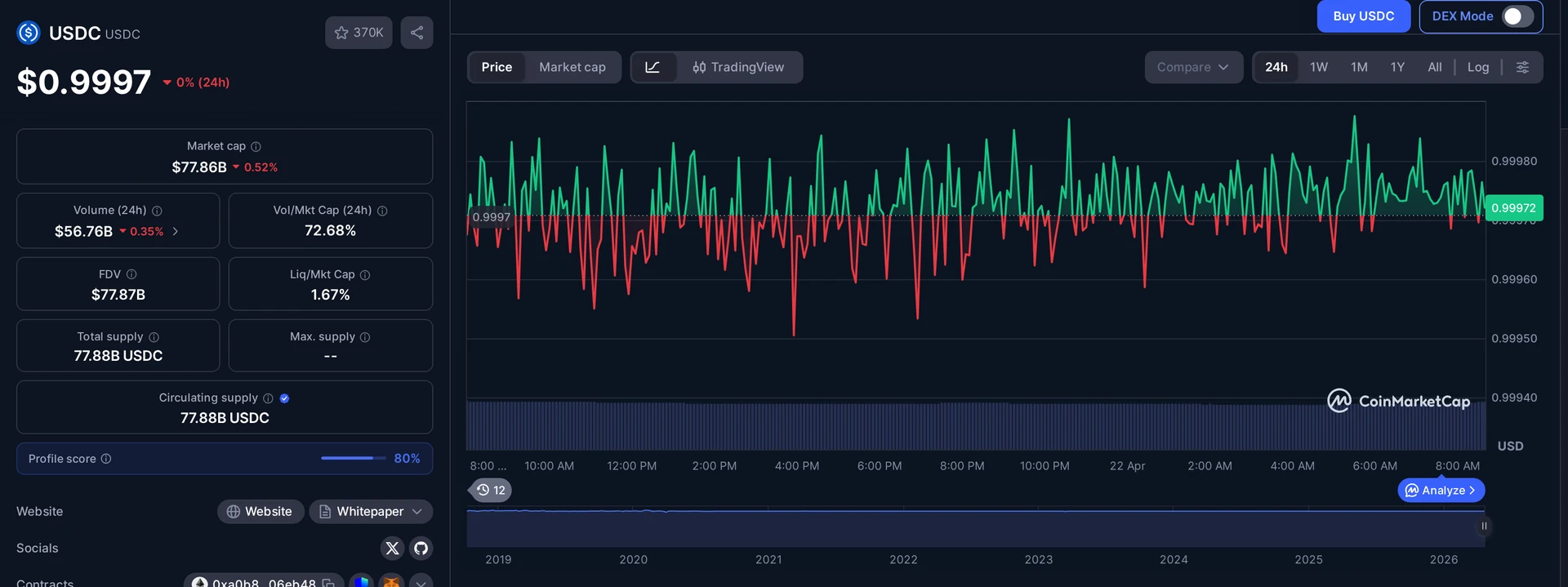
The hit landed on vaults holding wrapped bitcoin (WBTC), Matridock’s tokenized gold token XAUm, and the USDC stablecoin. Everything else, according to Volo Protocol, kept its balance. The team froze all vaults the moment the incident was confirmed and started working the phones with on-chain investigators.
“The ~$28M in TVL across all other Volo vaults is safe. The exploit was isolated to 3 specific vaults, and we have confirmed no shared attack vector exists with the remaining vaults,” the protocol wrote on X. They also said they are “prepared to absorb” the loss rather than shove it onto depositors.
The ~$28M in TVL across all other Volo vaults is safe. The exploit was isolated to 3 specific vaults, and we have confirmed no shared attack vector exists with the remaining vaults.
Why the Timing Makes This Worse
Context matters. The Volo breach didn’t land in a quiet week. It landed in the smoking crater left by the KelpDAO exploit, where an attacker minted unbacked liquid restaking tokens (rsETH) out of thin air and walked away with hundreds of millions. That attack didn’t stay contained. It spilled sideways.
Aave saw panicked withdrawals as rsETH collateral turned radioactive. Lending markets across the space priced in the contagion almost instantly. And then, before anyone had stitched up the first wound, Volo bled.
Call this what it is: a confidence crisis, not an isolated bug. When two protocols on two different chains get cracked inside a single week, the story stops being about smart contract quirks and starts being about whether the whole stack is structurally underbaked.
- April 19, KelpDAO drained of roughly $290 million via unbacked rsETH minting
- April 19 to 21, Aave users rush exits as rsETH collateral wobbles
- April 22, Volo Protocol confirms $3.5 million drained from three Sui-based vaults
How Much of the Volo Money Is Coming Back?
Short answer: very little, so far. Volo says it has “frozen” roughly $500,000 of the stolen assets through coordination with ecosystem partners. That is industry shorthand for immobilizing tokens on-chain so the attacker can’t move or swap them. It is not recovery. It is containment.
The rest is somewhere in the wild, and investigators are still tracing it. The team is working with the Sui Foundation and on-chain analytics firms to follow the trail. Volo has promised a full post-mortem once the investigation and remediation steps are finalized.
Whether that post-mortem arrives with refund terms or just forensic details is the question every depositor wants answered. The promise to “absorb” the loss is welcome. It is also a promise that will be tested against Volo’s treasury reserves.
What the Breach Says About the Sui Blockchain Story
The Sui blockchain has spent the last year selling itself as a performance-focused Layer 1 with a Move-based programming model that is supposed to be safer by design. That pitch just got a stress test. When a flagship yield platform on your chain loses millions, the narrative takes a hit whether or not the exploit turns out to be a Volo-specific coding issue.
To be fair to Sui, the early read from Volo is that the attack vector was localized to three vaults, not a systemic chain-level problem. The Sui Foundation is actively helping with the response. That cooperation is the minimum bar, and Volo’s team has publicly acknowledged it.
Still, Sui builders now have a PR problem their marketing can’t paper over. Institutional capital evaluating Move-based chains just got a new data point, and it is not the one the ecosystem wanted printed on a Wednesday morning.
The Bigger Number Nobody Wants to Look At
Zoom out and the math gets ugly. DeFi hacks have now stripped roughly $7.78 billion from users, according to DeFiLlama. Bridge protocols, the connective tissue between chains, have coughed up another $2.90 billion. Add them together and you clear $10 billion in cumulative losses, which is roughly the market cap of a crypto asset ranked between 10th and 15th globally.
That is an entire top-15 token’s worth of value vaporized by exploits. Not lost to market drawdowns. Not burned in a rug pull. Stolen through code that was supposed to have been audited.
And here is the inconvenient sub-plot underneath the headlines: institutional adoption is accelerating while security spend, relative to TVL, is not. More money is flowing in. The same bugs keep flowing out. At some point a Treasury desk is going to notice that the yield premium on DeFi doesn’t price the exploit risk correctly, and that repricing is going to hurt.
What Should Volo Depositors Do Right Now?
If you held funds in one of the three affected vaults, wait for Volo’s official remediation plan before making noise on social media. The team has publicly committed to absorbing the loss, which is stronger language than most exploited protocols use. Document your positions, screenshot balances, and keep an eye on official channels.
If you held funds in the other vaults, Volo claims your $28 million in combined TVL is safe and that no shared attack vector exists. Believing that claim is a risk-management decision, not a moral one. Some users will stay. Some will rotate out until the post-mortem drops. Both are defensible.
And if you were thinking about depositing fresh capital into any yield vault this week, regardless of chain, the honest answer is that the market just gave you two very recent reasons to wait.
- Follow official Volo communications on X for the post-mortem timeline
- Check whether your vault was among the three exploited or the unaffected set
- Revisit your overall DeFi allocation given the KelpDAO to Volo sequence
Frequently Asked Questions
What is the Volo Protocol hack?
The Volo Protocol hack is a security breach on the Sui-based yield platform that drained roughly $3.5 million from three of its vaults on April 22, 2026. Affected assets included wrapped bitcoin, tokenized gold token XAUm, and USDC. The remaining vaults, holding about $28 million in TVL, were reported unaffected.
How is the Volo breach connected to the KelpDAO exploit?
The two incidents are not linked by a shared attacker or shared code, but they landed within 72 hours of each other. KelpDAO lost hundreds of millions via unbacked rsETH minting on April 19, triggering forced withdrawals on Aave. Volo’s Sui-based vault exploit followed on April 22, deepening an already jittery DeFi market.
How much of the stolen Volo funds have been recovered?
About $500,000 of the stolen assets have been frozen on-chain through coordination with ecosystem partners, according to Volo Protocol. Freezing means the tokens cannot be moved or withdrawn. It is not the same as recovery. The bulk of the roughly $3.5 million taken remains under active investigation with the Sui Foundation.
How much have DeFi hacks cost users in total?
DeFi protocols have lost roughly $7.78 billion to hacks to date, according to DeFiLlama. Bridge protocols, which move assets between blockchains, account for another $2.90 billion. The combined total exceeds $10 billion, a figure equivalent to the market capitalization of a cryptocurrency ranked between 10th and 15th globally.
This article is for informational purposes only and does not constitute investment advice. Every investment and trading decision involves risk. Readers should conduct their own research before making any financial decisions.






Three vaults hit in one shot suggests a shared dependency, probably an oracle or a signer module. Has anyone confirmed whether the drained vaults shared the same admin key path?
another week, another sui vault rekt. move language was supposed to prevent this class of bug lol
The timing right after KelpDAO is what bothers me. Everyone keeps framing these as isolated incidents, but $3.5M on Volo plus the Kelp fallout is starting to look like coordinated probing of LSD and restaking vaults rather than random opportunism.
Been around since the bZx flash loan days and this rhymes hard. New chain, new yield primitive, same rushed audits. Sui L1 fundamentals are fine but the app layer is in its 2020 DeFi summer phase, expect more of these before the ecosystem hardens.