







































What to Know
- Singapore fintech Nium picked Coinbase to plug USDC into its global payments rails across 190 countries
- Businesses can fund payouts in stablecoins, settle in fiat, and skip the capital-draining prefunded account model
- USDC supply grew by roughly $2 billion in Q1 while Tether’s USDT shrank by $3 billion, the first divergence since 2022
- Nium’s network covers more than 100 currencies, 40 regulatory licenses, and real-time payouts across 100-plus corridors
The Nium Coinbase partnership has arrived, and it is aimed squarely at the most annoying problem in corporate treasury: money sitting dead in prefunded accounts across a dozen countries. Singapore-based Nium said Tuesday it picked Coinbase to wire USDC into its global payments network, letting businesses fund cross-border payouts with stablecoins and settle in either USDC or local fiat across more than 190 countries. Under the deal, Coinbase provides the custody, liquidity and wallet plumbing. Nium provides the last-mile payout rails. The combination is being pitched as on-demand liquidity for companies that are tired of pre-loading capital into jurisdictions just to wait three days for a wire to land.
How the Nium Coinbase Partnership Actually Works
The mechanics are simpler than the press release makes them sound. A business client loads a Nium account with USDC drawn from Coinbase infrastructure. Nium converts that balance into whichever local currency the payout corridor needs. The payment goes out. One managed flow, no correspondent banking chain, no overnight FX exposure baked in just because the sun happened to set in Frankfurt.
Santhosh Srinivasan, VP of treasury at Nium, put the complaint in plain language. Traditional cross-border rails force companies to park money across multiple jurisdictions while transactions crawl through time zones and banking networks. That capital is not earning anything. It is also not available for anything else. The Nium Coinbase partnership is designed to free that cash by letting clients fund on demand with stablecoins instead of sitting on pre-loaded fiat.
Nium also said the setup supports linking stablecoin balances to card programs for real-world spending. That is the hook for B2B treasury teams that want their stablecoin positions to behave like a checking account, not a crypto sandbox.
Clients can fund accounts on demand using USDC, convert to fiat in a single managed flow and send payouts globally, without tying up working capital in prefunded accounts across jurisdictions.
Why Does Prefunding Matter for Cross-Border Payments?
Prefunding is the silent tax on every cross-border payment business. To pay a supplier in the Philippines, a European firm keeps pesos parked in a Manila correspondent account for days. Multiply that across 40 markets and the trapped capital runs into hundreds of millions. That is the drag USDC kills.
The Federal Reserve has been studying this exact friction. A recent research note on cross-border payments and payment stablecoins flagged prefunding, FX conversion cost and settlement latency as three of the biggest inefficiencies in the legacy system. Stablecoin rails compress all three into one instruction, at least in theory. Nium is betting the theory finally holds in production.
The scale here is the reason to pay attention. Nium claims its network supports more than 100 currencies, local collection in 40 markets, real-time payouts in over 100 corridors and more than 40 regulatory licenses worldwide. That is not a pilot. That is live infrastructure with a stablecoin front door bolted on.
- Prefunding locks up working capital across dozens of banking jurisdictions
- FX conversion fees stack at every correspondent hop
- Settlement windows still stretch to T+2 or T+3 on major corridors
- Time-zone mismatches delay payout cutoffs for Asian and African markets
The USDC Push Is Bigger Than One Deal
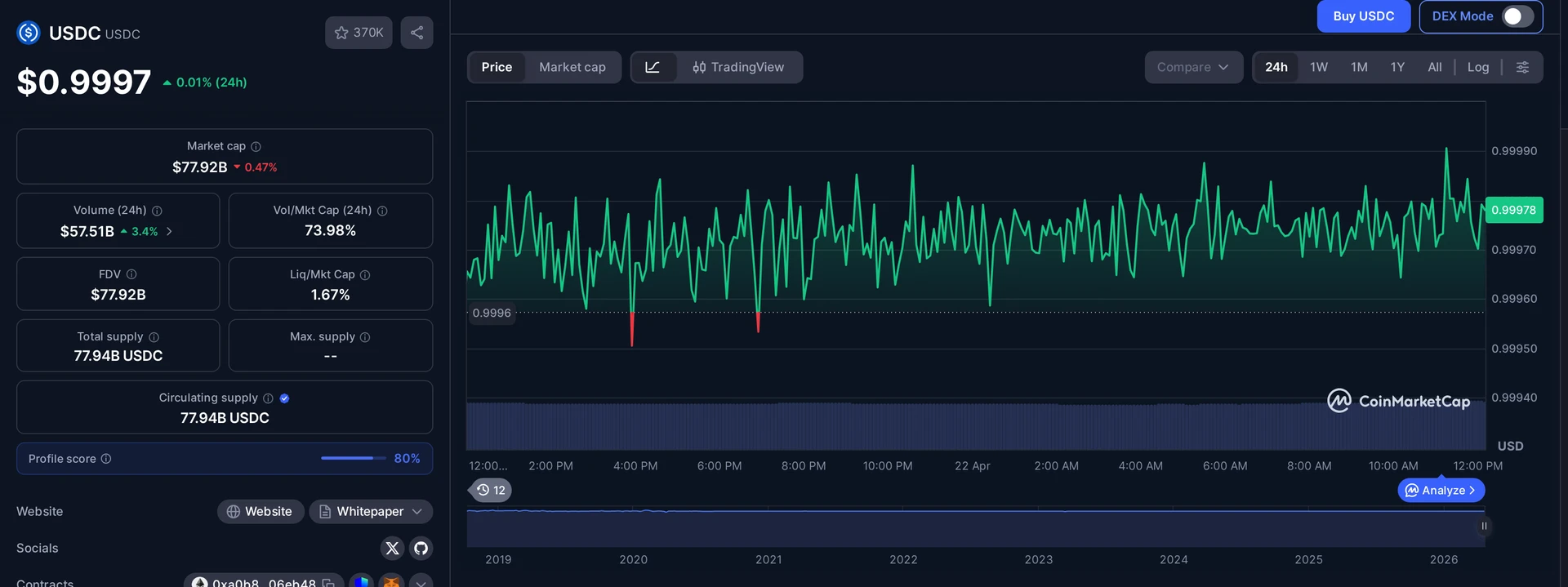
The Nium deal is part of a pattern, not a one-off. USDC was launched in 2018 by Circle and Coinbase as a dollar-pegged stablecoin backed by cash and short-term US Treasury reserves. DefiLlama data puts it as the second-largest stablecoin with a market cap near $78 billion, still a distance behind Tether’s USDT at roughly $188 billion.
The interesting part is the direction. A CEX.IO report earlier this month found USDC supply grew by about $2 billion in the first quarter while USDT shrank by roughly $3 billion. That is the first divergence between the two since 2022. Call it a slow-motion market share trade, with compliance-oriented corporates voting for the stablecoin that has Circle’s audits and Coinbase’s custody behind it.
Circle has been layering on partnerships to cement the payments use case. In March, the firm paired with Sasai Fintech to push USDC across African corridors, where remittance costs in parts of Sub-Saharan Africa still run above 7 percent, well past the United Nations’ 3 percent target. Earlier this month came the Circle Thunes deal, which extends USDC settlement across a network of 140-plus countries. Nium is now another brick in that wall.
What This Means for Stablecoin-Funded Cards and B2B Spend
The payout rails are only half the story. Nium recently launched a platform that lets businesses issue stablecoin-funded cards on Visa and Mastercard, with balances converted to fiat at the point of sale. Compliance, settlement and integration sit under one roof. Plug USDC on one side, swipe a card in Lisbon or Lagos on the other, and the merchant never has to know a stablecoin was anywhere in the flow.
That is the quiet revolution hiding in this press release. Most stablecoin payment stories focus on the moment of settlement. The card piece extends the primitive into everyday business spending: software subscriptions, travel, inventory. If USDC balances can be operated like any corporate card pool, then stablecoins stop being a treasury curiosity and start being line items in an FP&A model.
The cynical read is that this is still rails for rails’ sake until corporates actually move meaningful volume. Announcements are easy. Settling a nine-figure supplier run on a Friday afternoon is harder. The optimistic read is that Nium, with its 40 regulatory licenses and live corridors, is one of the few operators positioned to do it at production scale without a regulator pulling a fire alarm.
Who Wins and Who Gets Squeezed?
The clear winners are the B2B clients on Nium’s platform. They get a liquidity tool that replaces trapped fiat with on-demand stablecoins, and they get it without having to build a crypto team. Coinbase wins institutional stablecoin flow that lives inside its custody stack. Circle wins USDC velocity, which matters more than raw supply when the narrative is about usage instead of yield.
The squeezed side of the trade is the correspondent banking network. Every dollar that moves through a Nium-Coinbase-USDC pipe is a dollar that skipped a SWIFT message and a nostro account. Bank FX desks have watched this story coming for years. It is now close enough to hurt.
There is a regulatory angle too. The US stablecoin framework has tightened since 2025, and Circle’s compliance posture reads differently than Tether’s. Corporate treasurers read that kind of signal and act on it. If USDC keeps gaining share while USDT shrinks, this quarter’s divergence will not look like noise. It will look like the moment the institutional side of the market picked a lane.
Frequently Asked Questions
What is the Nium Coinbase partnership?
The Nium Coinbase partnership integrates USDC into Nium’s global payments network. Coinbase provides custody, liquidity and wallet infrastructure while Nium handles last-mile payouts across more than 190 countries. Businesses fund accounts in USDC and settle in either stablecoins or local fiat through a single managed flow.
How does USDC reduce cross-border payment costs?
USDC removes the need to prefund accounts in multiple jurisdictions. Instead of parking fiat in dozens of correspondent banks, companies hold stablecoins and convert them at the moment of payout. That frees working capital, cuts FX hops, and shortens settlement from days to near real time across most corridors.
How big is USDC compared with Tether?
USDC sits at roughly $78 billion in market capitalization, second to Tether’s USDT at about $188 billion according to DefiLlama. In the first quarter, USDC supply grew by about $2 billion while USDT shrank by roughly $3 billion, marking the first divergence between the two stablecoins since 2022.
Why does this deal matter for stablecoin adoption?
It moves stablecoins from crypto-native use cases into mainstream corporate treasury. Nium’s 40 regulatory licenses and live corridors in more than 100 currencies give USDC a production-scale distribution channel. Combined with stablecoin-funded Visa and Mastercard programs, it positions USDC as everyday B2B payment infrastructure, not a trading asset.
This article is for informational purposes only and does not constitute investment advice. Every investment and trading decision involves risk. Readers should conduct their own research before making any financial decisions.


















190 countries is the headline but the real unlock is killing prefunding. treasury teams have been begging for this for years, parking float in 40 different correspondent accounts is a nightmare on the balance sheet.
does the article clarify if Nium is holding USDC on chain or just using Coinbase as the fiat off ramp at destination? big difference for counterparty risk.
finally a rails story that isnt vaporware
Circle must be thrilled. USDC volume has been getting eaten by USDT in every market outside the US, and a distribution deal into Niums corridor network is exactly the kind of plumbing win they needed after the SVB depeg scare in 2023.
remember when Ripple promised this exact pitch in 2018 with xRapid and ODL? same deck, different stablecoin. ill believe the prefunding death when i see actual corridor volume reports six months from now, not a press release.