






































What to Know
- Eric Trump called Justin Sun’s lawsuit against World Liberty Financial ridiculous, jabbing at the TRON founder’s $6 million banana art purchase.
- Sun alleges WLFI wrongfully froze roughly 540 million of his tokens and stripped his governance rights through a concealed blacklist.
- Ten wallets control about 76% of WLFI voting power, with the Trump family holding an estimated 22.5 billion tokens.
- WLFI has fallen from $0.46 in September 2025 to near $0.076 in April 2026, a drop of more than 83%.
The Justin Sun lawsuit against World Liberty Financial has turned into a playground fight. Eric Trump fired back at the TRON founder on Tuesday, calling the federal complaint ridiculous and reminding everyone that Sun is the same guy who once paid $6 million for a banana taped to a wall. So much for the friendship. Months ago, Trump was calling Sun a great friend and saying he was TRON’s biggest fan. Now the two are trading public shots while $75 million of Sun’s money sits frozen inside a DeFi project the Trump family largely controls.
Eric Trump’s Banana Jab and the End of a Crypto Friendship
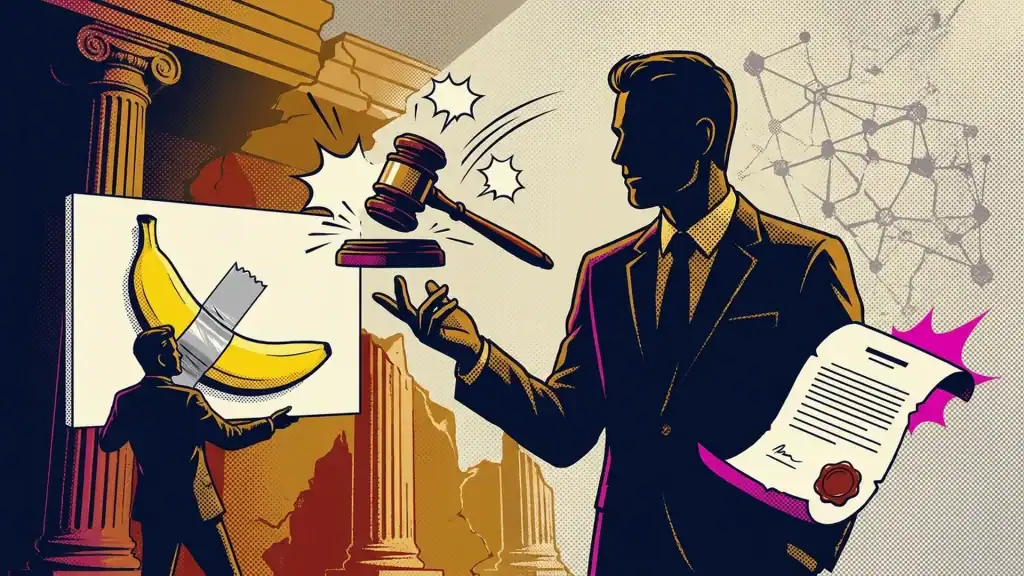
In a post on X, Eric Trump wrote that the only thing more ridiculous than Sun’s lawsuit is spending $6 million on a banana duct-taped to a wall. The jab landed because it is true. Sun really did buy the artwork, Maurizio Cattelan’s Comedian, at Sotheby’s in late 2024 for a final hammer price closer to $6.2 million. He ate it at a press conference in Hong Kong. It was a stunt. Everyone laughed. Eric Trump remembered.
Trump, who co-founded World Liberty Financial, said the team is incredibly proud of what it has built and dismissed the federal complaint as noise. That is the public line. The private reality is messier. The Trump family owns roughly 60% of World Liberty and, according to reporting cited in the original filing, had pulled in about $1 billion from the venture by December 2025. Sun, meanwhile, was the single biggest outside check, a $75 million early investor whose wallet is now locked out of the token he helped fund.
The only thing more ridiculous than this lawsuit is spending $6 million on a banana duct-taped to a wall.
What Does the Justin Sun Lawsuit Actually Allege?
The Justin Sun lawsuit makes one core claim: World Liberty Financial buried a concealed blacklist function in its smart contracts and used it to freeze Sun’s tokens without warning or due process. The federal complaint asks the court to restore his roughly 540 million WLFI tokens and his governance rights.
Sun says the whole thing traces back to September 2025. That was when the WLFI team blacklisted his wallet, pointing to on-chain transfers of about $9 million in WLFI to exchanges as evidence of early selling. Sun’s response in the filing is that those were test transactions, routine wallet moves, not a dump. He says he tried to resolve the dispute quietly for months before filing suit. According to the complaint, good faith negotiations went nowhere.
The legal theory matters for anyone who has ever trusted a DeFi token. If a project team can silently switch off a holder’s wallet, then the words decentralization and governance are marketing, not mechanics. That is the bigger fight underneath the banana jokes.
- Approximately 540 million WLFI tokens frozen in Sun’s wallet
- Claim: concealed blacklist function embedded in the smart contract
- Claim: governance rights stripped without notice or hearing
- Relief sought: unfreeze, restore voting power, damages
The $75 Million Check That Started It All
Sun did not just buy WLFI on the open market. He was the project’s largest outside investor, wiring in $75 million when the Trump-branded DeFi play was still raising cash. His net worth, pegged at $10.9 billion by the Bloomberg Billionaires Index, meant he had the firepower to anchor the round. In return, he got a wallet full of tokens and a public seat as one of World Liberty’s highest-profile backers.
Zach Witkoff, co-founder and CEO of World Liberty, struck back in his own statement. He described the suit as a desperate attempt to deflect attention from Sun’s own misconduct and said he expects the case to be tossed promptly. Witkoff argued the team’s actions were taken to protect users, framing the wallet freeze as a defensive move rather than a hostile one.
The two sides are not close to agreeing on basic facts. Sun says he made test trades. The project says he was dumping. Sun says the blacklist was hidden. The project says it was a safeguard. A federal judge will now decide whose version gets to stand.
Justin Sun’s recent lawsuit against World Liberty is a desperate attempt to deflect attention from Sun’s own misconduct. His claims are entirely meritless.
How Concentrated Is WLFI’s Governance?
Concentrated enough that the word governance starts to feel generous. On-chain data shows just 10 wallets hold roughly 76% of WLFI’s voting power. The Trump family alone sits on an estimated 22.5 billion tokens, a stake that reportedly translates to about 60% ownership of the venture. Ten wallets deciding the fate of a project that markets itself as decentralized is not a footnote. It is the story.
On April 15, 2026, the project published a World Liberty Financial governance proposal that covers more than 62 billion tokens. Under the draft terms, holders who do not affirmatively accept the new rules have their tokens frozen indefinitely. Advisor tokens face a mandatory 10% burn. Early purchasers get hit with a two-year cliff followed by two years of vesting. Opt in or your bag is bricked.
Sun, of course, could not vote on any of it. His wallet was already blacklisted. Critics say that is the whole point. A holder with a $75 million stake who disagrees with management is silenced before the poll even opens. Defenders say the proposal tightens the cap table and aligns long-term holders. Both can be true. Only one feels like DeFi.
Why WLFI Has Crashed More Than 83%
Price tells its own version of the story. WLFI hit $0.46 in September 2025, right around the time Sun’s wallet was blacklisted. By this week, it was trading near $0.076 per CoinGecko, a fall of more than 83% from the high. The token changed hands at roughly $0.08 as the lawsuit news broke. That is not a bad week. That is a collapse stretched over seven months.
The drivers are not mysterious. A concentrated cap table, a frozen whale, a governance proposal that locks out anyone who does not sign the new contract, and now a federal lawsuit from the project’s biggest outside investor. Each data point on its own is survivable. Stacked together, they read like a confidence trade going the wrong way. Traders who bought in expecting a decentralized Trump-flavored DeFi hub are looking at a cap table that belongs to the founders and a token that has lost four-fifths of its value.
The court fight will take months. The tweets will keep coming. Eric Trump has already shown he will punch back with whatever material is on hand, and a $6 million banana is very good material.
What Comes Next for World Liberty Financial and Sun?
The federal court will have to rule on whether a DeFi project can freeze a whale’s bag without notice. That question reaches well past World Liberty. If the concealed blacklist claim sticks, expect every serious token lawyer to start digging through the smart contracts of every major governance coin looking for the same switch. If World Liberty wins, expect more projects to write similar safeguards into their code and call it risk management.
For Maurizio Cattelan’s banana, the joke has outlived the purchase. Sun bought the artwork, ate it, and turned it into his personal meme. Eric Trump has now turned it into Sun’s punchline. That is the risk of stunts. They do not expire.
Frequently Asked Questions
Why is Justin Sun suing World Liberty Financial?
Justin Sun filed a federal lawsuit alleging that World Liberty Financial wrongfully froze approximately 540 million of his WLFI tokens and stripped his governance rights through a concealed blacklist function embedded in the project’s smart contracts. Sun claims the actions violated core DeFi principles of decentralization, transparency and user control over assets.
How much did Justin Sun pay for the banana artwork?
Justin Sun paid about $6.2 million at Sotheby’s in November 2024 for Maurizio Cattelan’s Comedian, the conceptual artwork featuring a banana duct-taped to a wall. He later ate the banana at a press conference in Hong Kong, turning the purchase into a publicity stunt that Eric Trump is now using against him.
How much of WLFI does the Trump family control?
The Trump family holds an estimated 22.5 billion WLFI tokens and reportedly owns about 60% of World Liberty Financial. Broader on-chain data shows roughly 76% of WLFI’s voting power sits in just 10 wallets. By December 2025, reports indicate the family had earned about $1 billion from the project.
What does the World Liberty Financial governance proposal require?
The April 15, 2026 proposal covers more than 62 billion tokens. Holders must affirmatively accept new terms or have their tokens locked indefinitely. Advisor tokens face a mandatory 10% burn. Early purchasers are subject to a two-year cliff followed by two years of vesting, tightening the cap table significantly.
This article is for informational purposes only and does not constitute investment advice. Every investment and trading decision involves risk. Readers should conduct their own research before making any financial decisions.





83% drop in a single day on WLFI is brutal, but I’d want to see the liquidity depth before blaming Sun’s suit. Was this forced liquidation cascade or just thin order books getting hit?
banana art guy suing anyone for financial shenanigans is peak 2026
Sun buying a taped banana for $6M then eating it was always going to age badly. Anyone pushing back on WLFI now gets that thrown in their face regardless of whether the legal claim has merit.
does anyone know if the 83% figure is from the token launch price or the recent high? the article isn’t super clear on the reference point
been watching these feuds since the Bitfinex/Tether days and they always follow the same arc. loud accusations, counter mockery, token dumps, then six months later everyone’s doing business together again like nothing happened. WLFI holders bagholding through this cycle are the real losers here.