






































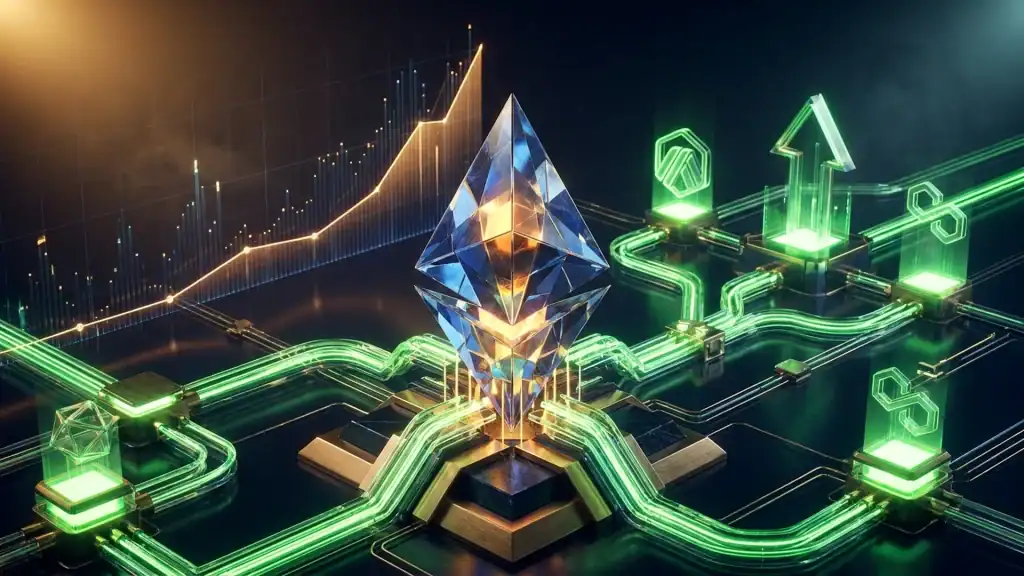
Ethereum Layer 2 networks have achieved a historic milestone, processing more daily transactions than Ethereum mainnet itself. Arbitrum, Optimism, Base, and zkSync collectively handle tens of millions of transactions daily at a fraction of mainnet costs, demonstrating that Ethereum’s scaling roadmap is delivering real-world results.
This article breaks down which L2s are winning, why users are migrating, and what record volumes mean for ETH’s long-term value proposition.
Key Takeaways
- Ethereum Layer 2 networks hit record transaction volumes, surpassing Ethereum mainnet activity.
- Arbitrum, Optimism, Base, and zkSync lead L2 adoption with lower fees and faster finality.
- Total Value Locked across L2s exceeds tens of billions, indicating strong user migration.
- Layer 2 rollups reduce transaction costs by 90%+ compared to Ethereum mainnet.
- ETH benefits from L2 settlement fees and blob data purchases, reinforcing its security layer role.
What Layer 2 Networks Are and Why They Matter
Layer 2 networks are scaling solutions built on top of Ethereum. Instead of processing every transaction on mainnet, L2s handle transactions off-chain and periodically settle batches back to Ethereum, inheriting its security while achieving massive throughput gains.
The two main L2 architectures are:
- Optimistic Rollups(Arbitrum, Optimism, Base): assume transactions are valid and only verify if disputed
- ZK-Rollups(zkSync, Starknet, Scroll, Linea): use cryptographic proofs to verify every transaction batch
Top Ethereum L2 Networks by Activity
| Network | Type | Key Strength | Notable Use Case |
|---|---|---|---|
| Arbitrum | Optimistic | Largest DeFi TVL on L2 | DEX trading, lending |
| Base (Coinbase) | Optimistic | Consumer apps, social | Farcaster, memecoins |
| Optimism | Optimistic | Superchain ecosystem | OP Stack rollups |
| zkSync Era | ZK Rollup | ZK EVM compatibility | Privacy-focused apps |
| Starknet | ZK Rollup | Performance at scale | Gaming, DeFi |
| Polygon zkEVM | ZK Rollup | Enterprise integrations | RWAs, institutional |
Why L2 Transaction Volume Is Exploding
Dramatically Lower Fees
L2 transactions typically cost cents or fractions of a cent compared to dollars on mainnet. This unlocks use cases like micro-payments, gaming transactions, and social media interactions that would be prohibitive on Ethereum L1.
💡 Tip:The EIP-4844 “blob” upgrade reduced L2 data costs by an order of magnitude, making fees even cheaper for end users.
Improved User Experience
Modern L2 wallets offer near-instant transaction finality, gas abstraction where apps pay fees, and seamless bridging. Users often don’t realize they’re on an L2, they just experience Ethereum that works.
Ecosystem Incentives
L2 networks have deployed billions in token incentives, liquidity programs, and developer grants. This has attracted both builders and users, creating network effects that compound over time.
How L2 Growth Impacts ETH Value
A common misconception is that L2s compete with ETH. In reality, every L2 transaction generates demand for ETH through multiple mechanisms.
Gas and Blob Purchases
L2s must pay Ethereum mainnet to post transaction data. These payments come in ETH, creating persistent demand as L2 activity grows.
ETH Burn Mechanism
Ethereum’s EIP-1559 burns a portion of transaction fees. High network activity, driven in part by L2 settlements, increases ETH burn rate and can make ETH deflationary during peak periods.
Security Premium
L2s inherit Ethereum’s security through cryptographic proofs or fraud-proof systems. The value of Ethereum as the most secure settlement layer grows as more value flows through L2s.
⚠️ Warning:Not all L2s are equally decentralized. Some rely on centralized sequencers that could theoretically censor or reorder transactions. Research before committing significant funds.
Risks and Considerations
L2 growth introduces new considerations users should understand.
- Bridge risk:Assets cross between L1 and L2 via bridges, which have been targets of major exploits
- Sequencer centralization:Most L2s rely on centralized sequencers during their early stages
- Withdrawal delays:Optimistic rollups have 7-day withdrawal delays for security
- Fragmented liquidity:Assets spread across many L2s can reduce trading depth
The Road Ahead for Ethereum Scaling
Record L2 volumes validate Ethereum’s rollup-centric roadmap. Future upgrades including Verkle trees, Danksharding, and continued EIP-4844 optimizations will further reduce L2 costs and expand throughput.
For users, the practical takeaway is clear: use L2s for everyday transactions, reserve mainnet for high-value transfers or where decentralization is paramount. The Ethereum ecosystem is now truly multi-layered, with L1 as the security anchor and L2s as the execution environment.






Base is the one I’m watching closely. Coinbase pipeline plus the fee structure is doing more for L2 adoption than any marketing campaign Arbitrum or Optimism have run this year.
tvl in the tens of billions sounds great until you remember how much of it is just recycled ETH chasing points programs
curious what the breakdown looks like between zkSync and the optimistic rollups on actual unique active wallets versus raw tx count. bots can inflate throughput pretty hard on cheap chains.
been here since the Plasma whitepaper days and honestly the rollup centric roadmap is the first scaling plan that actually shipped. sidechains in 2021 felt like a detour, this feels structural. still wary of sequencer centralization though, none of the big four are fully decentralized on that front yet.