







































What to Know
- $1.84 billion in total used crypto positions were wiped out in 24 hours on June 3, 2026, the biggest single-day liquidation since February 5
- $1.66 billion of those liquidations were long positions betting on price increases, with only $180 million on the short side
- Bitcoin open interest climbed from 759,000 BTC to 788,600 BTC even as prices fell, a signal that fresh short bets, not long exits, may be driving the move
- Whale accounts on OKX have flipped to a 0.54 long-short ratio, which CoinGlass labels ‘extremely bearish,’ while retail traders remain stubbornly long
Crypto long liquidations tore through the market on Wednesday like a wrecking ball through a crowded trade, $1.84 billion in used positions erased in a single day, with bulls absorbing nearly all the damage. The rout was the largest single-session wipeout since February 5, and if the positioning data is anything to go by, it may not be over.
What Triggered the $1.84 Billion Liquidation Cascade?
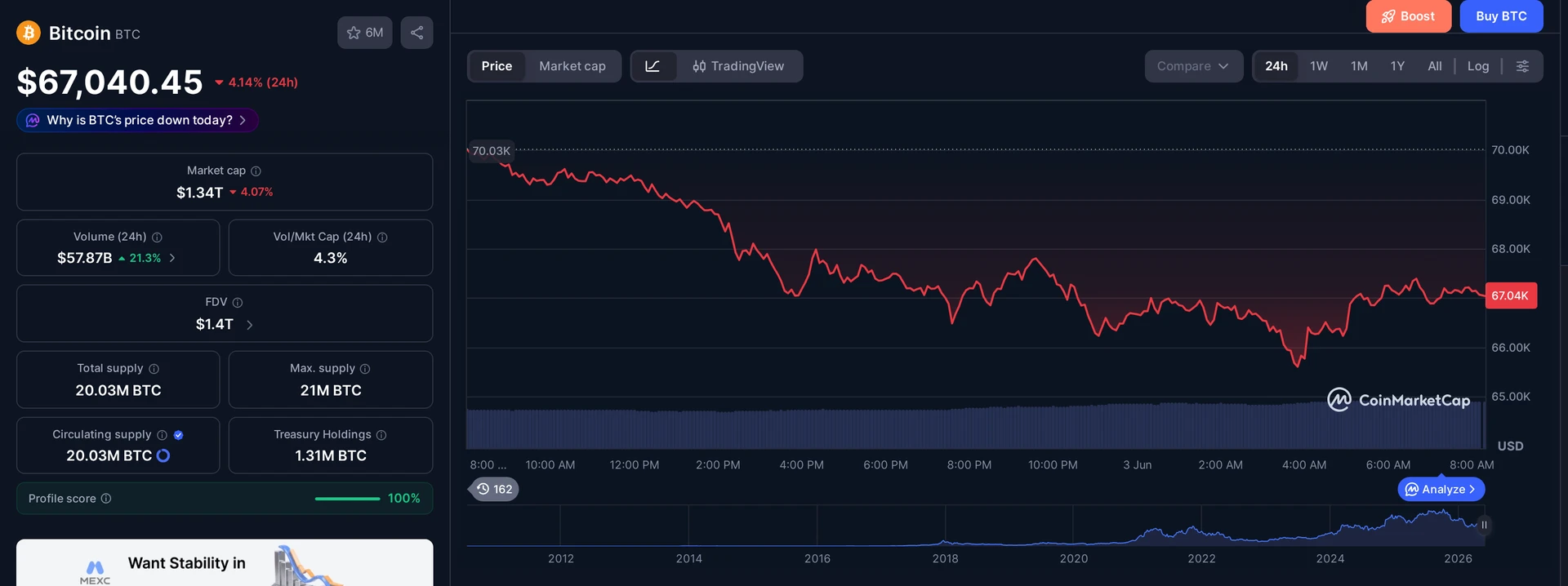
Bitcoin plunged below $66,000 and ether (ETH) cracked beneath $1,900, moves sharp enough to blow through the margin buffers on an enormous stack of levered long bets. According to CoinGlass liquidations data, roughly $1.84 billion in positions were force-closed in the 24-hour period, with longs accounting for $1.66 billion versus just $180 million on the short side.
That ratio alone tells you everything about how the market was positioned heading into Wednesday. For context: a liquidation happens when an exchange forcibly closes a used trade because the trader’s loss has eaten through their posted collateral. Long positions are bets that prices will rise; short positions wager on declines. When prices drop fast enough, long traders get liquidated, and if enough of them go at once, the forced selling accelerates the drop further, triggering more liquidations in a cascade. That’s exactly what happened here.
The single biggest casualty in a single order was a $59.67 million BTC-USDT long position unwound on HTX. That’s not a retail account. Someone with real size got caught leaning the wrong way.
Crypto Long Liquidations by Exchange: Who Took the Most Pain?
Binance dominated the carnage, absorbing $748 million in liquidations, roughly 41% of the entire cascade. Of those Binance positions, 89% were longs. That tells you the platform’s user base had crowded heavily into used bullish bets heading into the drop.
Hyperliquid processed $314 million in liquidations, with an even higher long concentration: 94% of its liquidated positions were long. Bybit wasn’t far behind at $247 million, with 93% of those being longs. Across all three platforms, the picture is consistent, bulls got slaughtered.
On the asset side, Bitcoin longs absorbed $883.66 million of the damage. Ether longs took another $475.73 million. Solana (SOL) longs were hit for $91.18 million. The remaining roughly $390 million was spread across HYPE, DOGE, SUI, BNB, NEAR, AAVE, LINK, and the broader top-30 long book. Diversified, yes, but the direction was uniform. Everything got hit.
Bitcoin Open Interest Rose During the Crash, And That’s a Problem
Here’s where the story gets more unsettling. During a liquidation cascade, you’d normally expect open interest, the total value of all outstanding, unsettled used futures contracts, to fall as positions are force-closed. Instead, it went up. According to bitcoin open interest rising falling price June 2026, the contract count climbed from roughly 759,000 BTC to 788,600 BTC even as the long book was being torched.
Rising open interest into a falling price is a classic bearish signal. It typically means new short positions are being opened, fresh bearish bets layering on top of the liquidated longs rather than buyers stepping in to absorb the selling. When shorts accumulate this way during a down move, the market hasn’t found what traders call a ‘clearing level’, the price at which enough buyers show up to stabilize things. The data suggests we’re not there yet.
Aggregate taker volume in the period reinforced the picture: $65.39 billion in sells against $60.16 billion in buys. Sellers were the marginal actors. The market was not in equilibrium.
Retail Still Long, Whales Already Short, Who’s Right?
The positioning split between retail and professional traders is the most telling piece of this story. Retail bitcoin traders on Binance, OKX, and Bybit are still sitting long, at ratios of 2.22, 2.01, and 1.58 respectively. They haven’t capitulated. After a $1.66 billion wipeout, they’re still leaning into the trade. Call that conviction, or call it denial.
Whale accounts on OKX tell a completely different story. They’ve flipped to a OKX whale accounts 0.54 long-short ratio extremely bearish, a reading that CoinGlass explicitly labels ‘extremely bearish.’ A ratio below 1.0 means short positions outnumber longs among large-account holders. At 0.54, the whales aren’t just hedging; they’re actively positioning for further downside.
This retail-versus-whale divergence is the clearest warning sign in the data. In most historical liquidation events, retail capitulation tends to mark bottoms. The fact that retail is still long here means that capitulation, if it comes, could trigger another wave of forced selling. The clearing level remains elusive.
Markets are currently pricing a 66% probability that bitcoin falls below $55,000 and a roughly coin-flip chance of sub-$50,000 prices before year-end. A break below $65,000 brings $60,000 into play. A sustained hold at current levels might produce a relief bounce, but the positioning data argues against that being the higher-probability outcome.
What Does This Mean for the Market Going Forward?
The convergence of signals here, rising open interest into a price decline, aggressive whale shorting, retail refusing to reduce exposure, and sellers dominating taker volume, paints a market that hasn’t cleared. This isn’t a setup where you look at the size of the liquidation and say ‘that’s enough.’ The $1.84 billion print on Wednesday is large, but the structural positioning underneath it hasn’t resolved.
For traders still holding used longs at reduced size, the critical question is whether the current price range acts as support or just a temporary pause before the next leg lower. The whale data suggests the professionals aren’t betting on a bounce. The open interest expansion suggests new shorts are still being built. And retail holding long ratios above 2.0 after a wipe of this magnitude is the kind of positioning that tends to provide fuel for further downside, not a floor.
This was the largest liquidation event since February 5. The market structure heading into that February event looked nothing like what we have now, back then, longs that got wiped were quickly replaced by buyers stepping in. This time, the open interest data suggests new shorts are replacing old longs. That’s a different setup entirely, and it deserves more caution than the ‘we already had the flush’ narrative suggests.
Frequently Asked Questions
What are crypto long liquidations?
Crypto long liquidations occur when an exchange automatically force-closes a used long position because the trader’s losses have exceeded the collateral they posted. Long positions bet on price increases, when prices fall sharply enough, the exchange closes the trade to prevent negative balances, often accelerating the price drop in a cascade effect.
Why did $1.66 billion in crypto longs get liquidated on June 3, 2026?
Bitcoin dropping below $66,000 and ether breaking under $1,900 triggered margin calls across the levered long book. The speed and depth of the decline exceeded posted collateral thresholds for traders on Binance, Hyperliquid, and Bybit, the three platforms that absorbed the most damage in the cascade, totaling $1.84 billion in total liquidations.
Why is rising Bitcoin open interest during a price drop a bearish signal?
When open interest rises as prices fall, it indicates that new short positions are being opened rather than longs simply being closed. Bitcoin open interest climbed from 759,000 BTC to 788,600 BTC during the crash, suggesting fresh bearish bets are layering on, not buyers absorbing the sell pressure, which implies the market has not found a price floor yet.
What is the significance of OKX whale accounts flipping to a 0.54 long-short ratio?
A long-short ratio below 1.0 means short positions outnumber longs. At 0.54, whale accounts on OKX hold nearly twice as many short positions as longs, a level CoinGlass labels ‘extremely bearish.’ Large-account traders tend to be better-informed than retail, making this flip a meaningful warning signal for further downside.
This article is for informational purposes only and does not constitute investment advice. Every investment and trading decision involves risk. Readers should conduct their own research before making any financial decisions.













1.66B in longs gone and ETH still can’t hold 1900. funding rates were already negative on Binance for two days before this, anyone watching OI saw it coming.
calling this the worst since February is a stretch when you adjust for open interest growth. Feb wipe was deeper in percentage terms, this one just looks bigger in nominal dollars.
BTC under 66k and SOL down 9 percent is exactly the kind of flush spot buyers wait months for. been stacking since the 68k bounce failed.
anyone know if the DOGE liquidation cluster was mostly perps or cross margin spillover from ETH positions?