





































What to Know
- $10 billion stablecoin market cap decline since the May 2026 peak, per RWA.xyz data.
- Tether’s USDT fell to $184 billion and Circle’s USDC dropped to $73 billion.
- Citi raised its 2030 forecast to as much as $4 trillion in a bull case.
- New issuer Paxos Global Dollar (USDG) has topped $3.2 billion in circulation.
Stablecoin market cap has dropped by about $10 billion since its May 2026 peak, marking the sharpest pullback for the stablecoin sector since 2023. Data from RWA.xyz shows the total value of stablecoins in circulation fell roughly 3% from its high point, a decline driven mostly by the two biggest issuers, Tether and Circle. One trading firm analyst says the retreat looks temporary, not the start of a bigger unwind.
Stablecoin Market Cap Posts Steepest Drop Since 2023
June alone saw a $7.7 billion decline in stablecoin market capitalization. That is the largest single month dollar drop since May 2022, when the algorithmic stablecoin TerraUSD and its sister token Luna collapsed and kicked off a brutal downturn known across crypto as the winter. This time is different in scale, but the comparison still stings for anyone who lived through that period.
Zoomed out, the picture is milder. Total stablecoin market cap has fallen close to $10 billion since its May 2026 peak, about a 3% drop. That is the steepest percentage decline since 2023, yet nowhere near the 26% collapse the sector suffered in 2022. Crypto markets have spent most of 2026 consolidating near yearly lows, and shrinking stablecoin supply is one more sign that onchain liquidity has thinned out.
Why Are Tether USDT and Circle USDC Losing Market Cap?
The decline traces almost entirely back to the two dominant issuers. Tether USDT market cap decline shows the largest stablecoin by market capitalization slipping to roughly $184 billion, down from $190 billion in May, a loss of about $6 billion. Tether remains the biggest player, so even a modest pullback moves the whole market.
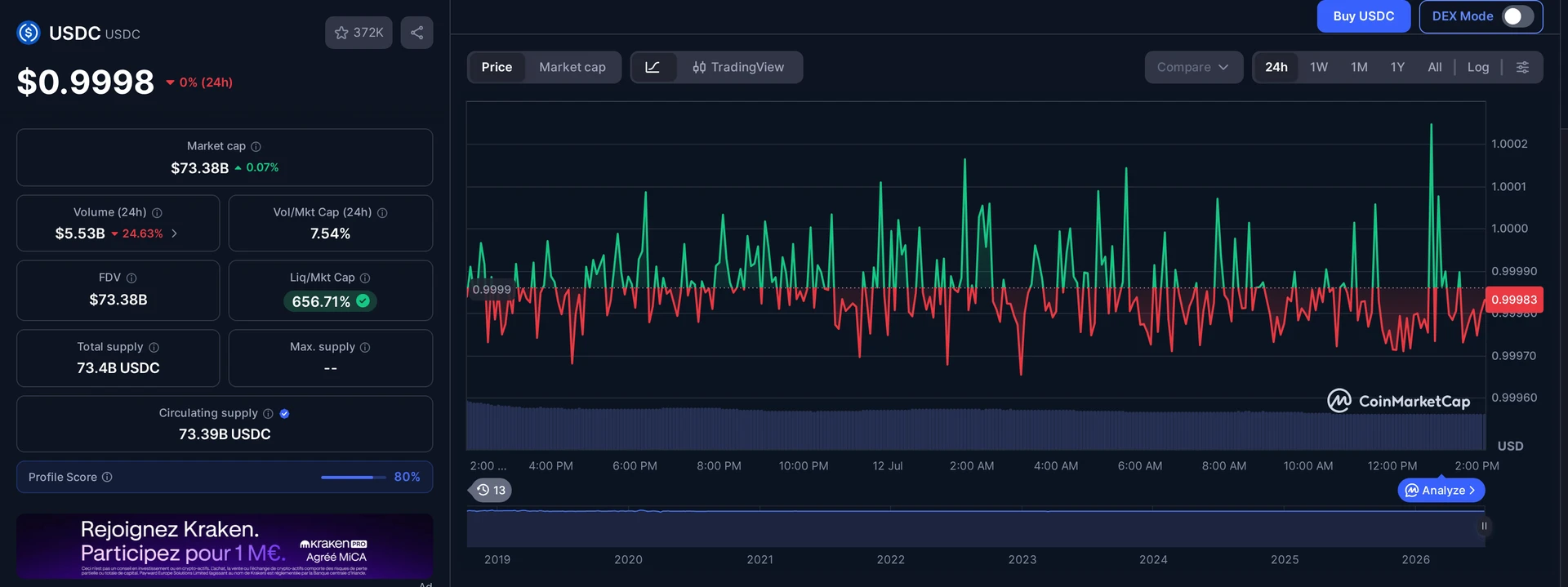
Circle has felt a bigger squeeze. Circle USDC market cap drop puts USDC at around $73 billion, down from a March 2026 peak just shy of $80 billion, a drop of roughly $7 billion. In percentage terms, that is a steeper retreat than Tether’s, and it comes as USDC competes with a growing list of newer, cheaper alternatives for exchange and payment volume.
Analysts Say the Pullback Is Not a Warning Sign
Paul Howard, senior director at trading firm Wincent, is not sounding any alarms.
Howard added that short-term liquidity swings are normal and do not change his view that stablecoins will keep playing a bigger role across digital asset markets. History backs him up, at least loosely. A similar $9 billion pullback happened between December 2025 and February 2026, right as bitcoin plunged from around $95,000 to $60,000. That decline reversed and stablecoin supply went on to set a fresh record.
Broader context matters too. The stablecoin market has largely stalled around $300 billion since October, which is roughly when bitcoin hit its $126,000 record, after more than doubling in size over two years. A stall after a run like that is not exactly shocking.
The recent decline in stablecoin market cap represents a relatively small pullback in what we believe is a long-term growth market.
Wall Street Still Expects Trillion-Dollar Stablecoin Growth
The current pullback runs counter to how big banks have been talking about stablecoins. Citi $4 trillion stablecoin forecast 2030 shows the bank raised its 2030 forecast to $1.9 trillion in its base case and $4 trillion in a bull case, up from earlier estimates of $1.6 trillion and $3.7 trillion. Standard Chartered has projected a $2 trillion stablecoin market by 2028.
Those numbers matter beyond bragging rights. Major stablecoins function as the quote currency for most crypto trading, and they are increasingly used for payments and settlement outside crypto exchanges entirely. That makes stablecoin supply a closely watched gauge of how much liquidity is sitting inside digital asset markets at any given time.
The forecasts also reflect where growth is expected to come from next. Both banks see stablecoins expanding beyond pure crypto trading and into everyday payments and cross-border settlement, a shift that would make the asset class less dependent on bitcoin and altcoin price swings for its growth story.
New Stablecoin Issuers Are Gaining Ground
Part of the slowdown at the top reflects a shifting competitive field, not necessarily shrinking demand for stablecoins overall. Passage of the GENIUS Act in the United States gave regulatory clarity that has pulled new issuers into the market, even as Tether and Circle both lost ground recently.
Paxos Global Dollar USDG circulation $3.2 billion shows the token, backed by a consortium that includes Robinhood, has surpassed $3.2 billion in circulation. USDGO, issued by Anchorage Digital alongside Hong Kong’s OSL Group, has nearly doubled to $900 million. OpenUSD, backed by a group of payments and financial firms, is among several newcomers lining up to challenge USDT and USDC directly, according to CoinGecko data.
None of these smaller players are close to threatening Tether or Circle’s dominance yet. But they are proof the total stablecoin pie may be redistributing rather than actually shrinking.
The 2022 Crash Was Far Worse for Stablecoins
For anyone tempted to panic, the 2022 bear market offers useful perspective. Stablecoin market capitalization fell from roughly $166 billion in March 2022 to $122 billion by September 2023, a decline of more than 26%, according to RWA.xyz data. Exchange collapse FTX and lender failures at Celsius, BlockFi and Genesis all hammered confidence that year.
Tether’s USDT fell from $78 billion to $65 billion between March and November 2022. USDC had it worse and it took longer to play out, sliding from $55 billion in July 2022 to below $24 billion by November 2023, made worse by the collapse of its banking partner Silicon Valley Bank in March 2023. TerraUSD’s implosion alone wiped out $18 billion from the stablecoin market.
Nothing happening right now looks close to that. Shrinking stablecoin supply does remove a tailwind for crypto prices though, and that is worth sitting with. Digital assets have now logged a third straight quarterly loss, the longest losing streak since 2022, as institutional money rotated into AI stocks and bitcoin ETFs recorded their biggest quarterly outflow since launch. Stablecoin growth has historically arrived alongside bull markets by pumping fresh onchain buying power into the system. Take that growth away and rallies get a lot harder to sustain unless new demand shows up from somewhere else.
Howard is betting the dip is noise. The next few months of stablecoin data will say whether he’s right.
Frequently Asked Questions
Why did stablecoin market cap fall in 2026?
Stablecoin market cap fell mostly because Tether’s USDT and Circle’s USDC both shrank. USDT dropped to roughly $184 billion from $190 billion, while USDC fell to about $73 billion from a March peak near $80 billion. Together the two issuers account for nearly all of the roughly $10 billion decline since May 2026.
How much did Tether USDT and Circle USDC lose since May 2026?
Tether’s USDT market capitalization fell by about $6 billion, dropping to roughly $184 billion from $190 billion in May 2026. Circle’s USDC lost around $7 billion, sliding to about $73 billion from its March 2026 peak of nearly $80 billion, according to RWA.xyz data.
Is the stablecoin market cap decline a warning sign for crypto?
Not according to Paul Howard, senior director at trading firm Wincent, who called the pullback a normal fluctuation within a long-term growth market. A similar $9 billion decline between December 2025 and February 2026 later reversed, and stablecoin supply went on to hit a fresh record.
What is the GENIUS Act and how does it affect stablecoins?
The GENIUS Act is U.S. legislation that gave regulatory clarity to stablecoin issuers, helping new entrants like Paxos’s Global Dollar (USDG) and Anchorage Digital’s USDGO enter the market. USDG has surpassed $3.2 billion in circulation, while USDGO has nearly doubled to $900 million since launch.
This article is for informational purposes only and does not constitute investment advice. Every investment and trading decision involves risk. Readers should conduct their own research before making any financial decisions.







10B off the peak sounds scary until you look at the base, that’s like a 4% drawdown on a market that doubled in a year. wake me when USDT actually loses its float.
curious what the split looks like between USDC and USDT redemptions here. is this treasury rotation into T-bills directly or just users cashing out to fiat?
seen this movie in 2022 after UST blew up, supply contracted for months before the next leg. small june dip after a may top is nothing structural yet.
june always drains liquidity, nothing new.