







































What to Know
- Bitcoin held flat near $78,000 on Friday as traders waited for fresh cues on the US-Iran war
- WTI crude oil cooled to $95 after nearly retesting $100, still heavy enough to stall risk assets
- Bid liquidity at $76,500 has already been pulled, hinting at a possible deeper retracement next
- The S&P 500 notched fresh record highs this week, leaving BTC the clear laggard of the macro set
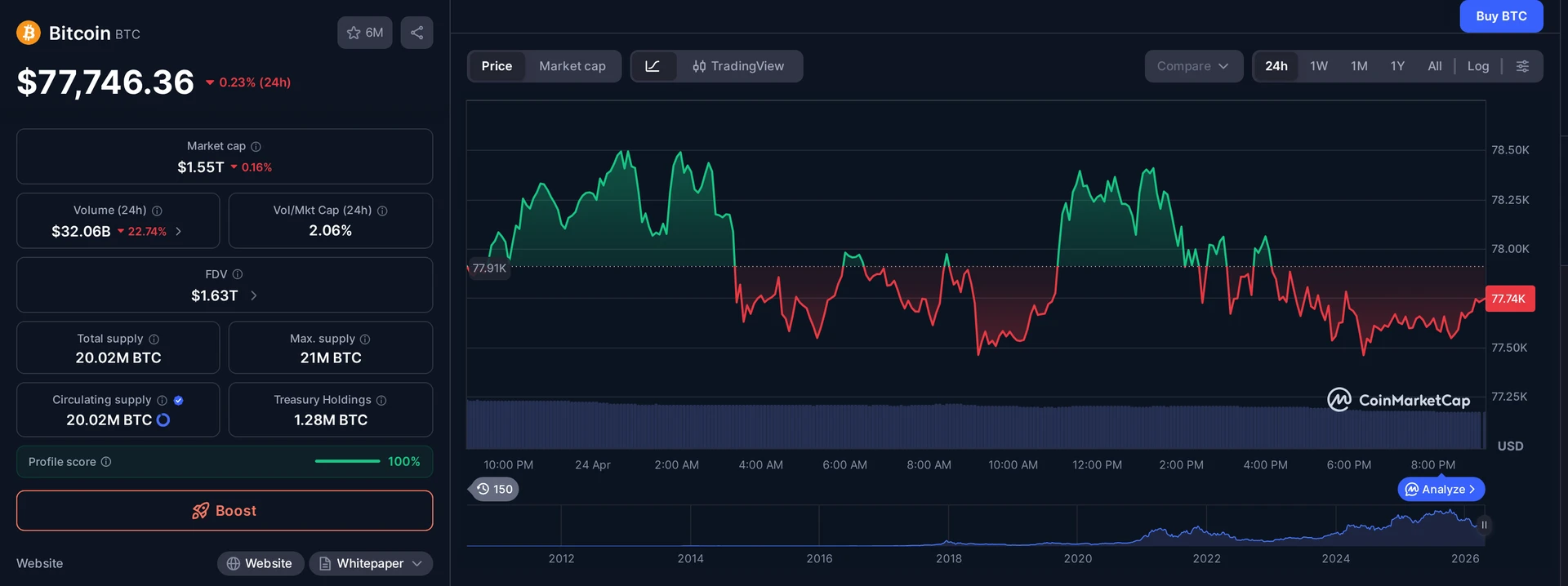
Bitcoin stalled at $78K into Friday’s Wall Street close, pinned down by an oil market that refuses to settle and a geopolitical backdrop that refuses to clarify. While the S&P 500 printed new all-time highs this week, BTC/USD barely moved, caught between bulls who think the war premium in energy has peaked and bears who see bid liquidity vanishing beneath spot. The tape is dull. The risk underneath it is not.
Bitcoin Stalled at $78K as War Headlines Freeze the Tape
Call it consolidation if you want. Traders on the desk call it waiting. Bitcoin closed the US session within a few hundred dollars of where it opened, flat on the day, flat on the week, and barely flat-adjacent on the month. Data from TradingView’s BTC/USD chart showed almost no directional movement for hours at a time, with price repeatedly tagging $78,000 and sliding off again.
That kind of price action happens for two reasons. Either the market has already decided and is waiting for confirmation, or the market has no conviction at all. Right now it looks like the second. Traders want to know how the US-Iran war lands before committing size in either direction, and nothing on Friday’s wires gave them that answer.
The macro backdrop makes the stall weirder, not less weird. Stocks are ripping. Metals got sold earlier in the week. If you wiped the ticker clean and looked at everything except BTC, you would guess risk was on. Bitcoin is the one asset ignoring the party.
BTC and stocks started the week off strong as metals have sold off. But as oil has been starting to move again the past few days, risk assets have stalled and are now chopping sideways.
Why Is WTI Crude Oil Weighing on Bitcoin Right Now?
Because every dollar oil adds is a dollar the Fed has to think about. WTI crude oil flirted with a retest of $100 before cooling to $95, and that was not enough to unfreeze risk assets. Spot prices tracked by the WTI crude oil benchmark have climbed steadily since the latest strikes.
Oil at $95 does two things to crypto that traders hate. It lifts headline inflation expectations, which keeps the long end of the Treasury curve jumpy. And it raises the odds that the Fed delays any cuts the market has already priced in. Neither is existentially bad for Bitcoin. Both are reasons not to buy today.
The correlation is not perfect, which is why the chop feels so tedious. When oil spikes hard, BTC drops. When oil drifts, BTC stalls. When oil falls, BTC catches a bid but not the kind that holds. That is the pattern this week, and nobody at a trading desk is pretending it is anything else.
- Energy shocks pump headline CPI, which shifts rate-cut odds
- Rising oil tightens consumer discretionary income, dragging growth expectations
- Risk-off flows from equities tend to hit BTC harder than gold on the first leg
- A confirmed de-escalation in the Gulf would likely flip the macro bid back on overnight
Earnings Season Becomes the Next Domino
Stocks cannot keep levitating on liquidity alone, and the desks tracking the breadth have started to say so out loud. Trading resource Mosaic Asset Company said in its latest Mosaic Asset Company chart alerts note that positive earnings figures will be essential to sustain continued upside for stocks, with the S&P 500 already printing record highs. The first quarter reporting season is about to pick up, and the numbers carry more weight than the headlines right now.
Their framing matters for crypto because BTC has spent most of 2026 correlated to the Nasdaq more than to gold. If forward earnings estimates start to roll over while oil stays bid, the equity tape loses its floor, and the macro correlation drags Bitcoin into the hole with it. That is the bear case in one sentence.
The bull case is almost as simple. If Q1 beats come in strong and guidance holds, the rate-cut debate loses its urgency but the earnings floor gets reinforced. In that scenario, BTC stops leaning on macro excuses and trades its own order book again. For now, the order book is not sending bullish signals.
With the first quarter reporting season about to pick up, it will be important to monitor forward earnings estimates for any changes in trend since the start of the year.
Bid Liquidity Is Thinning Under $78K
This is the part that should worry anyone long from higher. Trading resource Material Indicators flagged that bid liquidity at $76,500 has already been pulled. That was a level the firm publicly flagged as a magnet one day earlier, and it got hit faster than even the bearish desks expected. Low-time-frame order flow is now trending down, per the same data set.
For non-traders, pulled bids mean one thing: the buyers who said they would defend a level have quietly stepped away. The orders still show up further down, but not at the levels that would have caught this leg. Material Indicators added that it was surprised bid liquidity below spot price had not been pulled yet, which is trader-speak for, more downside is available if sellers want to take it.
Separately, JDK Analysis called the earlier rally a news-driven pump and said the volume profile shows BTC at the upper value extreme of the past two days. That is a technical way of saying the recent highs were mostly fumes, not accumulation. When volume profiles look like that and bid liquidity thins at the same time, the path of least resistance is rarely up.
- Bid liquidity at $76,500 was pulled ahead of any test of the level
- LTF order flow has flipped negative, per Material Indicators
- Volume profile shows BTC near the upper value extreme of the last 48 hours
- Whale order data has not rebuilt the bid stack below spot
What Traders Are Actually Doing This Weekend
Two camps, both small. The first is selling premium, writing strangles or iron condors around $78,000 on the bet that the chop continues through the weekend and decays their short options into Monday. That trade works as long as nothing on the US-Iran front breaks the range.
The second camp is running small long gamma, buying cheap options to own the break either way. Implied volatility has compressed enough during this sideways grind that owning convexity looks reasonable again, especially heading into a weekend where any headline can move the tape five percent before Asia opens.
Spot traders are mostly flat. That is the tell. When the aggressive discretionary desks are not pressing either direction, it usually means the next move is going to be decided by something outside the chart. Oil print, war headline, Treasury auction, earnings guidance. Pick your trigger.
What Happens If Oil Breaks $100 Again?
If WTI clears $100 and holds, the risk-off reflex kicks in immediately, and BTC is likely to lose the $76,500 shelf that already has no bids defending it. The next meaningful technical layer sits lower, and without a geopolitical de-escalation, there is no obvious catalyst to pull it back up before the Fed meeting.
If oil fails at $100 and rolls over toward $90, the macro weight lifts fast. Risk assets that have been chopping sideways all week would likely get a sharp bid, and Bitcoin would probably lead the snap-back given how compressed the tape has been. That is not a prediction. That is a scenario.
The uncomfortable truth for BTC holders is that none of this is about Bitcoin right now. It is about oil, it is about Tehran, and it is about the next Fed dot plot. The token is a passenger on someone else’s trade this week, and passengers do not pick the route.
Frequently Asked Questions
Why is Bitcoin stalled at $78K?
Bitcoin is stalled at $78,000 because traders are waiting for clarity on the US-Iran war while WTI crude oil near $95 pressures risk assets. The S&P 500 hit new record highs, but BTC is not following equities higher, with bid liquidity at $76,500 already thinning out ahead of any test.
How does WTI crude oil affect Bitcoin prices?
Rising WTI crude oil lifts headline inflation expectations and complicates the Federal Reserve’s rate-cut path. Higher oil tightens financial conditions and pushes capital away from risk assets like Bitcoin. When oil moves toward $100, BTC typically stalls or sells off, as seen this week when risk assets started chopping sideways again.
What is bid liquidity and why does it matter for Bitcoin?
Bid liquidity is the stack of resting buy orders below the current spot price. When large bids get pulled before they are hit, it signals that buyers are stepping away from defending a level. Material Indicators flagged that bid liquidity at $76,500 was already pulled, suggesting a deeper retracement is possible.
What could break Bitcoin out of the $78K range?
A cooling in oil prices below $90, a confirmed de-escalation in the US-Iran conflict, or a strong Q1 earnings season that reinforces the S&P 500 floor could each trigger a breakout. On the downside, WTI reclaiming $100 or disappointing forward earnings guidance would likely pull BTC through the thin liquidity under spot.
This article is for informational purposes only and does not constitute investment advice. Every investment and trading decision involves risk. Readers should conduct their own research before making any financial decisions.