





































What to Know
- 93% of GameFi projects are effectively dead and studio funding collapsed 93% by 2025
- Axie Infinity daily users crashed from 2.7 million at peak to roughly 5,500 today
- Gala Games is tangled in a lawsuit alleging its co-founder diverted $130 million in tokens
- Gaming’s share of Web3 venture dollars fell from 62.5% in 2022 to single digits by 2025
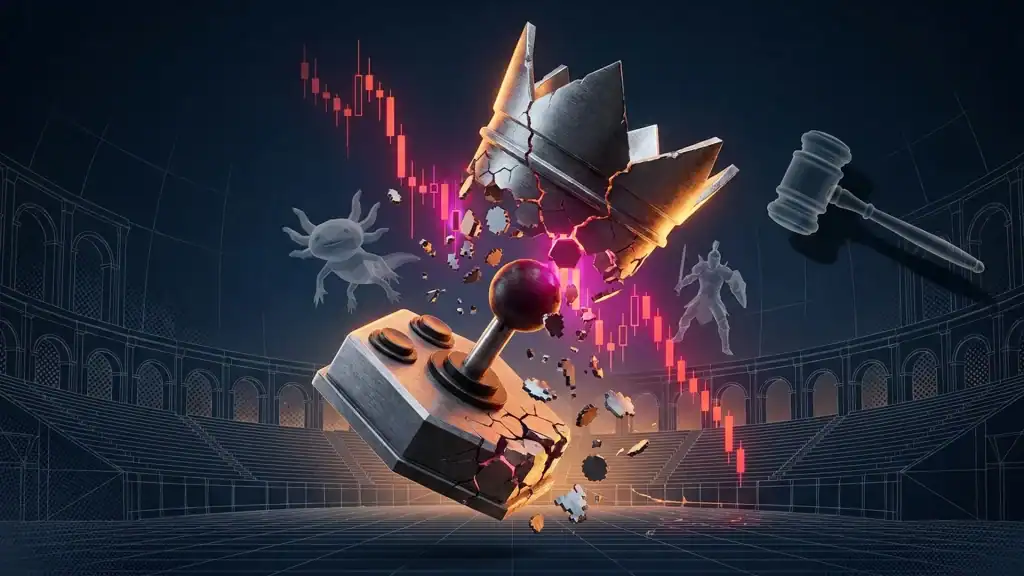
The Caladan Web3 gaming report out this week puts a number on what players already knew in their bones: roughly 93% of GameFi projects are dead, token prices sit about 95% below their 2022 peaks, and funding to studios has cratered 93% by 2025. Up to $15 billion went in. More than 300 blockchain titles have shut their doors. The whole thing was built for traders, not for people who actually wanted to play a game.
What Does the Caladan Web3 Gaming Report Actually Say?
The short version: capital got torched at every layer at once. The Caladan Web3 gaming report tracks losses across venture capital, retail NFT buyers, gaming guilds, and the Telegram tap-to-earn crowd. All of them are down. All of them at roughly the same time.
The report frames this as a structural failure, not a bad cycle. Studios raised tens or hundreds of millions before shipping anything that could hold a player’s attention for a weekend. Tokens launched first, games shipped later (if at all), and by the time a playable build arrived the economy underneath it had already imploded. Hamster Kombat shed 96% of its users inside six months. YGG, once the flagship gaming-guild token, trades 99.6% below its November 2021 peak.
Caladan’s authors put it plainly. “Capital was destroyed at every layer simultaneously,” the report states. That is a polite way of saying nobody got out.
Capital was destroyed at every layer simultaneously.
Axie Infinity Is the Clearest Picture of the Bust
If you want one chart that explains the whole crash, pull up Axie Infinity. Daily active users peaked near 2.7 million during the pandemic play-to-earn mania. Today the figure sits around 5,500, according to DappRadar tracking. That is a drop of roughly 99.8%, which is the kind of number that normally only shows up in rug-pull forensics, not in sector flagships.
Axie was the model everyone copied. Buy the NFT, earn the token, cash out as long as fresh money keeps walking in the door. The moment inflows slowed, the math ate itself. Rewards thinned, token prices slumped, and the Filipino scholars who had been playing eight hours a day for rent money walked away. What was left was a ghost economy with no new buyers and no product a gamer would voluntarily open on a Saturday.
The demand side never caught the supply. Even at the absolute top of the hype cycle, only 12% of gamers had ever tried a crypto game, per a Coda Labs survey cited by Caladan. Twelve percent. That is the ceiling the entire $15 billion sector was building toward, and most of them bounced after one session.
Gala Games, Pixelmon, and the Post-Mortem Parade
The individual wrecks are almost worse than the aggregate numbers. Gala Games is tied up in a lawsuit that alleges its co-founder diverted $130 million in tokens. Pixelmon raised $70 million in a 2022 NFT mint and, four years later, still has nothing resembling a public game. Ember Sword burned $18 million over seven years and closed last May. No refunds.
Square Enix, which most crypto people assume legitimized the space when it backed Symbiogenesis, quietly wound that project down in July. A Fortune 500 Japanese studio walking away without fanfare tells you more about the sector’s standing than any token chart. These were not small operators. These were supposed to be the proof that traditional gaming would come over.
Then there is the Telegram wave. Hamster Kombat pulled in something close to 300 million users on tap-to-earn mechanics, and the whole thing collapsed inside six months once the token airdropped and the incentive to tap the screen disappeared. The lesson repeated at every scale: take the reward out and the activity goes to zero.
- Pixelmon, $70 million raised in 2022, still no playable game four years on
- Ember Sword, $18 million spent over seven years, shut down May 2025 with no refunds
- Gala Games, $130 million token-diversion lawsuit still in discovery
- Square Enix Symbiogenesis, wound down in July after a quiet retreat
- Hamster Kombat, 96% user loss inside six months of launch
Where Did the Money Actually Go?
Straight into whatever VCs decided was next. Gaming commanded 62.5% of all Web3 venture investment in 2022. By 2025 that share had fallen to single digits. The displaced capital moved into AI, real-world-asset tokenization, and layer-2 infrastructure, because those categories tell a story a fund manager can put in a deck without explaining why 99.6% drawdowns are fine actually.
Even Animoca Brands, the most prolific backer the sector ever had, has cut gaming to roughly 25% of its portfolio. The firm is pivoting to stablecoins, RWAs, and AI. When the patient zero of Web3 gaming investment is diversifying out, the conversation about whether this cycle produced a winner is basically over.
Development timelines made everything worse. Games take three to five years to ship. Tokens trade in real time and demand constant momentum. By the time most of these titles were ready for a beta, the market cap of their launch token had already rounded to a rounding error. Nobody wanted to play a game whose currency was down 95% before the tutorial ended.
Was Any of This Actually About Games?
Not really. That is the uncomfortable part. The play-to-earn model was a financial product wearing a game costume, and the people who showed up were traders and yield farmers, not gamers. Caladan’s data confirms this at every turn: the users who drove peak metrics were chasing token rewards, not gameplay, and they disappeared the second the rewards stopped paying.
Real gamers kept telling the sector exactly what they wanted. They wanted entertainment. They wanted games that respected their time. They did not want a wallet signing prompt between every boss fight, they did not want to pay gas to equip a helmet, and they did not want their save file to be an NFT that could plummet 95% while they slept. The signal was loud. The studios chose not to hear it.
Call it what it is. This was a speculative cycle dressed up as a gaming revolution, and the bill came due in 2025. The sector is not dead in a philosophical sense, games on chains still exist and a small number will probably matter, but the $15 billion experiment in making tokens the gameplay is over.
What Happens to the Survivors?
The few titles still breathing are quietly de-emphasizing the tokens. That is the tell. If a studio’s 2026 roadmap leads with gameplay, PvE content, and cross-platform distribution instead of a new tokenomics whitepaper, it probably lives. If it leads with another airdrop, it probably does not.
Remaining investment has shifted away from individual titles and toward infrastructure, per the DappRadar shutdown data referenced in the Caladan report. Wallets, identity layers, and chain tooling for games that may or may not exist yet. It is a vote of no confidence in current titles dressed up as a vote of confidence in future ones.
For anyone still holding bags in gaming tokens from the 2021 cycle, the math is not kind. A 99.6% drawdown needs a 25,000% rally just to break even. That is not a recovery thesis. That is a lottery ticket.
Frequently Asked Questions
How much money did Web3 gaming burn through?
The Caladan Web3 gaming report estimates up to $15 billion was spent across the sector during the boom. By 2025, roughly 93% of GameFi projects were effectively dead, token values had fallen about 95% from 2022 peaks, and funding to studios had collapsed 93%. More than 300 blockchain games have shut down.
Why did Axie Infinity collapse?
Axie Infinity ran on a play-to-earn loop that paid existing players with tokens bought by new players. Once inflows slowed, rewards thinned and token prices slumped. Daily active users fell from roughly 2.7 million at the peak to around 5,500 today, a drop of about 99.8%, according to DappRadar data cited by Caladan.
What is the Gala Games lawsuit about?
Gala Games is entangled in litigation that alleges its co-founder diverted $130 million worth of tokens. The case is one of the most visible legal fights in Web3 gaming and sits alongside other high-profile failures like Pixelmon, which raised $70 million in 2022 and still has no public game, and Ember Sword, which shut down last May.
Is Web3 gaming dead?
The token-driven play-to-earn model that defined 2021 and 2022 is effectively over. Gaming’s share of Web3 venture capital fell from 62.5% in 2022 to single digits by 2025, and even Animoca Brands cut gaming to about 25% of its portfolio. A few survivors remain, but the sector has shifted from games to infrastructure.
This article is for informational purposes only and does not constitute investment advice. Every investment and trading decision involves risk. Readers should conduct their own research before making any financial decisions.






99.8% user drop is wild but honestly AXS was already bleeding out long before this report dropped. the scholarship model collapsed the moment SLP inflation outpaced new player demand, everything after that was just delayed recognition on the charts.
gala getting slapped with a $130M suit feels almost predictable at this point. what i want to know is whether the caladan report separates active wallets from sybil farming, because $15B in wipeout numbers mean nothing if half those TVL figures were recycled liquidity to begin with.
saw this coming since 2022 honestly
Been in since the CryptoKitties congestion days and every cycle the same pattern repeats: unsustainable token emissions dressed up as gameplay. P2E was never going to survive the first real bear, and anyone who lived through the 2018 dapp gold rush knew exactly how this chapter ends.