







































What to Know
- SEC Chair Paul Atkins said the agency is ‘on the cusp’ of releasing an innovation exemption for onchain tokenized securities trading
- The exemption offers a cabined framework for compliant blockchain-based securities activity while the SEC drafts longer-term rules
- The SEC’s March 17 interpretive guidance created a token taxonomy placing only tokenized securities under its core jurisdiction
- Commissioner Hester Peirce confirmed in March that staff were still building the exemption for limited experimentation
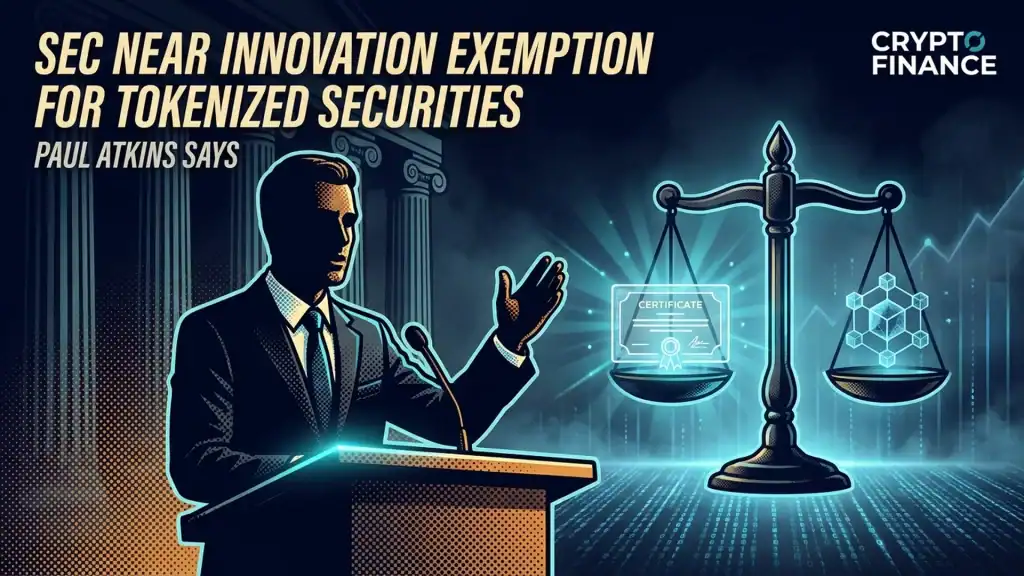
The wait for a workable US path for tokenized securities may finally be close to ending. Speaking at the Economic Club of Washington on Tuesday, SEC Chair Paul Atkins said the agency is “on the cusp” of releasing what he called an innovation exemption, a framework designed to let market participants trade onchain securities without tripping over rules written for a pre-blockchain market. For anyone holding bags in real-world asset protocols, this is the signal they have been waiting a year to hear.
What Did Paul Atkins Actually Say About the Exemption?
Atkins used precise language, and the language matters. He did not promise a finished rulebook. He promised a “cabined framework,” meaning a walled-off zone where firms can begin facilitating the trading of tokenized securities onchain while the Commission keeps working on long-term rules of the road.
That is a practical concession, not a philosophical shift. The SEC is not conceding that blockchain-native markets get a free pass. It is conceding that the current absence of any pathway has frozen the US out of a market that is moving fast in Zurich, Singapore and Abu Dhabi. Building a narrow sandbox is how you avoid losing the whole playground.
The Chair described the coming release as imminent. No exact date. No draft text circulating publicly. But “on the cusp” is not the vocabulary regulators use when something is six quarters away.
We are on the cusp of releasing what I call an ‘innovation exemption,’ which will provide market participants with a cabined framework to begin facilitating the trading of tokenized securities onchain in a compliant fashion as the Commission works toward long-term rules of the road.
Why the Innovation Exemption Matters for Onchain Markets
The innovation exemption has been drifting through SEC back rooms for the better part of a year. Atkins first floated the idea in July 2025, when he said the agency was weighing targeted relief to support tokenization and emerging trading methods. In March, Commissioner Hester Peirce said staff were still building the thing out, using it as a way to permit limited experimentation with tokenized securities while examiners tested how existing law mapped onto onchain venues.
Put plainly, the exemption is the device that lets a broker-dealer, an alternative trading system or a transfer agent touch tokenized equity without immediately violating a statute written in 1934. That is the whole problem, in one sentence. The laws do not recognize a smart contract as a recordkeeper. The exemption is the regulatory duct tape.
For real-world asset issuers, the difference between a working exemption and another round of speeches is enormous. Private credit, treasury tokens and onchain equity pilots have been crammed into Regulation D or offshore wrappers because no cleaner option exists. A functioning exemption opens the door to public-facing venues that can quote prices, route orders and settle trades in a way retail can actually access.
- Permits broker-dealers to handle tokenized securities without bespoke no-action relief
- Gives alternative trading systems a compliant lane to list blockchain-native instruments
- Lets transfer agents recognize onchain records without violating legacy rules
- Creates a measurable sandbox the Commission can evaluate before writing permanent rules
How the Token Taxonomy Sets the Table
The exemption does not arrive in a vacuum. On March 17, the SEC issued interpretive guidance introducing a token taxonomy that sorts digital assets into four buckets: digital commodities, collectibles, tools and stablecoins. Only one of those four falls inside the SEC’s core jurisdiction, and that bucket is tokenized securities.
That matters because the exemption only works if everyone agrees what counts as a security in the first place. The taxonomy does the definitional heavy lifting. The innovation exemption then does the operational heavy lifting. Together they form the two halves of a policy that the SEC has been trying to stitch together since the Gensler era ended.
Atkins called the taxonomy “long overdue” in his remarks, and on that point even his critics tend to agree. The fight is not over whether crypto needs clear lines. The fight is over where the lines get drawn and who owns the territory on each side. The taxonomy shoves most of the crypto universe toward the Commodity Futures Trading Commission and keeps the narrow slice of tokenized equity, bonds and funds on the SEC side of the fence.
What Is Stuck at the White House Right Now?
On March 24, the SEC sent its proposed interpretation to the White House for review. As of Wednesday, federal records still listed the proposal as “pending review.” That is the bureaucratic limbo every major rulemaking has to pass through, and it is where well-intentioned policy often sits for months while staff wrangle over footnotes.
The practical question for builders and investors is whether the innovation exemption itself needs the same White House trip. Based on how the SEC has structured past exemptive orders, it does not. The exemption can move through the Commission’s own process, which means Atkins has the authority to land it without waiting on anyone at the Office of Management and Budget.
That is the optimistic read. The cynical read: a Chair who wants to be seen as friendly to innovation has every incentive to announce the exemption is “on the cusp” well before anything is actually ready for publication. Washington has a long history of cusps that never tip.
Who Benefits, and Who Gets Left Out?
Winners first. Issuers already running tokenization pilots, including the large custodians and the handful of fintechs building onchain treasury products, get a compliant rail they can point to when institutional clients ask the obvious legal question. Broker-dealers that have quietly stood up crypto desks get a path that does not depend on custom no-action letters.
The clearer losers are the DeFi-native protocols that were hoping the SEC would extend its sandbox to permissionless venues. Nothing Atkins said suggests that. A “cabined framework” almost by definition means identified, registered participants operating within defined perimeters. Anonymous liquidity providers on a public automated market maker are not the constituency this exemption is built for.
Commissioner Hester Peirce, long the SEC’s loudest internal advocate for a tokenization sandbox, has been pushing a version of this idea for years. Her fingerprints are all over the current draft. Whether the final product resembles her original safe harbor proposal or a more conservative version trimmed by staff lawyers is the detail that will determine how much room the industry actually gets.
How This Fits the Broader Atkins SEC Agenda
One year into the tenure of Paul Atkins, the pattern is clear. The Commission is moving from enforcement-first to framework-first, issuing guidance instead of subpoenas, and trying to build bridges to market structure legislation that may or may not pass Congress this session.
The token taxonomy, the pending White House review and the innovation exemption are three pieces of the same puzzle. Taxonomy tells you what something is. Exemption tells you how to trade it. Legislation, eventually, makes the whole thing permanent. Without the third piece, everything the Commission does now is reversible by the next administration.
That reversibility is the elephant in the room. An exemption granted by this SEC can be narrowed or rescinded by a future one. Firms that build around the new framework will need to decide how much capital to commit to a structure that technically rests on the Commission’s discretion. Sophisticated legal teams already know the answer, and it is not zero, but it is not unlimited either.
What Happens Next for Tokenized Securities?
The short-term calendar looks roughly like this. The Commission publishes the innovation exemption. Comment period opens. Staff fields questions from the same broker-dealers and custodians that have been lobbying for a year. A handful of early applicants file for relief under the new framework. Somebody trades an actual onchain security in a fully compliant US venue for the first time, and the narrative snaps into place.
If you are watching price charts, the names most likely to move on headlines here are the tokenization infrastructure plays and the custodians. If you are watching the policy beat, the next milestone is the text itself. A cabined framework can be generously cabined or painfully cabined. Two paragraphs of rulebook language will settle which version won.
Frequently Asked Questions
What is the SEC innovation exemption for tokenized securities?
The innovation exemption is a proposed SEC framework that would let market participants trade tokenized securities onchain within a compliant, cabined perimeter. Announced as imminent by Chair Paul Atkins on April 21, 2026, it is designed as interim relief while the Commission drafts permanent rules for blockchain-based securities markets.
Who is Paul Atkins and why does this announcement matter?
Paul Atkins is the Chair of the US Securities and Exchange Commission. His remarks at the Economic Club of Washington signal that the long-discussed exemption has moved from staff drafting into near-final form, which would finally give US broker-dealers, trading systems and issuers a legal pathway for onchain securities activity.
When did the SEC publish its token taxonomy?
The SEC released interpretive guidance outlining its token taxonomy on March 17, 2026. The guidance groups digital assets into four categories: digital commodities, collectibles, tools and stablecoins. Only tokenized securities fall under the SEC’s core jurisdiction, with the other categories sitting outside the agency’s direct oversight.
How does the innovation exemption differ from legislation?
The exemption is a Commission-issued rule that can be adopted, narrowed or rescinded by the SEC itself. Legislation requires Congress and creates durable law. Atkins has framed the exemption as a bridge to future market structure legislation, meaning it is interim relief rather than a permanent fix for tokenized securities.
This article is for informational purposes only and does not constitute investment advice. Every investment and trading decision involves risk. Readers should conduct their own research before making any financial decisions.
















innovation exemption is doing a lot of heavy lifting here. does this actually preempt state blue sky laws or are we still going to have a 50-state patchwork for secondary trading?
Atkins has been signaling this since he took the chair. if it lands before summer that’s a genuine shift from the Gensler era posture, though I’ll believe the final text when I read it.
been through the 2018 no-action letter wave and the 2020 ATS pivot. every cycle the rulemaking looks imminent and then gets stuck in comment hell. hope this one breaks the pattern but conditioning expectations on twelve more months of drafts is the safer bet.
finally some forward motion on this file
curious what people think the scope will be. equities only, or does it extend to tokenized treasuries and private credit? the April 22 remarks were vague on that part.