






































What to Know
- $701 million in crypto frozen by U.S. authorities tied to investment scams targeting Americans
- 503 fake investment websites taken down, plus a Telegram channel recruiting workers into a Cambodia scam center
- Singapore Police prevented $2.86 million in losses during a one-month operation with Coinbase, Gemini, and Coinhako
- FBI logged over one million cybercrime complaints in 2025 with total losses near $21 billion
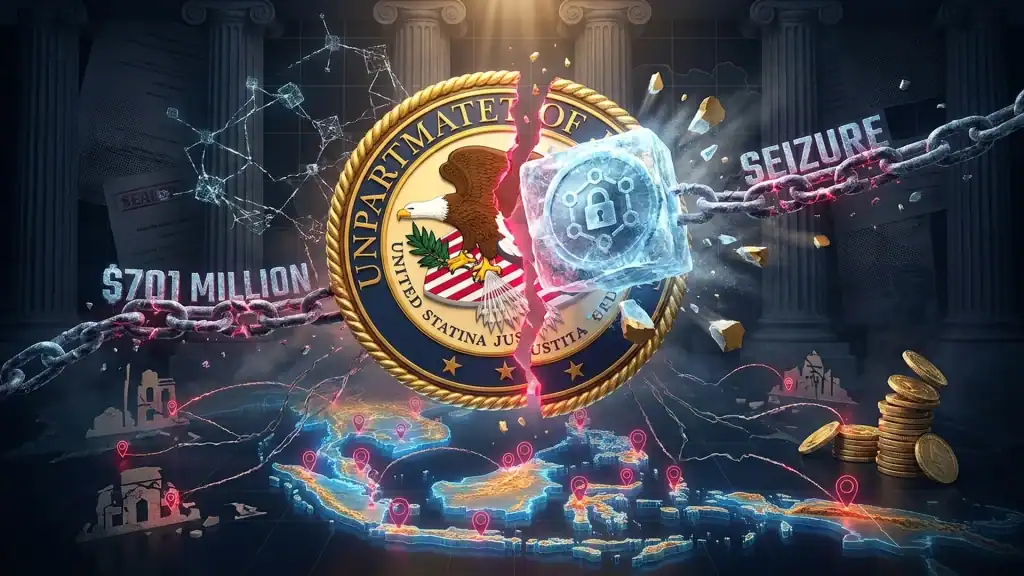
The DOJ crypto scam seizure just hit a new high-water mark. U.S. authorities froze more than $701 million in cryptocurrency tied to investment scam networks targeting Americans, the Department of Justice said Thursday, with assets restrained through coordinated action with crypto exchanges and a wave of court filings. The numbers are eye-popping. The geography behind them is the real story: pig-butchering compounds in Burma, Cambodia and Laos, where trafficked workers run fake trading dashboards on stolen identities. Washington is finally treating this like the transnational organized-crime problem it is, and the seized coins are no longer just sitting in a wallet. They are funding the new federal Bitcoin reserve.
Inside the $701 Million DOJ Crypto Scam Seizure
The headline figure landed on Thursday. The Justice Department said the $701 million in restrained crypto came out of work led by its Scam Center Strike Force, the unit set up specifically to chase the laundering pipelines behind investment-fraud rings. “The Scam Center Strike Force continues its work to identify, seize, and forfeit funds involved in money laundering related to scams, so that funds can be returned to victims whenever possible,” the agency said in a statement announcing the action.
What is different this time is the breadth. Prosecutors did not just freeze wallets. They pulled down 503 fake investment websites that had been showing victims fabricated dashboards, fake yield numbers, and bogus withdrawal queues. Visit those domains today and you get a federal seizure notice instead of a trading screen. They also took control of a Telegram channel that scam operators were using to recruit workers into a compound based in Cambodia, where job ads promising legitimate employment were a cover for trafficking.
The full DOJ crypto scam seizure filing names two Chinese nationals, Huang Xingshan and Jiang Wen Jie, accused of running a crypto fraud operation out of the Shunda compound in Burma. That compound was overrun in November 2025 by the Karen National Liberation Army, an ethnic armed group, in a raid that exposed direct links between militias and the scam economy.
The Scam Center Strike Force continues its work to identify, seize, and forfeit funds involved in money laundering related to scams, so that funds can be returned to victims whenever possible.
How the Scam Center Strike Force Built Its Case
The Scam Center Strike Force is barely two years old, but it has become the federal point of contact for everything pig-butchering related. The unit treats investment-scam compounds the way prior task forces treated cartels: trace the money, name the principals, take the infrastructure offline, and squeeze the extradition path.
This week’s filings build on a pattern that goes back months. In December 2025, prosecutors moved against domains tied to the Tai Chang compound in Burma, a site where operators had cloned legitimate trading apps and pushed victims toward malicious downloads that drained their wallets. The State Department has since put a $10 million bounty on information that could disrupt Tai Chang, language usually reserved for terror financiers and sanctioned regimes.
Read the Scam Center Strike Force charter and the strategy is plain. Identify the compound. Map the wallets. Coordinate with exchanges to freeze inflows. File a civil forfeiture complaint. Repeat. The 701 number is not the result of one heroic case. It is the result of dozens of smaller restraints stacking up over a year.
- $701 million in crypto restrained across multiple actions
- 503 fake investment domains seized and replaced with federal notices
- 1 Telegram recruiting channel taken down
- 2 Chinese nationals charged in connection with the Shunda compound
- $10 million State Department reward posted on Tai Chang
What Happens to the Seized Crypto Now?
Here is where the policy story bites. Forfeited crypto used to sit in government custody, get auctioned off years later, and disappear into the general fund. That changed in March 2025 when President Donald Trump signed the executive order creating a Strategic Bitcoin Reserve and a Digital Asset Stockpile, both seeded in part with confiscated coins.
So the $701 million does not just punish the scammers. It feeds a sovereign crypto balance sheet. That is a quiet but enormous shift in incentive structure. Federal prosecutors now have a direct policy reason to chase crypto-denominated crime aggressively, because every successful forfeiture grows a strategic asset that the White House has staked political capital on.
Victims still get priority on restitution where they can be identified. The DOJ statement emphasized returning funds “whenever possible.” In practice, pig-butchering victims are often elderly, often embarrassed, and often never come forward. The leftover coins are exactly the bucket that flows into the reserve.
Singapore Shows the Other Side of the Playbook
While Washington takes coins off the board, other jurisdictions are getting better at stopping deposits before they leave the victim’s account. Between March 16 and April 15, the Singapore Police Force ran a one-month sting that prevented more than $2.86 million in losses by coordinating directly with crypto exchanges in real time.
The exchange list reads like a who’s who of the regulated side of the industry: Coinbase, Gemini, Independent Reserve, and the regional platform Coinhako. Blockchain analytics firms TRM Labs and Chainalysis traced suspicious transactions while officers placed phone calls and door-knocked targets before the funds left.
According to the Singapore Police crypto scam operation summary, more than 90 direct interventions were made over the month. That is the model regulators have been begging exchanges to support: not after-the-fact subpoenas, but live victim rescue.
The operation’s success stemmed from the rapid exchange of information between the police and participating cryptocurrency exchanges, which enabled swift victim identification and immediate intervention.
Why Are Crypto Scam Losses Still Growing?
Short answer: because the supply side is industrial. The latest FBI cybercrime losses 2025 report logged more than one million complaints last year, with total reported losses near $21 billion. Even with seizures climbing, the gap between what is stolen and what is recovered is widening.
Southeast Asia is the engine room. Compounds in Myanmar, Cambodia and Laos run on trafficked or coerced labor. Workers are recruited with fake job ads, smuggled across borders, and forced to chat up targets on dating apps and LinkedIn until those targets agree to deposit into a fake trading platform. The economics are brutal and the margins are obscene. Every shut-down compound gets replaced by another within weeks.
Then there is AI. Voice cloning, deepfake video calls, and large language models writing flirt-script in flawless English have collapsed the cost of running a convincing scam to almost zero. The FBI’s report flagged AI-generated content as the single fastest-growing factor in the loss column. That trend will not reverse on its own.
Call it grim. The DOJ taking $701 million off the table is real progress. It is also a fraction of the $21 billion the FBI says walked out the door last year. The strike force is doing the work. The criminals are just doing more of it.
What This Means for Crypto Exchanges and Holders
Two things. First, expect more freeze requests, faster. The Singapore model of real-time exchange cooperation is what Washington wants to import, and the exchanges that already cooperate (Coinbase, Gemini, Kraken) will keep getting cited as the responsible counterparts. The ones that drag their feet will get named in court filings.
Second, if you have ever moved coins through a wallet that touched a sketchy yield platform, your transaction graph is being looked at. TRM Labs and Chainalysis are running these traces and the addresses they flag get propagated across the compliance stack. Innocent users sometimes get caught in cross-fire freezes. Document your sources of funds.
The bigger picture is that crypto is no longer the wild frontier where scams disappear into the chain. The chain is the evidence. The strike force just proved it again with $701 million worth of receipts.
Frequently Asked Questions
How much crypto did the DOJ freeze in the latest scam seizure?
The U.S. Department of Justice froze more than $701 million in cryptocurrency tied to investment scam networks targeting Americans. The action, announced Thursday, came through coordinated work with crypto exchanges and civil forfeiture filings led by the DOJ’s Scam Center Strike Force, with funds returned to identified victims when possible.
What is the Scam Center Strike Force?
The Scam Center Strike Force is a U.S. Department of Justice unit focused on identifying, seizing, and forfeiting funds laundered through investment-scam compounds, primarily in Southeast Asia. It coordinates with crypto exchanges, blockchain analytics firms, and foreign law enforcement to dismantle scam infrastructure, charge operators, and recover assets for trafficked workers and defrauded victims.
Where do scam compounds typically operate?
Most large pig-butchering compounds operate in Myanmar, Cambodia, and Laos, often inside special economic zones controlled by armed groups or local militias. Workers are frequently trafficked or coerced, recruited through fake job ads on Telegram and other platforms, and forced to run crypto investment scams aimed at victims in the United States, Europe, and Asia.
What happens to crypto seized by U.S. authorities?
Seized cryptocurrency is first used to compensate identified victims when possible. Remaining assets now feed the Strategic Bitcoin Reserve and Digital Asset Stockpile, which President Donald Trump established by executive order in March 2025. That policy turns successful forfeitures into a sovereign crypto holding rather than a one-time auction proceed.
This article is for informational purposes only and does not constitute investment advice. Every investment and trading decision involves risk. Readers should conduct their own research before making any financial decisions.