







































What to Know
- Army Master Sergeant Gannon Ken Van Dyke, 38, won more than $409,000 on Polymarket betting on the Maduro raid he helped carry out
- Tether froze $344 million in USDT on Tron, its largest single enforcement action ever, working with OFAC and US law enforcement
- Sam Bankman-Fried withdrew his Rule 33 new trial motion, telling Judge Kaplan he does not believe he will get a fair hearing
- Meta is cutting 8,000 jobs, about 10% of staff, to fund a $135 billion AI capex plan for 2026
A Polymarket insider trading case just landed on the desk of every compliance officer in crypto, and the defendant is wearing a US Army uniform. The Department of Justice charged Master Sergeant Gannon Ken Van Dyke on Thursday with using classified military intelligence to win more than $409,000 on prediction-market contracts tied to the January raid that captured Venezuelan President Nicolas Maduro. That was the headline story out of a Thursday news cycle that also delivered the biggest stablecoin freeze in Tether’s history, a surprise retreat from Sam Bankman-Fried, and another round of layoffs at Meta. Four stories. One very strange day.
The Soldier Who Bet on His Own Mission
Van Dyke, 38, was not some analyst on the sidelines reading cables. He was inside Operation Absolute Resolve, the January 3 raid that pulled Maduro out of Caracas. According to the criminal complaint, he placed 13 bets on Polymarket between December 26 and January 2, routing his traffic through a VPN to hide where he was placing the wagers from.
The positions were not subtle. He bet on whether Maduro would be removed. He bet on whether US forces would invade Venezuela. He bet on the specific outcomes that only someone read into the operation would know were coming. Total stake: roughly $33,000. When the mission succeeded, the contracts resolved in his favor and paid out more than $409,000.
What happened next is the part that reads like a how-not-to guide. Prosecutors say Van Dyke moved most of the winnings into a foreign crypto wallet within hours, then parked the remainder in a freshly opened brokerage account. Classic structure for someone who knows the money will be looked at. Less classic for someone who then keeps showing up to work on a base.
The whole world, unfortunately, has become somewhat of a casino. I was never much in favor of it. I don’t like it conceptually.
What Charges Is Van Dyke Actually Facing?
The short answer: five federal counts, plus a parallel civil case. The Polymarket insider trading indictment lists unlawful use of confidential government information, theft of government information, commodities fraud, wire fraud, and making an unlawful monetary transaction. The CFTC filed its own civil complaint the same day, a now-standard tag-team move on anything that touches a derivatives-style contract.
Polymarket itself is not a defendant. The company said it flagged the account on its own, referred the matter to the Justice Department, and handed over records without a fight. That detail matters more than it sounds. For a platform that spent years trying to convince US regulators it was not a casino for insiders, a cooperative first move on the first big insider case is the exact posture the CFTC wanted to see.
Commodities fraud is the charge that turns this from a military scandal into a crypto-market precedent. If prosecutors win on that count, every prediction market sitting in the regulatory gray zone has to start treating wagers backed by non-public material information the way Wall Street treats insider trading in stocks. That is a different compliance regime than what most of these platforms currently run.
- Unlawful use of confidential government information
- Theft of government information
- Commodities fraud
- Wire fraud
- Unlawful monetary transaction
- Parallel CFTC civil complaint
Tether Just Froze $344 Million and Aimed It at Circle
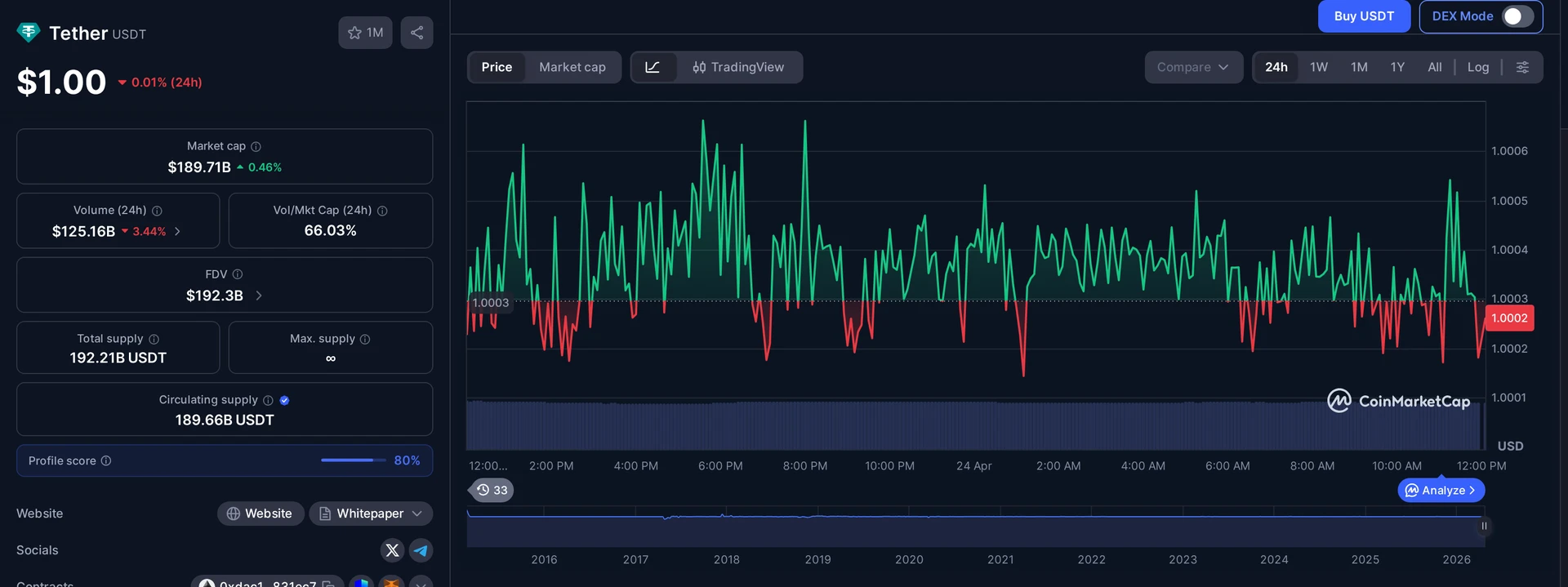
On the same day the DOJ announced the Van Dyke arrest, Tether freezes $344 million USDT across two Tron wallets after a coordinated request from OFAC and multiple US agencies. One address held $212.9 million. The other held $131.3 million. Both were flagged for suspected sanctions evasion and ties to criminal networks. Tether moved before the balances could be swept elsewhere.
The company did not name the holders. It did not describe the alleged criminal activity. What it did do is put a number on the scoreboard: this is the single largest enforcement freeze in Tether’s history. To date, the issuer has worked with more than 340 law enforcement agencies in 65 countries and frozen a cumulative $4.4 billion, including $2.1 billion linked to US agencies.
Paolo Ardoino, the CEO, did not bother with subtlety. He said USDT is not a safe haven for illicit activity and added a line that everyone in the industry heard clearly: “Recent events have shown what happens when platforms fail to move quickly.” That is a Circle reference. Say it out loud.
USDT is not a safe haven for illicit activity. When credible links to sanctioned entities or criminal networks are identified, we act immediately and decisively. Recent events have shown what happens when platforms fail to move quickly.
The Circle Problem Tether Keeps Pointing At
During the $285 million Drift Protocol exploit earlier this month, roughly $230 million in USDC flowed through Circle’s Cross-Chain Transfer Protocol during US business hours. Circle did not freeze the funds. Its stated reason: no formal law enforcement request and no OFAC designation on the addresses at the time the money was moving.
Legally defensible. Optically, a disaster. Tether contributed $127.5 million toward Drift’s recovery plan while Circle’s logo sat on the chain abuse report as the rails the thief used. In a market where stablecoin choice is driven by perceived operational trust almost as much as by liquidity, Tether has spent the last three weeks turning that split-second into a permanent marketing campaign.
Call it pragmatism, call it opportunism, but Ardoino’s team is running a cleaner playbook right now. Freeze first, explain second. The Circle argument, that due process should slow issuers down, is the more defensible one in a courtroom. It is losing the argument in the group chat.
Sam Bankman-Fried Blinks, Then Pulls His Own Motion
In the same news cycle, Sam Bankman-Fried new trial motion paperwork went in the other direction. The former FTX chief filed a letter withdrawing his Rule 33 bid for a retrial. The withdrawal was without prejudice, which leaves him room to refile once his pending Second Circuit appeal is decided. His stated reason, written directly to Judge Lewis Kaplan, was blunt.
“I do not believe I will get a fair hearing on this topic in front of you,” Bankman-Fried wrote. The motion itself had been filed back in February by his mother, the attorney Barbara Fried, on his behalf. That prompted Kaplan to demand clarification on who actually authored the document. Thursday’s letter answered that question: Bankman-Fried said he conceived the arguments, drafted multiple versions, and did most of the legal research himself while incarcerated, with his parents offering editorial suggestions and a New York attorney providing limited input.
The Second Circuit appeal arguing the original trial was “fundamentally unfair” is still live. So is his request to have the case reassigned away from Kaplan, whom he has accused of “extreme bias.” For now, he stays at a 25-year sentence on seven counts of fraud and conspiracy tied to FTX’s 2022 collapse. The retrial fight is on ice, not buried.
Meta Cuts 8,000 Jobs to Feed the AI Bill
Meta told staff Thursday that roughly 8,000 employees, about 10% of the company, will be out by May 20. The internal memo framed it as running the company more efficiently to offset other investments. Those other investments are AI, and the numbers are eye-watering.
Capex in 2025 was $72 billion. The 2026 projection sits between $115 billion and $135 billion, with most of the new money going to Meta Superintelligence Labs and data center buildout. Middle management and non-engineering roles are expected to absorb the largest share of the cuts. Another 6,000 open positions have been closed outright.
This is what Zuckerberg warned about on the January earnings call when he said 2026 would be “the year that AI starts to dramatically change the way that we work.” Turns out the change starts with paychecks that stop arriving. The crypto connection is indirect but real. Every big tech capex dollar that gets rerouted into GPUs and data centers tightens the power, chip, and real-estate supply that every serious on-chain AI project is also trying to buy.
Why Does the Polymarket Insider Trading Case Matter for Prediction Markets?
Direct answer: because it is the first time a US federal prosecution has treated a prediction-market wager the way the SEC treats insider stock trades. That framing was always coming. Polymarket ran for years as a permissionless venue where anyone could bet on election outcomes, war outcomes, corporate outcomes. The implicit defense was that the markets were just crowd-sourced forecasts, not regulated instruments.
The DOJ’s charging document blows that argument up. Once the government says classified information was used to profit on the platform, the platform is, functionally, a commodities venue. That is a new legal reality that every operator in the category, from Kalshi to Polymarket to smaller exchanges, has to underwrite for. Expect harder KYC on large bettors, faster pattern-detection for suspicious pre-event entries, and more proactive referrals to federal regulators. The industry just lost the ability to claim none of this was its problem.
Frequently Asked Questions
Who is Gannon Ken Van Dyke?
Gannon Ken Van Dyke is a 38-year-old US Army Master Sergeant charged by the Department of Justice with using classified military information to win more than $409,000 on Polymarket. He participated in Operation Absolute Resolve, the January 3 raid that captured Venezuelan President Nicolas Maduro, and placed bets on the operation’s outcome.
How much money did Tether freeze on April 24?
Tether froze $344 million in USDT across two Tron wallets on Thursday, coordinating with OFAC and US law enforcement. One wallet held $212.9 million and the other held $131.3 million. The action is the largest single enforcement freeze in Tether’s history, which now totals $4.4 billion across 65 countries.
Why did Sam Bankman-Fried withdraw his new trial motion?
Sam Bankman-Fried withdrew his Rule 33 motion because he told Judge Lewis Kaplan he did not believe he would get a fair hearing. The withdrawal was without prejudice, letting him refile once his Second Circuit appeal resolves. He remains serving a 25-year sentence for fraud tied to FTX’s 2022 collapse.
How many jobs is Meta cutting in 2026?
Meta is cutting approximately 8,000 jobs, about 10% of its total workforce, effective May 20. The company also closed 6,000 open positions. The cuts are designed to offset rising capital expenditures on artificial intelligence, projected to reach between $115 billion and $135 billion in 2026.
This article is for informational purposes only and does not constitute investment advice. Every investment and trading decision involves risk. Readers should conduct their own research before making any financial decisions.