







































What to Know
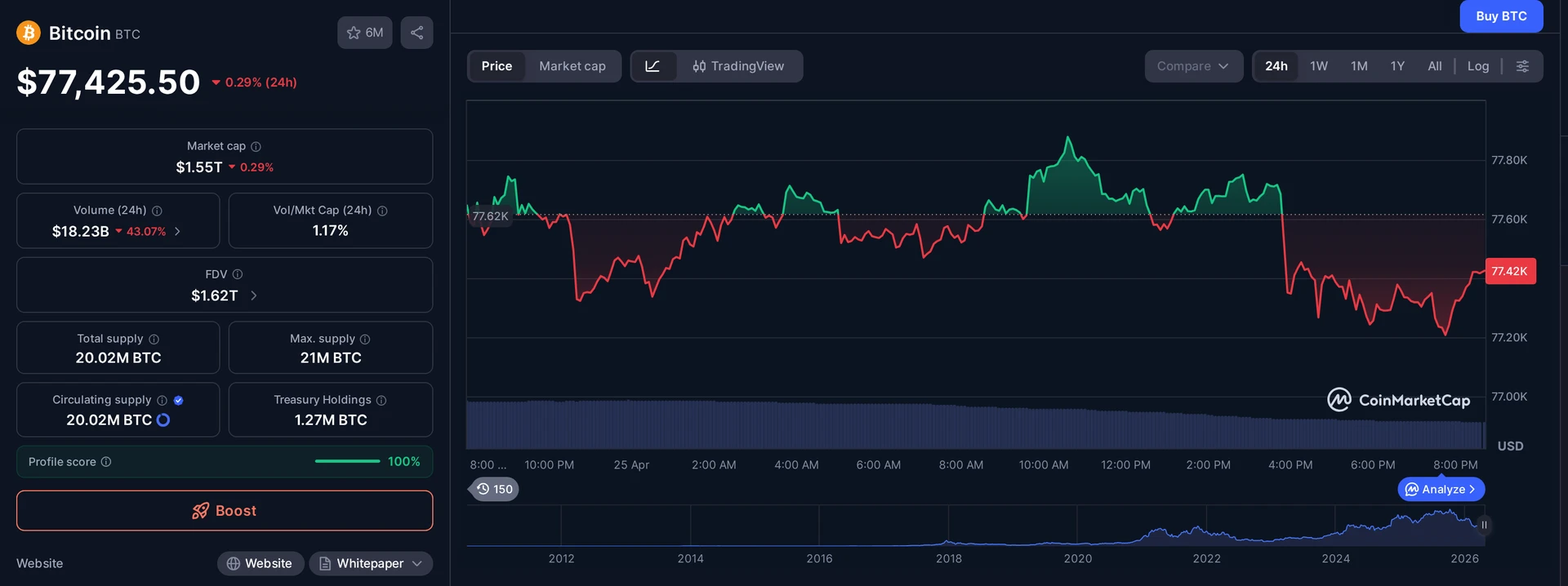
- Bitcoin broke above $79,000 on Wednesday, the highest print since January, before easing back to roughly $77,397.
- VanEck’s Matthew Sigel and Patrick Bush flagged a 6.7% hash rate drawdown that historically preceded a 37.7% median gain over 90 days.
- Spot Bitcoin ETPs logged net inflows in six of the last seven weeks through April 11, reversing $4 billion of earlier outflows.
The fresh VanEck Bitcoin analysis lands at an awkward moment for bears. After Bitcoin punched above $79,000 on Wednesday, its highest print since January, the asset is down a small 0.8% on the day near $77,397. VanEck analysts Matthew Sigel and Patrick Bush say that pullback is noise. The on-chain signals they track look the way they tend to look right before Bitcoin grinds higher.
What Is the VanEck Bitcoin Analysis Saying Right Now?
Sigel and Bush published their mid-April ChainCheck note on Friday and the message is blunt. Three on-chain metrics they treat as signal, hash rate trend, perpetual funding, and ETP flows, are flashing green at the same time. That triple alignment is rare and historically rewards patient buyers.
The full VanEck Bitcoin analysis leans on past cycles where two or more of these indicators turned at once. In their backtests, the combination of a meaningful hash rate decline alongside negative funding has preceded chunky rallies more often than not. The current setup, they argue, fits that pattern almost too neatly.
Bitcoin is up more than 11% in the last 30 days per CoinGecko data, so the call is not that the bottom is somewhere far below. It is that the path from here skews higher, not lower.
Why a Hash Rate Drop Is Actually Bullish
Bitcoin’s hash rate, the total computing power miners point at the network, has eased to a 30-day moving average of 985.5 EH/s. That is 7.5% below the all-time high of 1,065.7 EH/s set in late November. To anyone outside crypto that sounds like a bad headline. Inside crypto it is something else.
The network has lived through three sustained hash rate declines in the last five months. The most recent one ended on April 15 after 16 days and a peak drawdown of 6.7%. Older, less efficient miners switch off when prices and fees compress. Stronger ones survive. The chain keeps producing blocks. The story repeats.
What matters is what happened next in past episodes. According to the Bitcoin hash rate drawdown data VanEck cites, six of the last seven hash rate decline episodes ended with Bitcoin trading higher 90 days later. The median gain across those windows was 37.7%. That is not a guarantee. It is a base rate, and it is a generous one.
Hash rate drawdowns have historically been bullish for Bitcoin, with six of seven episodes resulting in Bitcoin trading higher 90 days later at a median gain of 37.7%.
Negative Funding Rates Keep Punishing the Shorts
The second leg of the thesis is funding. Perpetual futures use a funding mechanism to keep the contract price tethered to spot. When funding goes negative, shorts are paying longs to hold the trade. That usually means traders are leaning bearish, sometimes too bearish.
Since 2020, Bitcoin has averaged 11.5% returns during 30-day periods with negative funding, compared with 4.5% overall. Drop the threshold to a Bitcoin negative funding rate signal deeper than minus five percent, and the numbers get loud. 30-day returns climb to 19.4%. The 180-day number is 70%.
Read that twice. A market where shorts are stacking and paying for the privilege has, on average, paid spot holders 70 cents on the dollar over the next six months. That is the crowded-trade tax in numbers.
ETF Flows Tell a Different Story Than the Charts
Then there is the institutional tape. Between January 24 and February 21, spot Bitcoin ETF flows were ugly. Five straight weeks of outflows wiped out roughly $4 billion of exposure. Headlines at the time read like a funeral.
Then it stopped. In six of the last seven weeks through April 11, spot Bitcoin ETPs have logged net positive flows. The turnaround is large enough that it cannot be written off as rebalancing or noise from a single issuer. Allocators who walked away in February are back in the bid.
Daily transfer volume on the network is now sitting at $48.5 billion, the 81st percentile historically, even as it has cooled 5% month-over-month with lower realized volatility. Translation: there is real money still moving. It is just doing it more calmly than during the late-winter panic.
- $4 billion in spot Bitcoin ETP outflows from January 24 through February 21
- Net inflows in six of the last seven weeks through April 11
- Daily transfer volume at $48.5 billion, the 81st percentile historically
- Hash rate 985.5 EH/s, down 7.5% from the November peak
What Could Break the Bull Case?
The honest read is that any one of these signals can flip. If hash rate keeps bleeding past the 6.7% drawdown level seen in mid-April and miners start capitulating in size, the historical base rate that VanEck leans on becomes less useful. Drawdowns that go too deep stop being healthy resets and start being warnings.
Funding can flip just as fast. A push back to $80,000 plus would likely drag funding back into positive territory and erase the contrarian setup VanEck is highlighting. The window for the negative-funding edge is, by definition, a window. Traders who wait for confirmation tend to miss it.
ETF flows are the cleanest tell of the three. If allocators see another macro shock and step back the way they did in late January, the bid that has supported price into April thins out quickly. None of these risks are far-fetched. They are simply the other side of the trade Sigel and Bush are leaning into.
The Cynical Read Versus the VanEck Read
Here is the cynical take that does not get said often enough. ETF issuers like VanEck are paid when AUM grows, and AUM grows when Bitcoin goes up. Reading their bullish notes without that disclaimer in mind is a mistake.
But the data they are pointing at is not theirs. Hash rate is a public metric. Funding rates publish in real time on every major perpetual venue. ETP flow numbers come from third-party trackers. Anyone with a Bloomberg terminal and a free afternoon can run the same backtest.
What VanEck is doing is connecting three independent series and saying the alignment matters. You can argue with the conclusion. The numbers themselves are not really up for debate. Bitcoin is 11% higher on the month, the hash rate has reset, funding is paying spot holders, and the ETF crowd is buying again. That is not a setup that screams sell.
Frequently Asked Questions
What did VanEck analysts say about Bitcoin in April 2026?
VanEck analysts Matthew Sigel and Patrick Bush said in a Friday report that they remain bullish on Bitcoin. They cited a 6.7% hash rate drawdown, negative perpetual funding rates, and a flip back to net positive spot Bitcoin ETP inflows in six of the last seven weeks through April 11.
Why is a Bitcoin hash rate drawdown considered bullish?
Hash rate drawdowns usually mean older miners are switching off, leaving more efficient operators on the network. Historically, six of the last seven sustained Bitcoin hash rate declines were followed by higher prices 90 days later, with a median gain of 37.7%, according to VanEck’s analysis.
What do negative funding rates mean for Bitcoin price?
Negative funding rates on perpetual futures mean short sellers are paying longs to keep their positions open. Since 2020, Bitcoin has averaged 11.5% returns over 30 days during negative funding periods. When funding has dropped below minus five percent, returns rose to 19.4% over 30 days and 70% over 180 days.
How are spot Bitcoin ETF flows trending in 2026?
Spot Bitcoin exchange-traded products bled $4 billion across five consecutive weeks from January 24 through February 21. Flows then reversed, posting net positive inflows in six of the last seven weeks through April 11, suggesting institutional buyers have returned after the early-year sell-off.
This article is for informational purposes only and does not constitute investment advice. Every investment and trading decision involves risk. Readers should conduct their own research before making any financial decisions.