







































What to Know
- Hyperliquid whales flipped from net short to net long on Bitcoin in early March and have stayed long since.
- Bitcoin perpetual swap funding sits at -0.13% on a seven-day basis, with shorts paying longs for 47 straight days.
- Bitcoin has climbed from the mid-$60,000s in February to a brush near $80,000 earlier this week.
- Whale positioning is now the most aggressively long across the entire Glassnode dataset for Hyperliquid.
Hyperliquid whale long positions on Bitcoin are now the most aggressive on record, and shorts have been bleeding for nearly seven straight weeks. Glassnode data published this week shows the biggest traders on the onchain perpetuals venue flipped net long in early March and have only added to that bias since. The price chart agrees with them. Bitcoin has climbed from the mid-$60,000s in February to a brush near $80,000 earlier this week, and the funding curve is pinned in territory that historically precedes a squeeze.
Why Are Hyperliquid Whale Long Positions Loading Up on Bitcoin Now?
The short answer: they are getting paid to wait. Bitcoin perpetual swap funding sits at -0.13% on a seven-day basis, meaning shorts are paying longs every eight hours. That has held for roughly 47 consecutive days. For a whale willing to sit on a used long, the trade pays a yield while spot drifts higher.
Glassnode tracking of Hyperliquid whale long positions shows the cohort flipped from net short to net long in early March, increased the long bias through April, and now sits at the most aggressively long reading across the entire dataset. Hyperliquid has, over the past year, become the onchain venue of choice for size, and when the biggest accounts there move in one direction, spot Bitcoin tends to follow rather than lead. The March flip preceded the recovery from the mid-$60,000s. The chase higher into the high $70,000s came after.
Call it conviction, call it positioning before a catalyst. The cohort that has been right enough to dominate Hyperliquid order flow has bet the same direction for two months and refused to flinch.
The flip to net long in early March preceded the recovery from the mid-$60,000s. The positioning is now the most aggressively long it has been across the dataset.
What a 47-Day Negative Funding Streak Actually Means
A negative Bitcoin perpetual funding rate is the derivatives market’s way of saying the crowd is short. When more traders want short exposure than long exposure, the protocol charges shorts and pays longs to balance the book. The fact that this imbalance has run for 47 days is not normal. It is also not bearish in the way most retail traders read it. Sustained negative funding plus rising spot prices is the classic fuel mix for a short squeeze.
Here is the mechanic. Shorts opened in February and March at lower prices. They are now underwater on price and bleeding funding payments every eight hours. As spot grinds higher, the marginal short either tops up margin or gets liquidated. Each forced cover buys back the position, which adds spot demand, which pushes price further into the next cluster of short stops. That is how an orderly drift turns into a vertical candle.
The setup is not theoretical. Bitcoin has run this play before. The November 2024 leg from the high $60,000s to six figures inside three weeks started with the same combination of negative funding and aggressive whale longs.
Whether this round delivers depends on whether spot can break the recent high. If $80,000 cracks cleanly with volume, the squeeze writes itself. If $80,000 holds as resistance, the longs that have been so right for two months start to look stretched.
- -0.13% seven-day funding rate, one of the deepest negative readings of the cycle
- 47 consecutive days of negative funding, a multi-year extreme
- Whale net long bias on Hyperliquid at a dataset-wide record
- Spot Bitcoin up from mid-$60,000s to near $80,000 over the same window
How the Bitcoin Price Chart Has Tracked the Whale Trade
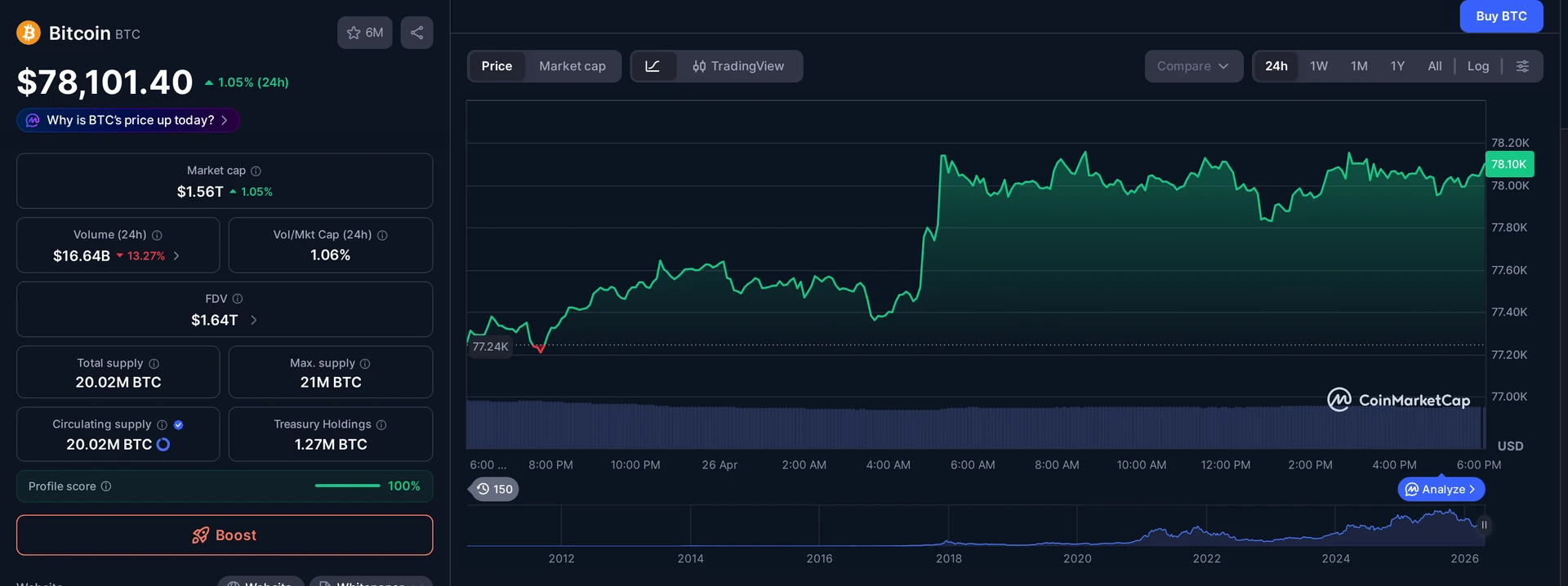
The current Bitcoin price action lines up almost perfectly with the Hyperliquid signal. February’s lows in the mid-$60,000s came right before the early-March whale flip. The grind through March and April carried spot back into the $70,000s, then to a brush of $80,000 earlier this week. Two months of higher lows, no panic flush, and a funding curve that punishes the short side daily.
Hyperliquid’s role in this chart matters. The venue has eaten meaningful share from centralized perpetual exchanges over the past year because it offers deep books, transparent on-chain settlement, and no withdrawal friction for size. When the largest accounts there hold a directional view for two months, that view tends to lead spot by days to weeks, not follow it. The March flip preceding the recovery is the cleanest example.
There is a counter-read worth flagging. Aggressive whale longs at a dataset extreme are also a contrarian signal in some regimes. If price fails to break the recent high and rolls over, those longs become the fuel for a long squeeze instead of a short squeeze. The same leverage that pushes Bitcoin into six figures can dump it back to the low $70,000s if the bid disappears.
Sustained negative funding matched with aggressive long positioning from Hyperliquid whales is the technical setup that produces short squeezes when spot prices break higher.
The Macro Backdrop That Could Push This Either Way
Bitcoin is not trading in a vacuum. The S&P 500 closed at a record high on Friday, capping its longest weekly advance since 2024. Risk assets have been in coordinated bid mode, and crypto tends to amplify whatever direction equities pick.
Geopolitics added a wrinkle this weekend. Talks between Iran and the U.S. that were scheduled in Pakistan never happened. President Donald Trump canceled his delegation’s trip to Islamabad after the Iranian foreign minister left the country before the U.S. group set off. Headlines like that usually inject volatility into oil, gold, and Bitcoin in roughly that order.
On the rates side, Treasury yields dropped after the Justice Department closed its probe into Federal Reserve Chair Jerome Powell, potentially clearing the path for Kevin Warsh‘s confirmation as the next Fed leader. Lower yields plus a more dovish Fed lean is the cleanest tailwind Bitcoin can ask for at this stage of the cycle.
Stack those three together. Equities at all-time highs, geopolitical risk that historically helps Bitcoin’s monetary narrative, and a softer rates picture. If the Hyperliquid whales were sitting on this trade for two months waiting for a setup, the macro just handed them one.
What Comes Next for Bitcoin Holders
Two numbers to watch over the coming hours and days. The first is $80,000. A clean break with rising volume is the trigger that turns the whale long thesis from a positioning story into a price story. The second is funding. If the seven-day rate flips positive even briefly, that signals shorts have capitulated and the squeeze has fired. If funding stays at -0.13% or deeper while price grinds higher, the fuel tank is still full.
The risk case is straightforward. If $80,000 caps the move and Bitcoin rolls back into the low $70,000s, the long side starts paying funding for the first time in seven weeks, and the same whale concentration that looks bullish today becomes the overhang. Concentration cuts both ways.
For now, the data points in one direction. Two months of whale conviction, 47 days of paid-to-wait funding, and a spot chart making higher lows. The next move is up to the tape.
Frequently Asked Questions
What are Hyperliquid whale long positions?
Hyperliquid whale long positions are large bullish bets on Bitcoin perpetual futures placed by the biggest accounts on the onchain exchange Hyperliquid. Glassnode data shows this cohort flipped from net short to net long in early March 2026 and now sits at its most aggressively long reading on record.
Why is the Bitcoin perpetual funding rate negative for so long?
The Bitcoin perpetual funding rate is negative because more traders want short exposure than long exposure. The seven-day rate sits at -0.13%, and the streak has held for roughly 47 consecutive days. Shorts pay longs every eight hours, making it one of the longest bearish derivatives stretches on record.
What price level matters most for Bitcoin right now?
The $80,000 level is the key trigger. Bitcoin brushed it earlier this week after climbing from the mid-$60,000s in February. A clean break above $80,000 with volume would likely fire a short squeeze, because shorts trapped from lower levels would be forced to cover into thin liquidity above.
Does whale positioning on Hyperliquid actually predict Bitcoin's price?
Hyperliquid has become the onchain venue of choice for large traders over the past year, and a sustained long bias from whales there has historically led spot Bitcoin price action by days to weeks. The March 2026 flip to net long preceded the recovery from the mid-$60,000s, supporting the leading-indicator read.
This article is for informational purposes only and does not constitute investment advice. Every investment and trading decision involves risk. Readers should conduct their own research before making any financial decisions.