








































What to Know
- $53.40, Litecoin’s price on May 24, 2026, still 78% below its May 2021 all-time high of $410.26
- July 27, 2027, projected date of the next Litecoin halving, cutting the block reward from 6.25 LTC to 3.125 LTC
- Analyst Crypto Patel puts the odds of LTC reaching $1,000 at just 5% to 10%, requiring a multi-cycle institutional push into 2030
- Canary Capital filed a spot Litecoin ETF using Coinbase Custody and BitGo as regulated custodians, with the SEC formally acknowledging the filing
The Litecoin ETF debate and the 2027 halving have pushed LTC price targets back into the spotlight, splitting analysts between what the asset has going for it and what it keeps failing to deliver. Crypto analyst Crypto Patel recently laid out the full picture, assigning a realistic range of $150 to $300 for LTC between 2026 and 2028, while putting the probability of a $1,000 print at just 5% to 10%, with the asset still sitting 87% below its 2021 all-time high of $410.26.
Where Litecoin Stands Right Now
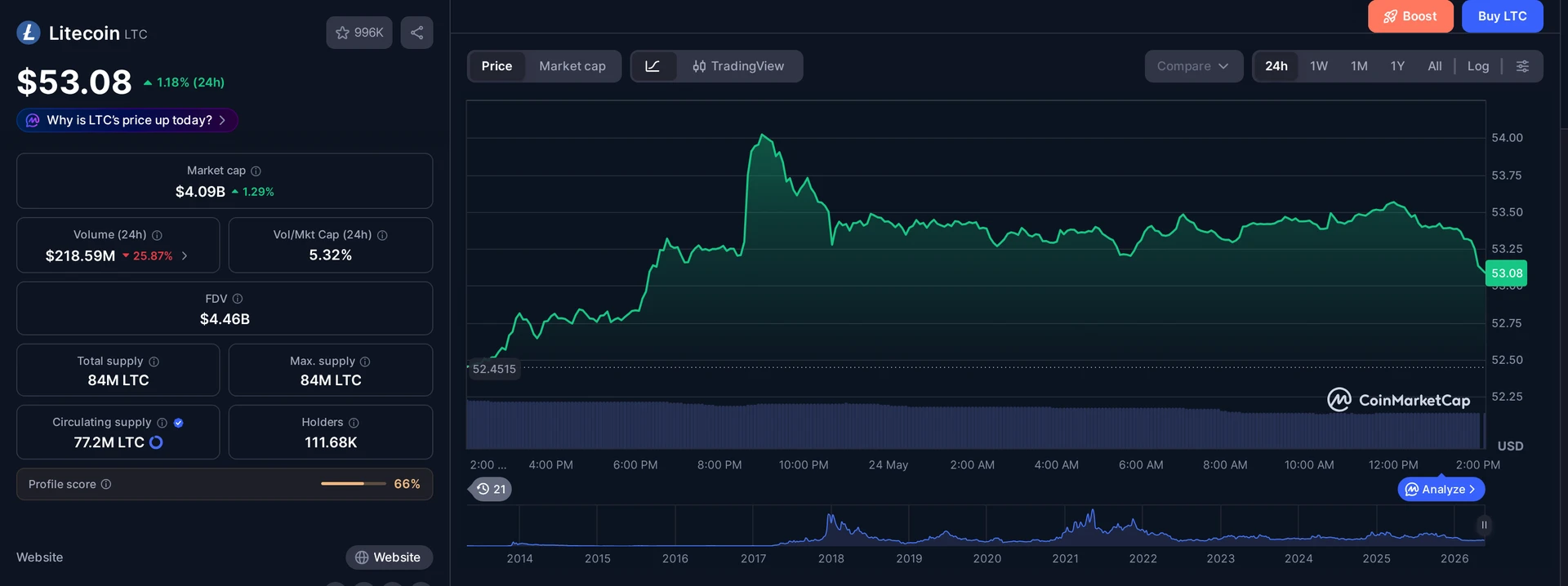
Litecoin traded at $53.40 on May 24, 2026, up 2.8% over 24 hours but down 5.32% over the prior week and 4.95% over 30 days, according to market data. Its market cap sat near $4.12 billion, placing it at rank #27 across all crypto assets. The 24-hour trading range ran between $51.95 and $54.04, with volume reaching about $205.46 million.
That puts Litecoin in a familiar spot: technically active, picking up minor daily gains, but going nowhere fast on a longer timeframe. The gap from its May 2021 all-time high of $410.26 is still massive, roughly 87% below that peak. That context is everything when reading analyst calls about where LTC could go next.
Crypto Patel described Litecoin as a patience trade. His words were direct: LTC is not a ‘100x rocket.’ His base case puts a realistic cycle peak somewhere in the $150 to $300 range through 2028, with an extension to $400 to $600 if broader market conditions turn strongly bullish. The $1,000 level is a different story entirely.
Can LTC hit $500? Possible in next bull cycle peak. For $1,000+, that requires multi-cycle thesis going into 2030+.
What Does the Litecoin ETF Actually Do?
The regulated access argument is the strongest card in the Litecoin bull case. Canary Capital’s Litecoin ETF is a classic spot product, it holds actual LTC through regulated custody partners Coinbase Custody and BitGo, giving investors a brokerage-based route to LTC exposure without the need to manage wallets, private keys, or exchange accounts.
The SEC formally acknowledged Litecoin ETF filings from Canary Capital, and separately recognized spot Litecoin filings from Grayscale and CoinShares. That acknowledgment does not mean approval, but it does put LTC alongside other assets that have moved through the regulatory pipeline. For retail and institutional investors who need a compliant wrapper, those filings matter.
But so far, the inflows tell a humbler story. During one notable session in November 2025, Solana, Hedera, and Litecoin ETF products posted inflows while Bitcoin and Ethereum ETFs saw outflows. Litecoin’s recorded inflow for that session was $855,880. That is not nothing, but it is a long way from the billions that shifted into Bitcoin ETF products in the months after their approval. That gap is exactly what Crypto Patel was pointing at when he said full institutional embrace has not arrived yet.
The 2027 Halving and the Litecoin Supply Picture
The Litecoin 2027 halving is projected for around July 27, 2027. When it happens, the block reward will fall from 6.25 LTC to 3.125 LTC, cutting new issuance in half. That is not a small change, it directly reduces the rate at which fresh LTC enters the market.
The supply picture already looks tight on paper. Litecoin’s circulating supply sits near 77.2 million LTC out of a hard maximum of 84 million, meaning more than 91% of all LTC that will ever exist has already been mined. The halving tightens that further. If demand rises through ETF inflows or exchange activity at the same time new supply drops, the math works in bulls’ favor.
The catch is that halvings do not create demand on their own. They reduce future issuance. Whether buyers actually show up depends on market sentiment, macro conditions, and whether LTC finds new use cases. Litecoin’s previous halvings, in 2015 and 2019, produced mixed price results. The 2019 halving in particular saw LTC run hard ahead of the event and pull back sharply afterward. History is not a reliable guide here.
Litecoin also carries MimbleWimble Extension Blocks, a privacy layer built into the protocol. MWEB lets users move coins into a parallel private block secured by the same miners, then return to the base chain when needed. It is an optional feature rather than a requirement. Whether that functionality attracts meaningful usage or raises regulatory red flags remains an open question.
Why $1,000 Is a Hard Math Problem
Crypto Patel ran the market cap numbers directly. At $500, Litecoin would need a fully diluted market cap of roughly $42 billion based on its maximum supply of 84 million coins. At $1,000, that figure reaches $84 billion. To put that in perspective, a $84 billion valuation would push Litecoin well above its current rank and into territory currently occupied only by the top five or six crypto assets.
Getting there would require a combination of major capital rotation into LTC, sustained ETF demand comparable to Bitcoin, renewed interest in LTC as a payments layer, and a broader bull market that lifts all assets. Crypto Patel put the odds of that scenario at 5% to 10% and explicitly tied it to a multi-cycle timeframe stretching past 2030. The $500 target he called ‘possible’ carried a 20% to 30% probability, which is still a minority view.
The competitive landscape makes the bull case harder. Litecoin built its original reputation as a faster, cheaper version of Bitcoin for payments. That story has aged poorly. Stablecoins like USDT and USDC now handle fast dollar transfers across multiple networks, often with lower volatility and more predictable settlement. For merchants and users who just want to move money quickly, Litecoin’s volatility works against it.
Smart contract networks like Ethereum and Solana pull institutional and developer attention toward yield, DeFi, and application platforms. Litecoin has none of that. It runs a simple proof-of-work chain with fixed supply and long uptime, and its supporters will tell you that simplicity is the point. For critics, it is exactly what limits LTC’s ceiling.
There are real positives. Litecoin has been running for more than 14 years, making it one of the oldest proof-of-work networks in existence. It has low fees, predictable issuance, and a fully auditable supply. Coinbase added LTC alongside XRP, DOGE, and ADA as collateral for USDC loans through Morpho, giving eligible users a way to borrow against their holdings without selling. That kind of integration inside regulated products keeps Litecoin relevant even if it never becomes a DeFi hub.
The $1,000 question is ultimately a question about timing and capital. Litecoin has the structural arguments, capped supply, halving mechanics, ETF access, long operating history. What it does not have, yet, is the demand flow to validate those arguments at the price levels bulls are hoping for.
Frequently Asked Questions
What is the Litecoin 2027 halving and when does it happen?
The Litecoin halving is a scheduled protocol event that cuts the block reward paid to miners in half. The next halving is projected for around July 27, 2027, when the reward drops from 6.25 LTC to 3.125 LTC. This reduces the rate of new LTC entering circulation, which supporters argue supports price over time.
Can Litecoin reach $1,000?
Analyst Crypto Patel puts the probability at 5% to 10%, calling it a multi-cycle scenario dependent on full institutional adoption beyond 2030. At $1,000, Litecoin’s fully diluted market cap would reach $84 billion based on its 84 million maximum supply. That would require major capital rotation, sustained ETF inflows, and a strong broader market.
What is the Canary Capital Litecoin ETF?
Canary Capital filed a spot Litecoin ETF that holds actual LTC through regulated custody partners Coinbase Custody and BitGo. It gives investors a brokerage-based route to LTC without managing wallets or exchange accounts. The SEC formally acknowledged the filing, along with similar filings from Grayscale and CoinShares, but has not yet approved them.
How much Litecoin is left to mine?
Litecoin has a hard maximum supply of 84 million LTC. As of May 2026, approximately 77.2 million LTC were in circulation, meaning more than 91% of the total supply has already been mined. The remaining supply will be released gradually through block rewards, which are cut in half at each halving event.
This article is for informational purposes only and does not constitute investment advice. Every investment and trading decision involves risk. Readers should conduct their own research before making any financial decisions.


















Patel’s 5 to 10 percent odds seem fair to me. The Canary Capital filing matters more for liquidity than price, and the 2027 halving barely dents supply since LTC inflation is already pretty low. What float assumption are people even using to get to $1,000?
A $1,000 target needs roughly a 13x from here. Nobody pushing that number ever explains where the demand actually comes from once the ETF launch hype wears off.
An LTC spot ETF plus the halving landing in the same window is exactly the setup I was hoping for. Even if $1k is a long shot, just reclaiming the old $400 zone would be huge for a coin most people had written off.
5 percent odds and folks are already calling for $1k lol
Been holding since the sub $3 days back in 2015 and I’ve watched LTC get hyped into every halving. 2015, 2019, 2023, same pattern each time: a run into the event, then a long slow bleed after. The ETF angle is genuinely new this round though. Does anyone here actually think institutional flows break that post halving fade, or do we just leak out like always?