







































What to Know
- Bitcoin is up roughly 13.6% in April, on pace for its strongest monthly gain since early 2025.
- Tether minted about $5 billion of fresh USDT in two weeks, pushing total supply near $150 billion.
- The $79,000 level is acting as a ceiling, with traders watching the April Fed meeting for the next cue.
- Wintermute’s desk says markets have stopped flinching at Middle East headlines, a mix of fatigue and complacency.
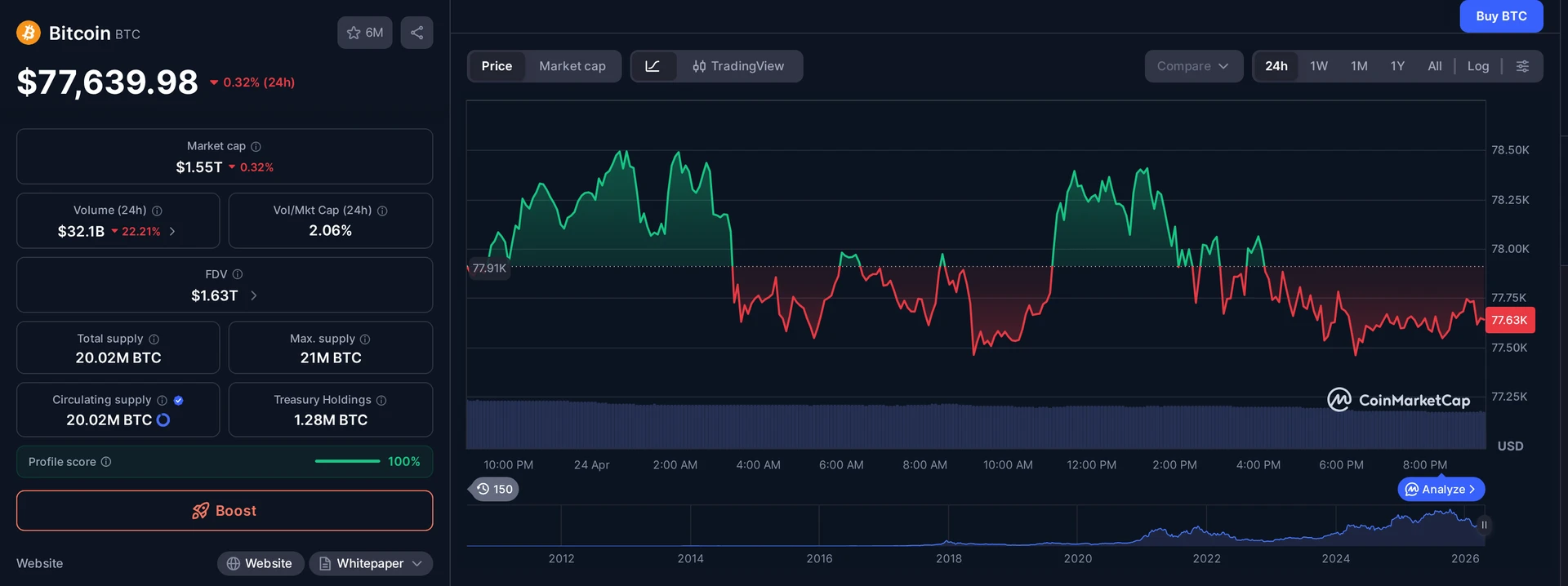
Bitcoin best month in a year territory is here, and the engine behind the move is not ETF fanfare or a fresh corporate treasury announcement. It is plumbing. BTC held above $77,000 into Friday, consolidating after punching to its strongest level since early February earlier in the week, while Tether’s dollar token quietly printed fresh supply at a pace the market has not seen since the last serious leg higher. The largest cryptocurrency is up roughly 13.6% in April, its best monthly performance in a year on CoinGlass data, and traders are finally letting themselves say the word rebound out loud.
Bitcoin Best Month in a Year: What Is Powering the Rally
Put this in context. Crypto just exited its longest losing streak since 2018, with consecutive monthly declines from October through February turning every rally attempt into a fade. Portfolios went quiet. Funding went flat. You could feel the exhaustion on every timeline that usually screams at green candles. Then April arrived and the tape simply stopped behaving the way it had for half a year.
The macro backdrop did most of the heavy lifting early. U.S. equities staged a sharp recovery, with the S&P 500 and Nasdaq clawing back to record highs after a brief detour into correction territory. Risk appetite returned before the crypto narrative did, which is usually how these turns work. Bitcoin followed, then led, then settled into a range near the top of its recent band.
The specifically crypto part of the story is the Tether supply expansion. Circulating USDT has pushed to just under $150 billion, adding roughly $5 billion across the past two weeks after months of near-stagnation. That is not a rounding error. That is a wall of fresh stablecoin capital showing up on exchanges during the exact window bitcoin decided to stop falling.
What Does Tether’s $5 Billion Mint Actually Mean?
Short answer first. Stablecoins are the working capital of crypto markets. When Tether issues more USDT, traders on exchanges suddenly have more dry powder parked in dollar-pegged tokens they can swap for bitcoin, ether, or anything else. Analysts routinely read that expansion as a cue that capital is flowing into the asset class, not out of it.
Look at the on-chain leg. The dominant deployment of Tether’s dollar-pegged token lives on Ethereum, where USDT on Etherscan shows circulating supply grew by roughly $5 billion over the past two weeks. That is money moving to the edge of the trading system, not sitting idle in a treasury account.
The timing lines up too cleanly to ignore. Months of flat Tether supply paired with a bitcoin downtrend. Two weeks of aggressive minting paired with BTC printing its best month in twelve. You can argue about correlation versus causation all afternoon, but the order of operations is hard to dismiss.
The equities and crypto markets seem to have stopped caring about intricate headlines on the conflict’s direction. This shows a certain level of fatigue and potentially complacency.
The $79,000 Ceiling Everyone Is Watching
Not every chart on desks is green. The $79,000 level has turned into a hard cap this week, with traders taking profits every time BTC tags the zone. That is not random. It is structural.
Adam Haeems, head of asset management at Tesseract Group, said the level matters because heavy institutional overhead supply sits just above it. Translation: funds that bought higher during past cycles are waiting at that price, and the market has to eat through them before the next leg.
Whether bitcoin actually punches through depends less on how hard buyers push and more on who those buyers are. Short covering rallies look identical to real breakouts for about 48 hours. Then the short covering ones fade. A breakout fueled by sustained institutional demand, on the other hand, tends to turn resistance into support and stick.
- Short-covering squeezes fade once momentum cools, per Haeems
- Institutional bids backed by spot ETF inflows tend to hold
- A clean break of $79,000 flips the level into support
- Failure keeps BTC boxed in the $75,000 to $77,000 range
The April Fed Meeting Is the Next Real Test
Here is the pivot point. The April Fed meeting lands in the middle of this setup, and Haeems said it could decide whether the current rally holds or hands back its gains. Rate policy is not the only variable, but it is the loudest one.
If spot ETF inflows keep grinding higher through the meeting, $79,000 stops being resistance and starts being a floor, which opens the door to a higher trading range. If flows stall, the path of least resistance drops bitcoin back into the $75,000 to $77,000 band that capped most of early spring.
The honest read is that macro has done its part. Equities are at record highs. Stablecoin supply is expanding. The piece still missing is sustained institutional bid above $79,000 on a closing basis, not just an intraday poke.
Geopolitics: The Risk Markets Have Decided to Ignore
Geopolitical tensions in the Middle East have not resolved. Uncertainty around the Iran conflict persists. Oil prices remain elevated. By the old playbook, any of those alone would be enough to cap a risk-on rally.
For now, markets are looking straight through it. De Maere called out the pattern bluntly: traders have stopped flinching at every new headline, which can read as resilience or as complacency depending on your priors. Strong corporate earnings and well-behaved equity indices are doing the offset work, absorbing what would otherwise be a drag on sentiment.
Call it pragmatism, call it denial. Either way, it is the current mood. And while the mood holds, bitcoin gets to keep writing its best month in twelve.
What This Rally Actually Proves
One clean takeaway. Crypto is not rallying because of a single catalyst. It is rallying because multiple pieces clicked into place at the same time. Equity markets recovered. Stablecoin issuance resumed. The longest losing streak since 2018 finally exhausted itself. Traders bored of defensive positioning started putting capital back to work.
The cynical read is that this is a relief rally dressed up as a regime change, and the $79,000 rejections are the market telling you exactly that. The optimistic read is that Tether’s $5 billion mint is the early signal of real capital coming back, and the resistance is just the overhang before the next leg.
Both can be true at the same time for a few weeks. The Fed meeting is where the market has to pick one.
Frequently Asked Questions
Why is bitcoin having its best month in a year?
Bitcoin is up about 13.6% in April, its strongest monthly gain since early 2025, on the back of a U.S. equity rebound, roughly $5 billion of fresh Tether supply hitting exchanges, and the end of a losing streak that stretched from October through February.
How does Tether's supply growth affect bitcoin's price?
Stablecoins act as trading capital on crypto exchanges. When Tether mints new USDT, traders have more dollar-pegged liquidity to deploy into bitcoin and other assets. Analysts read sustained supply expansion as a cue that capital is rotating into crypto, which typically supports higher prices over short windows.
What happens if bitcoin breaks $79,000?
Adam Haeems of Tesseract Group says a sustained break of $79,000 backed by institutional demand would likely flip the level from resistance into support, opening a higher trading range. A failed attempt driven mainly by short covering would instead send bitcoin back into the $75,000 to $77,000 band.
Why does the April Fed meeting matter for bitcoin?
The Fed decision arrives during a fragile rally. If spot ETF inflows continue through the event, traders expect the $79,000 ceiling to hold as support. If flows fade around the announcement, bitcoin risks losing its April gains and slipping back into the lower range that capped price action in early spring.
This article is for informational purposes only and does not constitute investment advice. Every investment and trading decision involves risk. Readers should conduct their own research before making any financial decisions.