









































What to Know
- SpaceX filed its S-1 with the SEC, disclosing it holds 18,712 BTC worth approximately $1.45 billion
- The company bought its Bitcoin at a cost basis of $35,000 per coin and is now sitting on paper gains of roughly $789 million
- SpaceX is targeting a Nasdaq listing under ticker SPCX at a private-market valuation of $1.75 trillion
- Under new FASB fair-value accounting rules active since late 2025, SpaceX must report Bitcoin gains and losses every quarter
The SpaceX IPO Bitcoin treasury disclosure confirmed Wednesday what the market had long suspected: Elon Musk’s rocket company is carrying $1.45 billion in BTC into the public markets. The S-1 submitted to the Securities and Exchange Commission shows SpaceX holds 18,712 BTC, making the company the seventh-largest known corporate Bitcoin holder on the planet, ahead of Coinbase, just as it prepares to list publicly on Nasdaq under the ticker SPCX.
SpaceX IPO Bitcoin Treasury: What the S-1 Filing Shows
The SpaceX S-1 filing 18712 BTC balance sheet shows a position built at a cost basis of $661 million, or about $35,000 per coin. That entry price is notable: $35,000 is roughly where Bitcoin traded in late 2023, meaning SpaceX held through the entire bull run without selling its core stack.
Arkham Intelligence had tracked the SpaceX stash as low as 6,095 BTC at one point in the past year. The S-1 settled the debate with a confirmed figure of 18,712 coins held as of December 31, 2025. Someone bought more along the way. The S-1 doesn’t say exactly when, but the cost basis math points to accumulation well below current market prices.
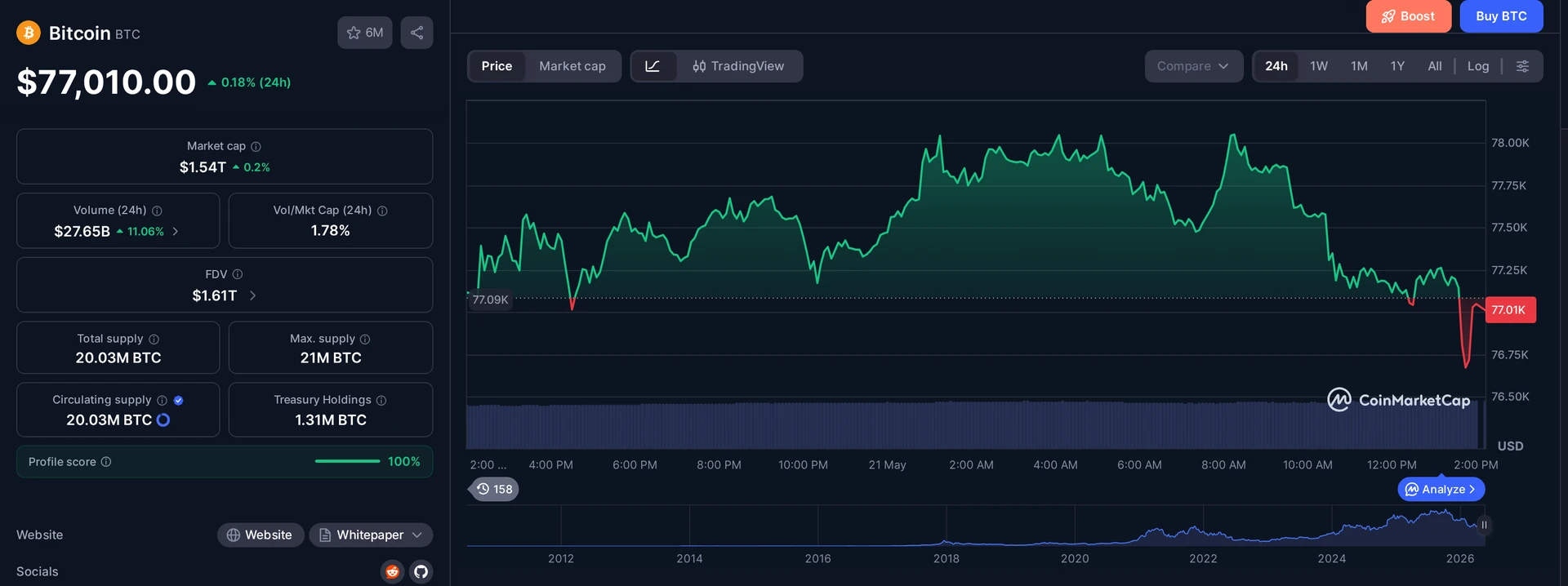
With Bitcoin trading above $77,000 at time of filing, SpaceX carries unrealized paper gains of approximately $789 million on that stack. That is nearly half again what it paid. For a company pulling in $18.7 billion in annual revenue, the Bitcoin line is a small percentage of the balance sheet, but the disclosure itself is the story.
What Does the SpaceX Nasdaq IPO Mean for Bitcoin Markets?
Does the SpaceX IPO push Bitcoin higher?
The short answer: it adds a new publicly traded company with a multi-billion-dollar Bitcoin exposure that every index fund, ETF, and retail investor will now be able to track in real time. That matters for price discovery and institutional legitimacy in ways that private holdings never could.
The SpaceX IPO Nasdaq SPCX 1.75 trillion valuation gives the company a private-market price tag larger than Tesla by market capitalization. If that valuation holds at listing, SpaceX would become the largest public company to carry Bitcoin as a balance-sheet asset, surpassing Tesla and sitting second only to Strategy Inc. in absolute Bitcoin exposure among public companies.
Strategy Inc. still dominates that leaderboard by a wide margin, holding more than 843,000 BTC worth north of $64 billion. SpaceX’s 18,712 BTC is a fraction of that. But the company’s sheer size and global brand recognition mean the disclosure lands differently than most corporate treasury announcements. When a $1.75 trillion company says it holds Bitcoin, the conversation shifts.
Tesla, which Musk also leads, disclosed holding more than 11,000 bitcoins in its most recent quarterly filing, valued at close to $900 million. When SpaceX lists, Musk will control two separate public companies each carrying Bitcoin on their books. That is a first.
FASB Fair Value Rules Force Full Bitcoin Transparency
Here is where the regulatory picture gets important for anyone watching corporate Bitcoin adoption. The FASB fair value crypto accounting bitcoin 2025 standard, which took effect in late 2025, requires public companies to mark their crypto holdings at fair market value every reporting period.
Before these rules existed, companies could hold Bitcoin at cost and ignore price swings entirely, or only write down losses, never up. That era is over. SpaceX will now report its 18,712 BTC position every quarter, with unrealized gains and losses flowing straight into its income statement.
That creates a two-sided exposure. When Bitcoin runs, SpaceX’s quarterly earnings look better. When Bitcoin drops hard, those same earnings take a hit. Tesla learned this firsthand in 2022 when it sold the bulk of its Bitcoin holdings partly to avoid ongoing earnings volatility. SpaceX’s decision to carry a larger Bitcoin stack into the public markets suggests Musk is comfortable with that trade-off, or at least willing to bet investors will be.
The quarterly disclosure requirement also means that institutional investors who previously had no window into SpaceX’s crypto exposure now get a fresh data point every three months. That level of transparency is exactly what Bitcoin advocates have pushed for. It also means any future accumulation or reduction in the stack becomes immediate public information.
SpaceX Bitcoin History: From 2021 Purchase to 2026 IPO
SpaceX’s Bitcoin story starts in 2021, when Musk added cryptocurrency to the company’s financial assets around the same time Tesla made its own $1.5 billion purchase. The two moves came within months of each other and reflected a moment when Musk was the loudest corporate voice in the Bitcoin conversation.
The path from 2021 to the current 18,712 BTC position was not a straight line. Holdings appeared to dip significantly, Arkham Intelligence flagged the stash at roughly 6,095 BTC at one point last year. Whether SpaceX sold and bought back, or whether on-chain attribution was simply incomplete, the S-1 now gives the definitive number: 18,712 coins, with a blended purchase price around $35,000 each.
SpaceX posted $18.7 billion in total revenue in 2025. Starlink alone contributed $11.39 billion of that. The satellite internet business is the growth engine Wall Street will price the IPO around. Bitcoin is a side note in the income statement, but not in the narrative. For the crypto community, a company with a $1.75 trillion valuation disclosing a $1.45 billion Bitcoin position is the most consequential corporate crypto story of the year.
Corporate Bitcoin adoption has accelerated since Strategy Inc. built its massive position, but SpaceX is a different kind of company. It generates real revenue, operates critical infrastructure, and is tied directly to government contracts. Its decision to hold Bitcoin alongside all of that signals something about where the asset stands in the eyes of major institutional operators, not just pure-play investment vehicles.
- 2021: SpaceX first adds Bitcoin to balance sheet alongside Tesla’s $1.5B purchase
- Late 2024: Arkham Intelligence tracks SpaceX holdings as low as 6,095 BTC
- December 31, 2025: S-1 confirms final position of 18,712 BTC at $661M cost basis
- May 2026: S-1 filed with SEC ahead of Nasdaq listing under ticker SPCX
- Current: Unrealized paper gains of approximately $789 million on the Bitcoin stack
Where SpaceX Ranks Among Corporate Bitcoin Holders
The S-1 places SpaceX seventh on the global list of known corporate Bitcoin holders. That ranking puts it ahead of Coinbase, which is itself a crypto-native business. Most of the companies above SpaceX on that list built their positions specifically as a treasury strategy. SpaceX arrived at the same destination through a different path: an aerospace and satellite company that simply never sold.
Strategy Inc. leads by an enormous margin with more than 843,000 BTC. The gap between first place and seventh is vast. But the significance of SpaceX’s position is not the size of the stack relative to Strategy, it is the size of the company carrying it. A $1.75 trillion firm going public with Bitcoin on its books changes how fund managers, regulators, and retail investors think about the asset class.
The IPO itself is expected to be one of the largest in U.S. market history given SpaceX’s private-market valuation. Bitcoin will be a footnote in the prospectus to most analysts. To the crypto community, it is the headline.
Frequently Asked Questions
How much Bitcoin does SpaceX hold?
SpaceX holds 18,712 BTC as of December 31, 2025, according to its S-1 filing with the Securities and Exchange Commission. The position was purchased at a cost basis of approximately $661 million, or roughly $35,000 per coin, and is currently valued at about $1.45 billion.
What is the SpaceX IPO ticker symbol and where will it list?
SpaceX plans to list on the Nasdaq stock exchange under the ticker symbol SPCX. The company filed its S-1 registration statement with the SEC in May 2026. Its private-market valuation stands at $1.75 trillion, which would make it one of the largest public listings in U.S. market history.
Why does the FASB fair value rule matter for SpaceX Bitcoin?
Under FASB fair-value accounting rules that took effect in late 2025, SpaceX must report unrealized Bitcoin gains and losses in every quarterly filing. This means Bitcoin price swings will directly affect its reported earnings, making the $1.45 billion position visible and volatile on its public income statement every three months.
Is SpaceX the largest corporate Bitcoin holder?
No. SpaceX ranks seventh among known corporate Bitcoin holders with 18,712 BTC. Strategy Inc. leads with more than 843,000 BTC worth over $64 billion. Tesla, also led by Elon Musk, holds more than 11,000 BTC. SpaceX’s position is notable because of the company’s enormous $1.75 trillion valuation, not the size of the stack.
This article is for informational purposes only and does not constitute investment advice. Every investment and trading decision involves risk. Readers should conduct their own research before making any financial decisions.








18,712 BTC at avg cost basis would tell us a lot more than the $1.45B figure. Anyone seen if Musk disclosed acquisition timing in the filing, or is it just the mark to market number?
spcx ticker at $1.75T valuation feels rich when half the bitcoin position could swing 20% in a week
Been around since Microstrategy first loaded up in 2020 and watched every corp treasury play since. SpaceX going public with BTC on the books is different though, this is the first time a private space giant brings crypto into a mainstream IPO prospectus. Retail demand for SPCX will be insane.