








































What to Know
- Strategy sold 32 BTC between May 26 and May 31 at an average price of $77,135 per coin, totaling $2.5 million
- The proceeds go toward distributions on Strategy’s preferred stock, marking the first standalone disclosed bitcoin sale in an 8-K filing
- The same filing confirmed a purchase of 2,395 BTC, making Strategy a net buyer despite the sale
- Strategy held 843,706 bitcoin at a blended average purchase price of $75,699 as of May 31, 2026
The Strategy bitcoin sale of 32 BTC for $2.5 million in late May 2026 is getting more attention than the small dollar figure deserves. The company disclosed the transaction in an 8-K filing on Monday, June 1. Average net price: $77,135 per coin. Total proceeds: $2.5 million. Purpose: funding distributions on its preferred stock. And yet, this is the same company sitting on 843,706 bitcoin. The optics are strange. The math is not.
What the 8-K Filing Actually Says
Strategy filed an 8-K on Monday disclosing two separate bitcoin transactions that took place during the same week. The first: a Strategy bitcoin sale of 32 BTC between May 26 and May 31 at an average net price of $77,135 per coin, generating $2.5 million in proceeds. The second, buried a few lines lower: the purchase of Strategy 32 bitcoin sale preferred stock distributions May 2026 2,395 BTC during the same period. The company is a net buyer by a wide margin.
The proceeds from the sale are earmarked specifically for distributions on Strategy’s preferred stock, according to a footnote in the filing. This is a narrow, defined purpose. The company did not liquidate bitcoin to cover operational costs, buy back equity, or fund new acquisitions. It sold a sliver of its holdings to meet an obligation it already had on the books.
The 8-K also disclosed that Strategy raised $128.3 million through its at-the-market ATM common stock program during the week. A small portion of those proceeds went toward bumping its U.S. dollar cash reserve from $871 million to $900 million. The rest presumably feeds back into the broader treasury strategy.
Is This Really the First Strategy Bitcoin Sale on Record?
Not exactly. The company sold bitcoin before. Near the bottom of the 2022 bear market, Strategy offloaded 704 BTC at roughly $18,000 per coin. That transaction came bundled in a filing alongside a purchase of 2,395 BTC, which framed it as a tax-loss harvesting move rather than a distressed sale. Strategy remained a net buyer in that case too.
What makes the latest transaction different is the filing structure. According to the 8-K, this appears to be the first time Strategy has disclosed a net bitcoin sale as a standalone item in an 8-K, and the first time the company has publicly flagged a bitcoin sale on its own website. That distinction matters more from a transparency standpoint than from a balance sheet standpoint.
The Strategy bitcoin tax-loss harvesting 2395 BTC net buyer dynamic is worth sitting with. Selling 32 coins while buying 2,395 in the same reporting window is not a pivot away from bitcoin accumulation. It looks more like portfolio hygiene dressed up in preferred stock obligations.
Call it pragmatic. Call it a rounding error on a 843,706-coin stack. Either way, Strategy did not blink.
Bitcoin Dropped and Futures Got Wiped Out. Are the Two Connected?
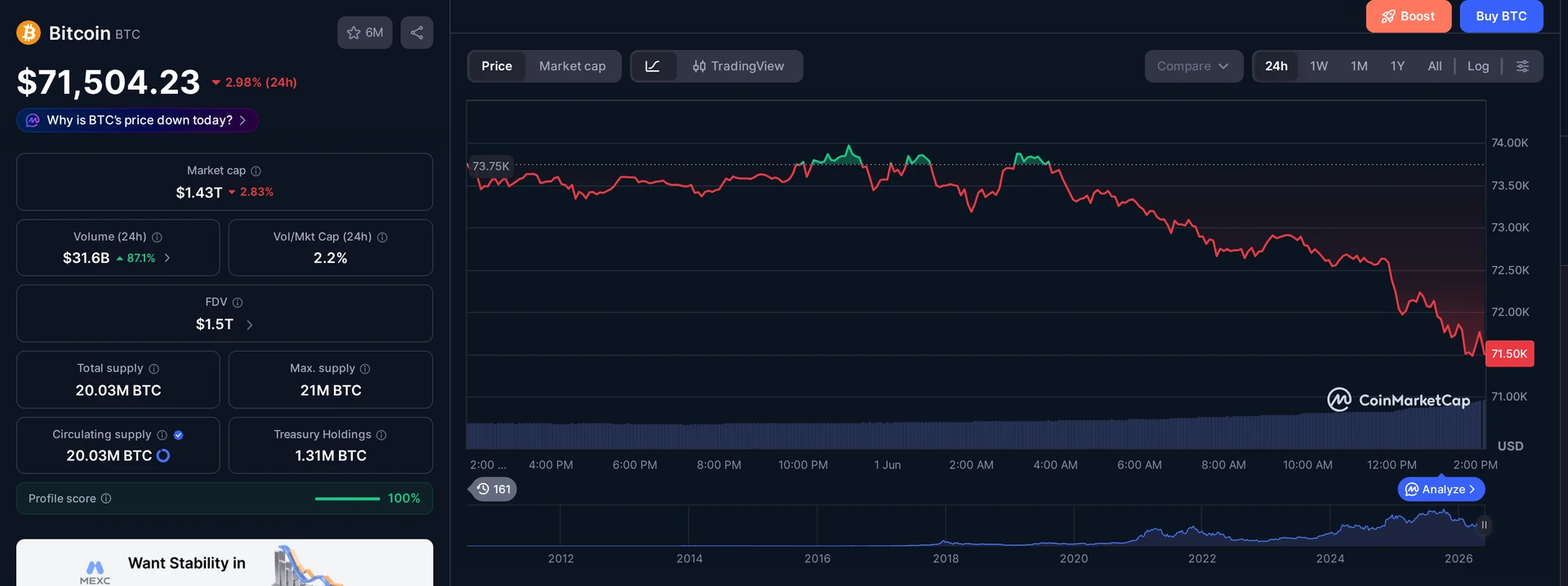
Bitcoin briefly fell under $72,000 around the time the filing hit. The timing raised eyebrows. Shortly after, bitcoin futures liquidations $90 million May 2026 data showed over $90 million in BTC-tracked futures positions got wiped out. Traders using leverage got caught on the wrong side.
Pinning that liquidation event directly on the Strategy news would be a stretch. Moves of that size in bitcoin usually have several triggers stacking on top of each other. But the filing landed during an already shaky week for crypto markets, and the headline of a Strategy bitcoin sale, however small, was enough to feed the fear cycle.
The broader market context matters here. Crypto markets had been struggling even as risk assets in equities climbed higher globally. Bitcoin under $72,000 at a moment when the S&P 500 was holding gains is the kind of divergence that makes long-term holders nervous and leveraged traders reckless. The $90 million in liquidations reflects that tension, not just one filing from one company.
What Does This Mean for Strategy’s Bitcoin Holdings?
Strategy held 843,706 bitcoin as of May 31, 2026. The blended average purchase price across all those coins is $75,699. The 32 coins sold in late May went out at $77,135 each, so the sale price cleared the average cost basis. Strategy did not sell at a loss. It sold above its average entry, met a preferred stock distribution obligation, and added more bitcoin in the same week.
The company had also previously tapped $1.5 billion of its 2029 convertible notes after depleting a substantial portion of its cash holdings, which adds some context to why maintaining cash reserves matters. Letting the dollar reserve slip too far while holding that much bitcoin and those fixed obligations is a risk management problem, not just an accounting exercise.
For investors watching MSTR, the key figure is the net position change, not the gross sale. The company added roughly 2,363 BTC net during the week of May 26 to May 31, even after the sale. The bitcoin strategy is intact. The preferred stock is getting paid. The cash reserve is back above $900 million. None of that screams reversal.
What it does say is that managing a treasury of this size requires actual treasury operations. You cannot hold 843,706 BTC and expect zero friction along the way. Preferred distributions, convertible note management, ATM programs, cash buffers. These are the levers of a company that has chosen bitcoin as its primary asset but still has to function as a public company with shareholders, obligations, and a balance sheet that regulators read.
Why Does the Market React So Hard to Small Bitcoin Sales?
The outsized reaction to a 32-coin sale from a company with over 843,000 coins reveals something about market psychology more than anything else. Strategy has become a proxy for bitcoin conviction. When it buys, traders read confidence. When it sells anything at all, even a fraction of a percent of holdings, the reflex is to question the thesis.
Michael Saylor has spent years building Strategy into the most visible corporate bitcoin holder in the world. That reputation creates a sensitivity that no other corporate treasury has. A pension fund selling 32 bitcoin would not move markets. Strategy selling 32 bitcoin gets CoinDesk coverage and futures liquidations in the same breath.
The company’s overall position remains one of the largest single concentrations of bitcoin outside of known exchange wallets and sovereign holdings. At 843,706 BTC and an average cost of $75,699, the portfolio is worth well north of $60 billion at recent prices. Thirty-two coins sold for preferred stock distributions is less than 0.004 percent of that. The story is not the sale. The story is what the market decided the sale meant.
Frequently Asked Questions
Why did Strategy sell 32 bitcoin in May 2026?
Strategy sold 32 BTC between May 26 and May 31 to fund distributions on its preferred stock, according to its 8-K filing. The sale generated $2.5 million at an average price of $77,135 per coin. The company also bought 2,395 BTC during the same period, remaining a net buyer.
Is Strategy still a net bitcoin buyer after the May 2026 sale?
Yes. The same 8-K filing that disclosed the 32-coin sale also reported the purchase of 2,395 BTC during the same week. Strategy held 843,706 bitcoin as of May 31, 2026, at a blended average price of $75,699 per coin. The net position increased despite the sale.
Has Strategy ever sold bitcoin before?
Yes. Near the bottom of the 2022 bear market, Strategy sold 704 BTC at roughly $18,000 per coin, alongside a simultaneous purchase of 2,395 BTC in what was framed as a tax-loss harvesting exercise. The May 2026 sale is notable as the first disclosed net sale in a standalone 8-K filing.
What happened to bitcoin futures after Strategy's filing?
Bitcoin briefly fell under $72,000 around the time the 8-K was filed, and over $90 million in BTC-tracked futures positions were liquidated shortly after. Analysts attributed the volatility to several overlapping factors, with the Strategy filing adding pressure to an already weak market week.
This article is for informational purposes only and does not constitute investment advice. Every investment and trading decision involves risk. Readers should conduct their own research before making any financial decisions.


















selling 32 BTC to fund preferred stock divs feels like a tail wagging the dog. 843k stack is fine but the financing structure is what people should be watching, not the headline number.
wait so they’re trimming BTC to pay STRK/STRF holders? someone do the math on how sustainable that is if btc chops sideways for two quarters
been here since the 2022 Saylor buying spree and this is the first real outflow I remember seeing on an 8-K. cycles always end with the loudest bull becoming a seller, even if it’s just 32 coins.