








































What to Know
- $3.45 billion left U.S. spot Bitcoin ETFs over 11 consecutive trading days, the longest outflow streak since November 2025
- BlackRock’s IBIT shed $440.3 million on Monday alone, accounting for the bulk of the day’s $483.8 million total outflows
- Strategy disclosed selling 32 BTC for roughly $2.5 million in a Form 8-K filing, breaking its long-standing hold-only policy
- More than $388 million in leveraged long positions were liquidated as BTC dropped to an overnight low near $70,200
Bitcoin ETF withdrawals just hit a milestone that should worry anyone holding BTC. U.S. spot Bitcoin exchange-traded funds recorded $483.8 million in net redemptions on Monday, stretching a withdrawal streak to 11 consecutive trading days and pushing cumulative outflows during that run to $3.45 billion, according to data from SoSoValue. The selloff didn’t arrive from one direction, it came from everywhere at once.
Bitcoin ETF Withdrawals Top $3.45 Billion in 11-Day Streak
BlackRock’s IBIT was responsible for most of the damage on Monday, with BlackRock IBIT 440 million single-day outflows totaling $440.3 million, nearly 91% of the day’s total net outflows across all U.S. spot BTC ETFs. That’s not a rotation. That’s a rout.
Among all the funds tracked, only Morgan Stanley‘s MSBT managed to attract fresh capital, pulling in a modest $6.14 million. Every other fund posted net zero or net negative. The contrast is striking: one small fund swimming upstream while the rest of the market flushes capital out the door.
This is what the 11-day losing streak looks like up close. The cumulative $3.45 billion in outflows during this stretch eclipses May’s already ugly picture, the funds recorded $2.43 billion in net redemptions across the full month of May, their largest monthly outflow since November 2025. Monday’s single-day figure alone represents roughly 20% of May’s entire monthly total.
Why Did BTC Drop Below $71,000 on Monday?
What caused Bitcoin to fall below $71,000?
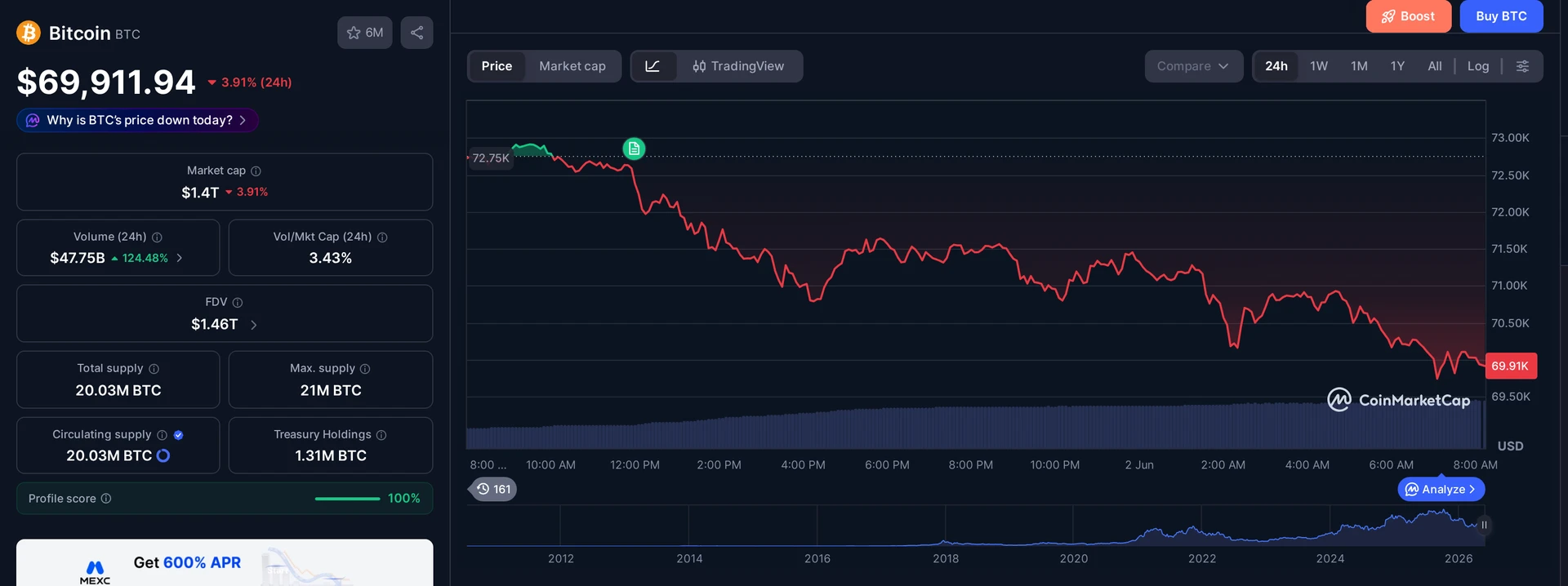
Bitcoin fell below $71,000 on Monday, touching an overnight low near $70,200 before recovering slightly to around $70,750. The cryptocurrency was down 3.6% over the prior 24 hours, a meaningful single-day drop that triggered a wave of forced selling in derivatives markets.
Three distinct pressure points converged. First, the ETF outflows themselves created a persistent bid-side vacuum. When the largest institutional vehicles for BTC exposure are consistently selling, spot markets feel it. Second, geopolitical headlines hit risk appetite hard: Iran suspended negotiations with the United States following Israel’s military operations in Lebanon, injecting fresh uncertainty into global markets. U.S. President Donald Trump pushed back on the narrative, posting on Truth Social that talks were still moving forward.
“Talks are continuing, at a rapid pace, with the Islamic Republic of Iran,” Trump wrote on Truth Social on Monday.
Third, and this one deserves more attention than it’s getting, Strategy broke a long-standing promise. The company, once the loudest institutional voice for holding Bitcoin forever, disclosed in a regulatory filing that it had sold BTC for the first time in years.
Talks are continuing, at a rapid pace, with the Islamic Republic of Iran.
Strategy’s 32 BTC Sale Rattled Market Confidence
Call it symbolic, call it a canary, either way, Strategy’s Form 8-K was a gut punch for Bitcoin bulls. According to the Strategy 32 BTC sale Form 8-K May 2026 filed with the SEC, the company sold 32 BTC between May 26 and May 31 at an average price of $77,135, generating approximately $2.5 million in proceeds earmarked for preferred stock distributions.
In the grand scheme of Strategy’s holdings, 32 BTC is a rounding error. The company holds hundreds of thousands of coins. But the market doesn’t trade on math alone, it trades on narrative, and Strategy’s narrative has always been that it doesn’t sell. Ever. That narrative just cracked.
The psychological damage from this disclosure is real. Traders who built confidence partly on Strategy’s public commitment to holding now have to recalibrate. If Strategy sells when it needs cash for preferred stock distributions, what happens when the pressure is larger? The market started asking that question on Monday, and the answer wasn’t comfortable.
What Do the $388M in Liquidations Mean for BTC Price?
How do leveraged liquidations affect Bitcoin’s price?
The drop below $71,000 didn’t just hurt spot holders. Derivatives traders took a severe hit. According to Bitcoin leveraged long liquidations 388 million Coinglass, more than $388 million in leveraged long positions were forcibly closed during the downturn, a liquidation cascade that accelerated the very decline it was responding to.
This is the self-reinforcing mechanism that makes BTC crashes sharper than they look on paper. When Bitcoin breaks through a key support level, exchanges automatically sell the underlying asset to close failing leveraged positions. That forced selling adds fresh supply to an already weak market, pushing prices lower still, which then triggers the next batch of liquidations. Monday’s $388 million wipeout followed exactly that script.
Market analysts noted that capital rotation out of digital assets and into cash positions was already underway before the geopolitical headlines hit. Risk aversion was building. The Iran-U.S. diplomatic breakdown simply lit a fuse that was already laid.
For BTC to find stable footing, buyers need to show up at current levels and absorb both the ETF selling pressure and any residual liquidation overhang. As of Monday, Bitcoin was hovering just above $70,000. That’s a level that has served as support before, but the context heading into this test is considerably worse than past visits to this price zone. The ETF streak, the Strategy disclosure, the geopolitics. Three different headwinds, same direction.
Frequently Asked Questions
What are Bitcoin ETF outflows?
Bitcoin ETF outflows occur when investors redeem shares of spot Bitcoin ETFs, requiring fund managers to sell BTC holdings to return cash. Sustained outflows signal net institutional selling pressure and can weigh on BTC price when the pace is large enough to move spot markets.
Why did BlackRock IBIT see $440 million in outflows on Monday?
BlackRock’s IBIT recorded $440.3 million in single-day outflows on Monday, accounting for roughly 91% of total U.S. spot Bitcoin ETF withdrawals that day. Analysts attributed the move to combined pressure from geopolitical uncertainty around U.S.-Iran relations and the symbolic shock of Strategy’s first BTC sale in years.
What did Strategy's Form 8-K disclose about its Bitcoin sale?
Strategy’s Form 8-K, filed with the SEC, revealed the company sold 32 BTC between May 26 and May 31, 2026, at an average price of $77,135 per coin. The roughly $2.5 million in proceeds were designated for preferred stock distributions, marking the firm’s first known BTC sale in years.
How do leveraged liquidations accelerate a Bitcoin price drop?
When BTC falls through key price levels, exchanges automatically liquidate leveraged long positions by selling the underlying Bitcoin. That forced selling adds supply to a weak market, pushing prices lower and triggering further liquidations. During Monday’s drop, over $388 million in leveraged longs were wiped out in this cascading process.
This article is for informational purposes only and does not constitute investment advice. Every investment and trading decision involves risk. Readers should conduct their own research before making any financial decisions.
















11 days of outflows and IBIT shedding $440M is the part that worries me. Institutional flows were supposed to be the sticky money, not the first to bail at $71K.
strategy actually selling btc? that’s the headline imo, saylor never sells
Anyone know if the $3.45B figure includes GBTC or is that just the spot ETF cohort minus Grayscale? The reporting on this varies wildly depending on who’s counting.
seen this movie in 2021 after the coinbase listing top. ETF flows always reverse hard once price breaks a key level, and 71k was the obvious one. wouldn’t be shocked to see another 2 weeks of red before the bid comes back