





































What to Know
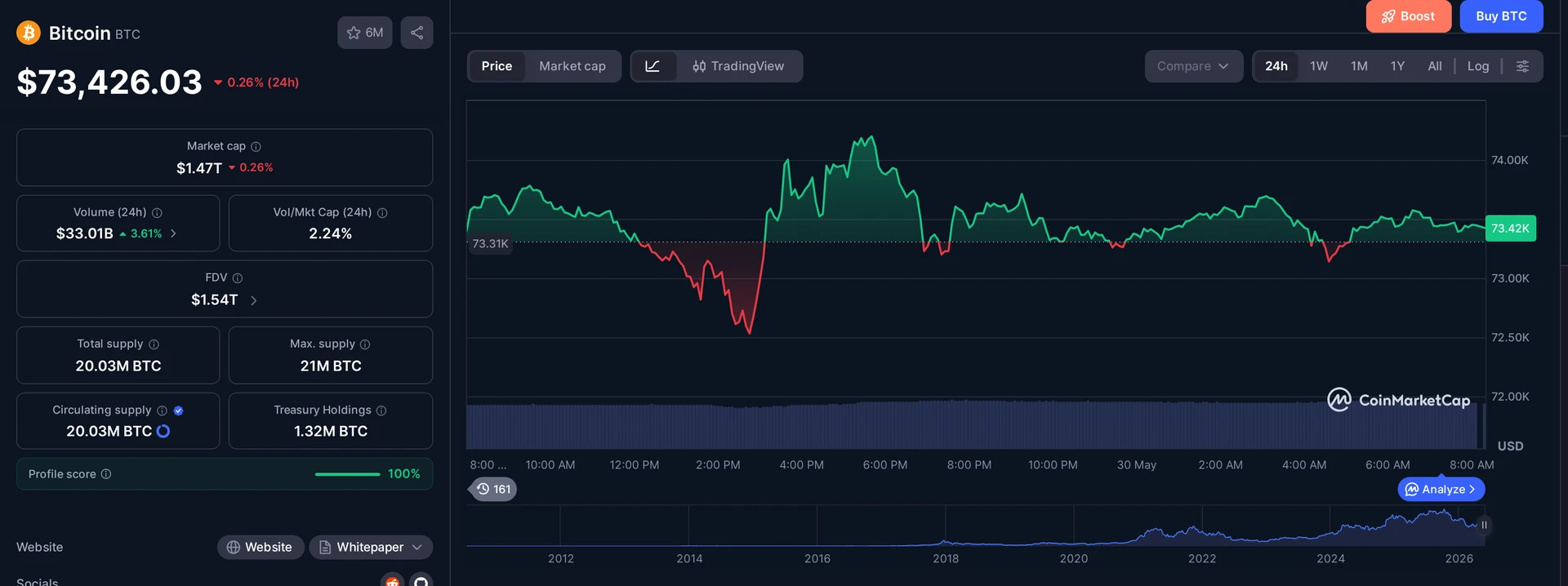
- Bitcoin dropped 2.6% on the week to $73,445 even as U.S. equities posted a ninth consecutive weekly gain
- Spot bitcoin ETF inflows cooled noticeably, adding to downward pressure on crypto markets despite improving macro conditions
- Hyperliquid’s HYPE token surged 19.4% to $65, the week’s standout winner, after ICE chair Jeffrey Sprecher called it bigger than NASDAQ
- XRP eked out a 0.7% weekly gain and BNB added 1.9%, bucking the broader crypto selloff
Cooling spot bitcoin ETF inflows pushed BTC down 2.6% to $73,445 this week, even as the S&P 500 wrapped its ninth straight weekly gain on Friday, the longest such streak since 2023 and one of the rarest runs in four decades of market history. Bitcoin and the broader crypto market decoupled from equities in a painful way, with Ether, Solana, and TRON’s TRX all sliding while traditional risk assets climbed on U.S.-Iran ceasefire optimism.
Stocks Keep Climbing. Crypto Doesn’t Follow.
The S&P 500 is up nearly 20% from its March lows. Brent crude settled around $92 a barrel. Treasuries ticked higher on the week. By any conventional reading, this is the kind of macro environment where risk assets thrive, and crypto, long marketed as the ultimate risk-on trade, should be partying.
It isn’t. Ether dropped 2.5% to $2,011. Solana fell 2.2% to $82.42. TRON’s TRX took the worst hit in the top ten, sliding 5.6% for the week, according to CoinDesk data. Even Dogecoin finished in the red. The only major that avoided the slide was XRP, which managed a 0.7% weekly gain, barely enough to call it a win.
What’s driving the disconnect? The simplest answer: spot bitcoin ETF inflows cooling May 2026. When institutional flows through the ETF wrappers slow, the bid underneath spot BTC softens. That dynamic played out in real time this week, with softer ETF demand reinforcing what would otherwise look like profit-taking at elevated levels.
Why Are Spot Bitcoin ETF Inflows Slowing?
Spot ETF flows are the clearest institutional signal the market has right now. When allocators are adding, price has a floor. When they pull back, even just to pause, that floor disappears fast. That’s the short version of what happened this week.
The longer version involves the macro backdrop itself. Hopes for a U.S.-Iran ceasefire extension pushed equities and oil higher, but the same geopolitical uncertainty that makes traders nervous about crypto has them rotating into more familiar risk-on vehicles: equities, energy, and to a lesser extent Treasuries. Crypto doesn’t fit neatly into that rotation. It doesn’t pay a yield. It doesn’t hedge oil. And right now, it’s not going up.
President Trump said Friday he was ready to make a “final determination” on a preliminary ceasefire agreement with Iran, but he restated hard demands: Iran must abandon its nuclear program, surrender enriched uranium, and open the Strait of Hormuz. Those conditions sit well beyond what Tehran has indicated it would accept publicly. Traders are pricing in some probability the deal collapses, and that uncertainty is keeping risk appetite uneven across asset classes.
Bigger than NASDAQ.
Hyperliquid’s HYPE Token Was the Week’s One Bright Spot
Not everything bled. Hyperliquid’s HYPE token ripped 19.4% on the week to $65, comfortably the strongest performer in the top tier of crypto assets. The catalyst was unusually high-profile: Jeffrey Sprecher Hyperliquid bigger than NASDAQ, speaking at a Bernstein conference, called the decentralized perpetuals venue bigger than NASDAQ in trading activity. That’s not a throwaway comment from a random commentator. Sprecher runs Intercontinental Exchange, the parent company of the New York Stock Exchange. When the man who literally owns one of the world’s premier exchanges tips his hat to an on-chain derivatives platform, markets listen.
The HYPE rally isn’t just a one-week fluke either. Sentiment around the Hyperliquid protocol has been building for months as it has taken meaningful market share from centralized perpetuals venues. Weekly volumes on the platform have drawn comparison to mid-tier CEX derivatives books, and the Sprecher endorsement, or at least his framing of it, pulled that narrative into mainstream financial media for the first time.
Call it the Sprecher bump. Whether HYPE can hold those gains without further institutional validation is the real question. But for now, it’s the only major crypto asset that had a good week.
Does the Iran Deal Make or Break the Next Crypto Move?
The macro rally underpinning equities has one glaring vulnerability: it’s largely built on ceasefire optimism. The S&P 500’s nine-week run, the oil price stabilization, the Treasury bid, all of it is partially a function of traders pricing in a world where the U.S.-Iran standoff de-escalates. If that deal falls apart, the trade unwinds fast.
For crypto, the implication cuts both ways. A confirmed ceasefire removes the uncertainty premium that’s keeping institutional allocators cautious, and historically, reduced macro uncertainty has been a precondition for crypto rallies. On the flip side, a deal collapsing could drag equities lower and take whatever risk appetite remains in digital assets with it.
The Hyperliquid HYPE token 19 percent weekly rally aside, this week demonstrated something the market keeps forgetting: Bitcoin is not a simple macro hedge. It is a risk asset that requires active institutional demand to sustain rallies. When ETF inflows slow and equities absorb all the available risk appetite, BTC drifts. That’s not a bug. That’s what the correlation data has been saying for two years.
BNB added 1.9% on the week, quietly outperforming most of its large-cap peers. XRP’s 0.7% gain was marginal but notable given the broader red across the board. Neither move signals any particular fundamental catalyst, they look more like relative strength in an otherwise soft week than the start of independent trends.
Frequently Asked Questions
Why did Bitcoin fall while the S&P 500 kept rising?
Spot bitcoin ETF inflows slowed significantly this week, removing the institutional bid that has supported BTC prices in recent months. Without fresh demand through ETF wrappers, Bitcoin drifted lower even as equities benefited from ceasefire optimism and positive macro sentiment.
What is Hyperliquid and why did HYPE surge 19.4%?
Hyperliquid is a decentralized perpetuals exchange that has gained significant market share from centralized crypto derivatives platforms. HYPE surged after Intercontinental Exchange CEO Jeffrey Sprecher called Hyperliquid bigger than NASDAQ in trading activity at a Bernstein conference, boosting institutional attention.
What did Jeffrey Sprecher say about Hyperliquid?
Sprecher, who runs the parent company of the New York Stock Exchange, praised Hyperliquid at a Bernstein conference and described its trading activity as bigger than NASDAQ. The comments gave rare mainstream financial credibility to a decentralized on-chain derivatives venue.
How did XRP and other altcoins perform this week?
XRP was a rare outperformer this week, gaining 0.7% on the week to lead the few altcoins finishing in the green. BNB added 1.9%. Most major altcoins fell sharply: Ether dropped 2.5%, Solana slid 2.2%, and TRON’s TRX suffered the worst top-ten loss at 5.6% down for the week.
This article is for informational purposes only and does not constitute investment advice. Every investment and trading decision involves risk. Readers should conduct their own research before making any financial decisions.







nine straight green weeks on the S&P and BTC still cant catch a bid, that divergence is what should worry people not the 2.6% dip itself
etf inflows cooling was the tell honestly
Anyone else notice XRP underperforming even with the SEC case fully behind them? Genuinely asking what the bear thesis is at this point because the chart looks heavy.