




































What to Know
- $1.04 billion, Tether’s confirmed net profit for Q1 2026, verified by accounting firm BDO
- $8.23 billion, Tether’s excess reserve buffer hit a new all-time high as of March 31, 2026
- $141 billion in U.S. Treasury exposure makes Tether the 17th-largest holder of Treasuries worldwide
- $189 billion, USDT market cap as circulation grew by $5 billion in Q2 2026
Tether Q1 2026 net profit reached $1.04 billion, according to an attestation report prepared by BDO, one of the world’s leading independent accounting firms. The result came despite volatile global markets in the first three months of the year. Tether’s reserve buffer also hit a record high, and USDT circulation kept growing into the second quarter.
BDO Attestation Confirms Tether Q1 2026 Net Profit of $1.04 Billion
Tether released its Q1 2026 financial attestation report on May 3, 2026. BDO prepared the report, confirming the accuracy of Tether’s figures and reserves data. The stablecoin issuer posted a Tether Q1 2026 net profit $1.04 billion attestation of just over $1.04 billion for the quarter ending March 31, 2026.
That is a strong result by any measure. Markets were turbulent in Q1, with broad macro uncertainty weighing on risk assets. Tether managed to grow its reserve base and turn a profit above one billion dollars through that stretch, which is not something many financial firms can say.
BDO’s involvement matters here. An independent accounting firm signing off on these numbers adds a layer of credibility that Tether has often been asked to provide. The attestation does not rise to the level of a full audit, but it is a formal third-party review. That distinction is worth keeping in mind.
Our responsibility is to make sure USD₮ works without compromise. That means building a system that behaves the same way in any market condition, not just when things are stable. The focus is on keeping the structure simple, liquid, and resilient by design, so it does not depend on favorable environments or external support.
How Does Tether Back Its Reserves?
Tether’s reserve base is built around short-duration, high-quality liquid instruments. The biggest piece is U.S. Treasury bills. As of March 31, 2026, Tether’s direct and indirect exposure to Tether 17th largest US Treasury holder $141 billion reached $141 billion, putting the company at 17th place among the largest holders of U.S. Treasuries globally.
That ranking puts Tether ahead of many sovereign wealth funds and central banks when it comes to Treasury exposure. Short-dated sovereign debt is the core of the reserve strategy, according to the company. It provides regular liquidity without taking on interest rate risk from longer maturities.
Beyond Treasuries, Tether holds $20 billion in physical gold and $7 billion in bitcoin as part of its reserve base. These are described as macro assets that can perform under stress conditions. The combination of liquid government debt plus hard assets like gold and BTC is Tether’s answer to questions about what backs the dollar peg.
Total assets stood at $191.7 billion against $183.5 billion in liabilities as of March 31, 2026. That leaves an excess of more than $8.2 billion, which Tether calls its reserve buffer. That buffer hit a new all-time high during the quarter.
One thing to note: Tether keeps its proprietary investments completely separate from the USDT reserves. Those investments are funded from excess capital and profits. The company says they have no effect on the quality, liquidity, or transparency of the reserves backing USDT.
USDT Circulation Grows and Market Cap Passes $189 Billion
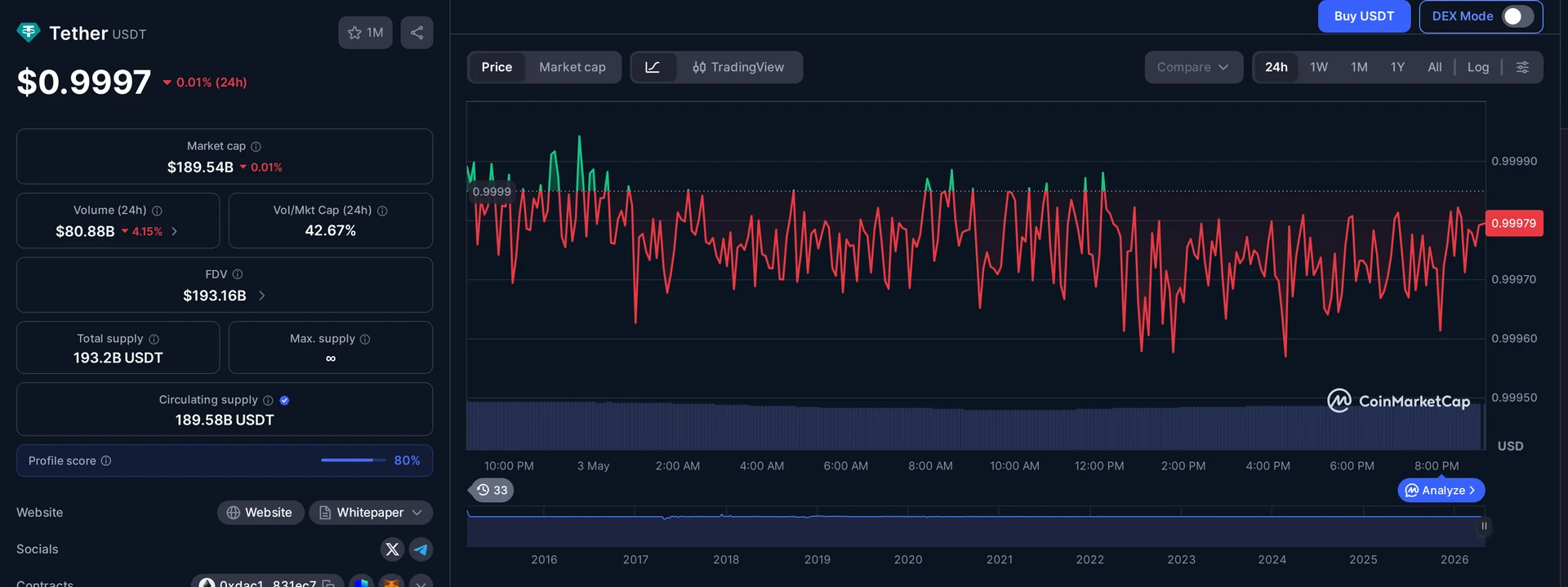
USDT did not sit still in the first quarter. Circulation expanded by $5 billion in the second quarter of 2026, and the stablecoin’s USDT market cap $189 billion stablecoin circulation 2026 hovered above $189 billion at the time of the report’s release. That makes USDT by far the largest stablecoin in the world by circulating supply.
Stablecoin demand has been growing for a while now, and Tether sits at the center of that trend. A big part of the growth comes from markets where people have limited access to the U.S. dollar through regular banking channels. USDT fills that gap. For someone in a country with a weak local currency, holding USDT is effectively a way to hold dollars without needing a bank account.
That use case has always been Tether’s strongest argument. It is not just a trading vehicle for crypto speculators. It is functioning dollar infrastructure for a lot of people who genuinely need it. The growth in circulation reflects that demand is real and expanding.
CEO Paolo Ardoino has been consistent about this framing. Tether is not building a product for favorable market conditions. The system is supposed to work the same way when markets fall apart.
People should not have to question whether the system works; it just has to work.
What Does Tether’s Q1 Result Mean for Stablecoins?
Tether posting over a billion dollars in quarterly profit is significant for the broader stablecoin debate. Regulators in the U.S. and Europe have been examining stablecoin issuers closely. A company this large, earning this much, holding this many Treasuries, is now a systemic consideration in dollar markets.
The $141 billion Treasury position alone is enough to make policymakers pay attention. Tether is not a small crypto firm anymore. It is one of the larger holders of U.S. government debt on the planet. Any discussion about stablecoin regulation needs to account for what happens to that Treasury position if redemption pressure spikes.
The excess reserve buffer of $8.23 billion is meant to address exactly that scenario. Tether’s argument is that the buffer is large enough to absorb significant outflows without touching the core reserve assets. Whether that argument holds up under genuine stress is something regulators and market observers will keep watching.
For holders of USDT, the Q1 attestation provides more transparency than was available in earlier years. BDO’s confirmation of the figures does not replace an audit, but it is more than most stablecoin issuers provide. The question going forward is whether Tether moves toward a full audit or stays with the attestation model.
The stablecoin market is not slowing down. Tether’s numbers show the demand side is strong. Supply growth, reserve quality, and regulatory clarity will shape how the next few quarters play out.
Frequently Asked Questions
How much profit did Tether make in Q1 2026?
Tether reported a net profit of $1.04 billion in the first quarter of 2026, according to an attestation report prepared by BDO. The result was achieved despite volatile global market conditions during the January to March period. Total assets reached $191.7 billion, and the excess reserve buffer hit a record $8.23 billion as of March 31, 2026.
Who prepared Tether's Q1 2026 attestation report?
BDO, described as one of the world’s leading independent accounting firms, prepared Tether’s Q1 2026 attestation report. BDO confirmed the accuracy of Tether’s financial figures and reserves data as of March 31, 2026. The attestation is a formal third-party review but does not constitute a full audit of Tether’s operations.
How large is Tether's U.S. Treasury position?
Tether’s direct and indirect exposure to U.S. Treasury bills reached $141 billion as of March 31, 2026. That figure makes Tether the 17th-largest holder of U.S. Treasuries globally, ranking it ahead of many sovereign funds and central banks. The company focuses on short-duration instruments to maintain liquidity.
What is the current USDT market cap in 2026?
The USDT market cap was above $189 billion at the time Tether released its Q1 2026 attestation report on May 3, 2026. USDT in circulation also grew by $5 billion during the second quarter of 2026, reflecting continued global demand for the stablecoin, particularly in markets with limited banking access.
This article is for informational purposes only and does not constitute investment advice. Every investment and trading decision involves risk. Readers should conduct their own research before making any financial decisions.







$1.04B in a single quarter is wild but the $8.23B excess reserve is the number that actually matters for solvency talk. BDO attestation though, still not a full audit.
still waiting on a real PCAOB audit before i call this anything more than a quarterly press release
USDT cap above $189B in May is insane to think about, back in 2020 we were arguing whether they could even hold the peg past $10B
what’s the actual breakdown of the reserve composition this quarter? T-bills vs gold vs BTC holdings would be useful context
people forget Tether printed billions through every cycle since 2017 and the FUD never stuck. profitability at this scale just makes the whole stablecoin race look uneven.